
DMC palette & hand embroidery guide
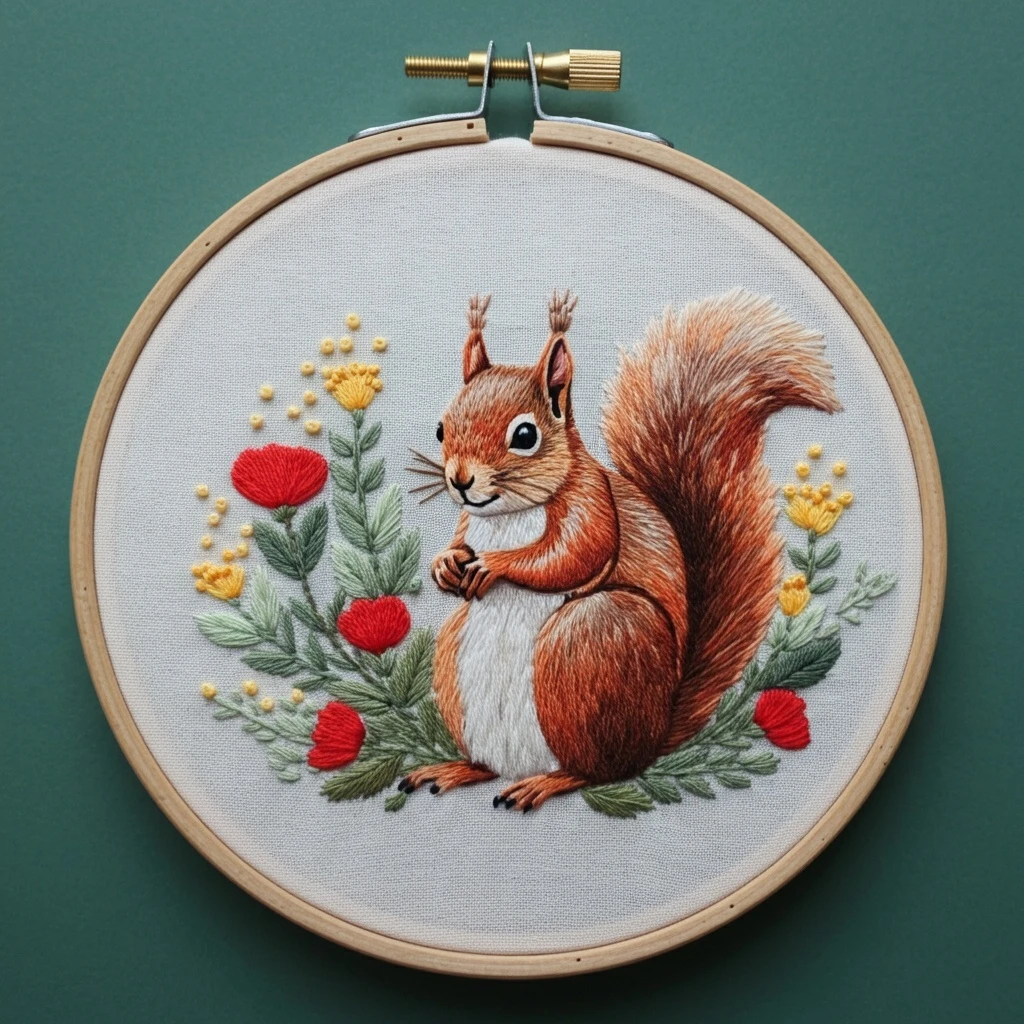
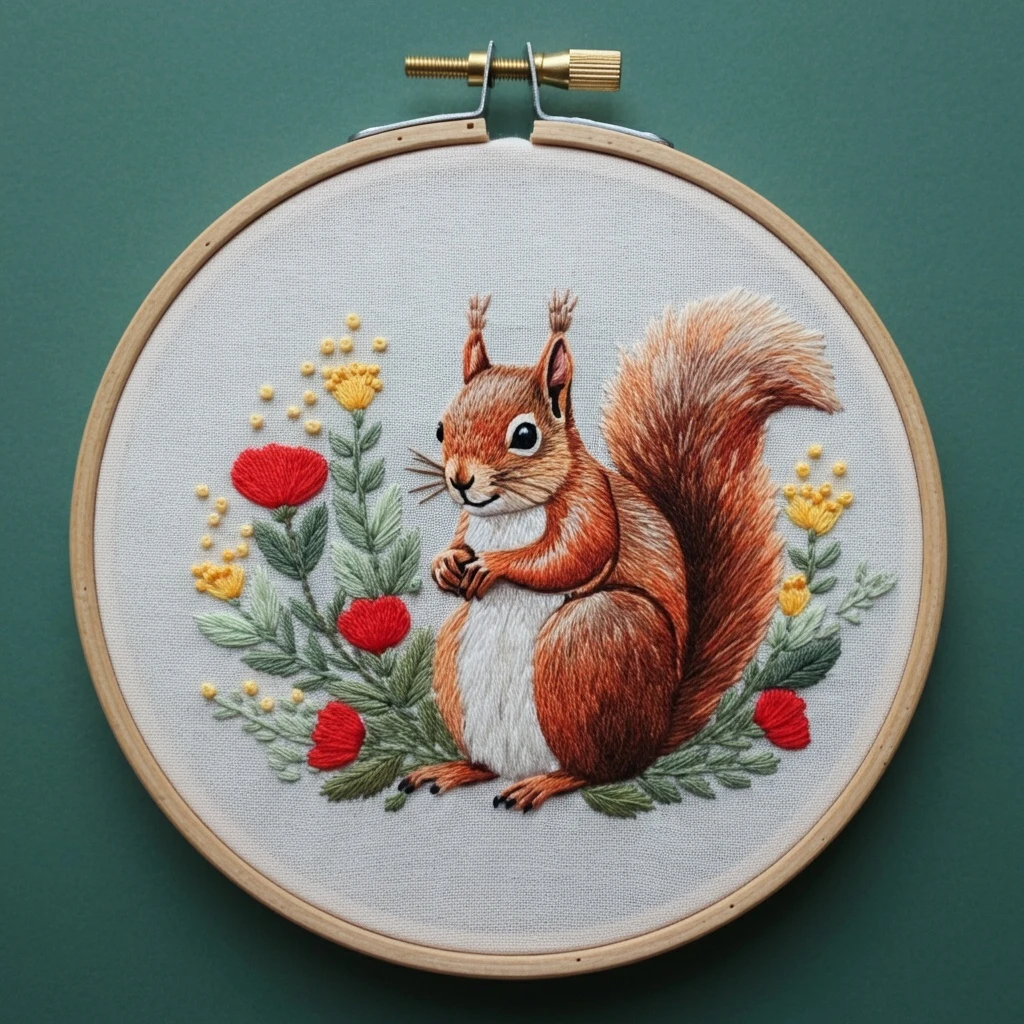
Red Squirrel And Floral Wreath
A warm woodland composition with a russet squirrel, feathery tail, bright red meadow blooms, golden knot flowers, and a soft sage-green wreath. The stitching should feel natural and lightly textured: smooth fur on the body, airy tail strokes, dimensional flower centers, and layered foliage.
Core DMC Color Palette
Use these as a practical hand-embroidery palette. Keep the squirrel slightly variegated by changing strand counts and mixing copper, tan, and mahogany shades rather than filling every area with one flat color.
DMC 3371
Black Brown
Deepest tail grooves, ear interiors, paw separations, and shadow accents around the nut.
DMC 801
Coffee Brown - Dark
Warm dark fur shadows on the back, haunch, tail base, and underside of the forearms.
DMC 920
Copper - Medium
Main red-squirrel body color; excellent for long-and-short fur direction strokes.
DMC 921
Copper
Brighter orange highlights on cheek, shoulder, flank, and outer tail hairs.
DMC 922
Copper - Light
Soft transitions on the face, paws, ear tips, and sunlit tail edge.
DMC 3865
Winter White
Cream belly and muzzle base; shade with beige so the white does not look stark.
DMC 842
Beige Brown - Very Light
Belly shadows, muzzle underside, and gentle blending between cream and copper fur.
DMC 310
Black
Eye, nose, claws, and tiny final details. Use sparingly with one strand.
DMC 321
Red
Primary red petals; satin stitch or split-fill gives a clean floral punch.
DMC 817
Coral Red - Very Dark
Lower petal shadows, petal overlap, and a few inner flower lines.
DMC 742
Tangerine - Light
Yellow flower tufts and brighter French knots in the wreath.
DMC 743
Yellow - Medium
Light-catching knot flowers and small pollen dots around the yellow sprigs.
DMC 522
Fern Green
Main soft leaf color for fern fronds and small wreath stems.
DMC 3052
Green Gray - Medium
Muted midtone foliage; blends naturally with the linen background.
DMC 3364
Pine Green
Dark leaf undersides and wreath depth near the squirrel’s feet and tail.
DMC 524
Fern Green - Very Light
Fine highlights on fern tips and pale leaves behind the squirrel.
Stitch Map & Thread Counts
| Design area | Best stitches | Strands | Practical notes |
|---|---|---|---|
| Squirrel face and body | Long-and-short stitch, split stitch, tiny directional straight stitches | 1 strand for face detail; 2 strands for body fill | Follow the fur direction: nose to cheek, shoulder to belly, hip downward. Keep stitches uneven in length so the copper shades blend softly. |
| Large fluffy tail | Long-and-short stitch, feathered straight stitch, occasional couching | 1–2 strands | Build from dark interior grooves outward. Add loose 922 and 3865 highlight hairs last, letting them extend slightly beyond the filled shape. |
| Belly, chest, and muzzle | Split-fill, long-and-short, satin for tiny muzzle pads | 1 strand near face; 2 strands on belly | Use 3865 with a few 842 shadow strokes. Avoid pure white blocks; fine beige strokes make the belly look soft and rounded. |
| Red flowers | Satin stitch, padded satin, split stitch outline | 2–3 strands | Start each petal at the base and fan outward. Place 817 at the tucked lower edge and 321 across the bright petal faces. |
| Yellow sprigs and dot flowers | French knots, colonial knots, small straight stitches | 2 strands for knots; 3 strands for larger dots | Vary knot wraps: one wrap for tiny pollen dots, two wraps for full yellow flower heads. Mix 742 and 743 randomly. |
| Leaves and wreath stems | Fishbone stitch, fly stitch, stem stitch, detached chain | 2 strands for leaves; 1 strand for fine stems | Layer dark 3364 leaves underneath, then 522 and 524 on top. This keeps the wreath airy instead of heavy. |
| Eye, whiskers, paws, nut | Back stitch, satin stitch, straight stitch, French knot | 1 strand for black details; 2 strands for nut | Place the white eye highlight after the black is complete. Work whiskers as single-strand straight stitches so they stay delicate. |
Blending & Shading Plan
The squirrel is the focal point, so reserve the most careful shading for the face, haunch, and tail.
- Fur gradient: use 3371/801 in the darkest seams, 920 for the core, 921 for bright russet areas, and 922 for soft highlights.
- Tail texture: stitch in long curved bands rather than horizontal rows. Leave tiny gaps between final highlight hairs for a fluffy edge.
- Flower depth: outline red petals with one strand of 817 before filling with 321; this prevents the red blooms from looking flat.
- Green balance: alternate 522 and 3052 on adjacent leaves so the wreath has natural variation.
Outlining Details
Use outlines selectively: too much dark line can make the squirrel look cartoonish.
- Use one strand of 801 for gentle fur separation on the shoulder, haunch, and tail base.
- Use 3371 only at the eye, nose, claws, deepest paw creases, and the lowest tail shadows.
- Outline leaves with 3052 or 3364, not black, so foliage stays soft.
- For whiskers, try 1 strand of 801 or 842 instead of black for a more natural finish.
Suggested Stitching Order
Transfer and stabilize. Use a fine water-soluble pen on linen or cotton. Hoop the fabric drum-tight and keep the squirrel’s face lines very clean.
Lay the wreath foundation. Stitch the main stems first with one-strand stem stitch, then add dark green background leaves before the pale leaves.
Fill the squirrel body. Work the cream belly and face transitions first, then add copper body sections, saving the darkest accents for later.
Build the tail in layers. Start with 801/3371 in the inner tail curve, add 920 and 921, then finish with scattered 922 and 3865 highlight hairs.
Add flowers and knots. Satin stitch red blooms after leaves so petals sit forward. Work French knots last to keep them raised and clean.
Finish with tiny character details. Add eye highlight, nose shine, claws, whiskers, and a few final fur strokes only after the main shapes are complete.
Beginner tip: When shading fur, do not try to make every stitch identical. Slightly uneven stitch lengths and small overlaps create the soft animal texture seen in the sample. Practice the tail on scrap fabric before stitching the final piece.
Texture Suggestions
Dimensional flowersPad the red flower centers with a small layer of split stitch before satin stitching over them. This creates rounded, velvety petals.
Soft fern wreathUse fishbone stitch for large leaves and detached chain for tiny side leaves. Change greens every few leaves for a hand-gathered look.
Natural squirrel furBlend one strand of 920 with one strand of 921 in larger body areas. For the tail, use mostly single strands for fine hair texture.
Golden flower clustersMix French knots and short straight stitches so the yellow sprigs have both pollen dots and small petal fans.
Clean facial expressionKeep eye and muzzle stitches small. A single white highlight stitch can bring the squirrel to life.
Balanced hoop finishLet the wreath remain lighter at the top and fuller near the base to visually ground the squirrel.
Quick Beginner Checklist
| Before stitching | During stitching | Finishing |
|---|---|---|
| Pre-sort copper shades on a card and label them clearly; 920, 921, and 922 can look similar in dim light. | Rotate the hoop as needed so fur stitches always travel in the natural growth direction. | Steam lightly from the back over a towel, avoiding pressure on French knots and padded petals. |
| Test red floss on your fabric; vivid reds can dominate, so keep green foliage slightly muted. | Use shorter thread lengths for metallic-looking highlights and pale belly sections to prevent fuzzing. | Trim stray fibers around the tail with tiny scissors, but leave intentional long highlight strokes intact. |