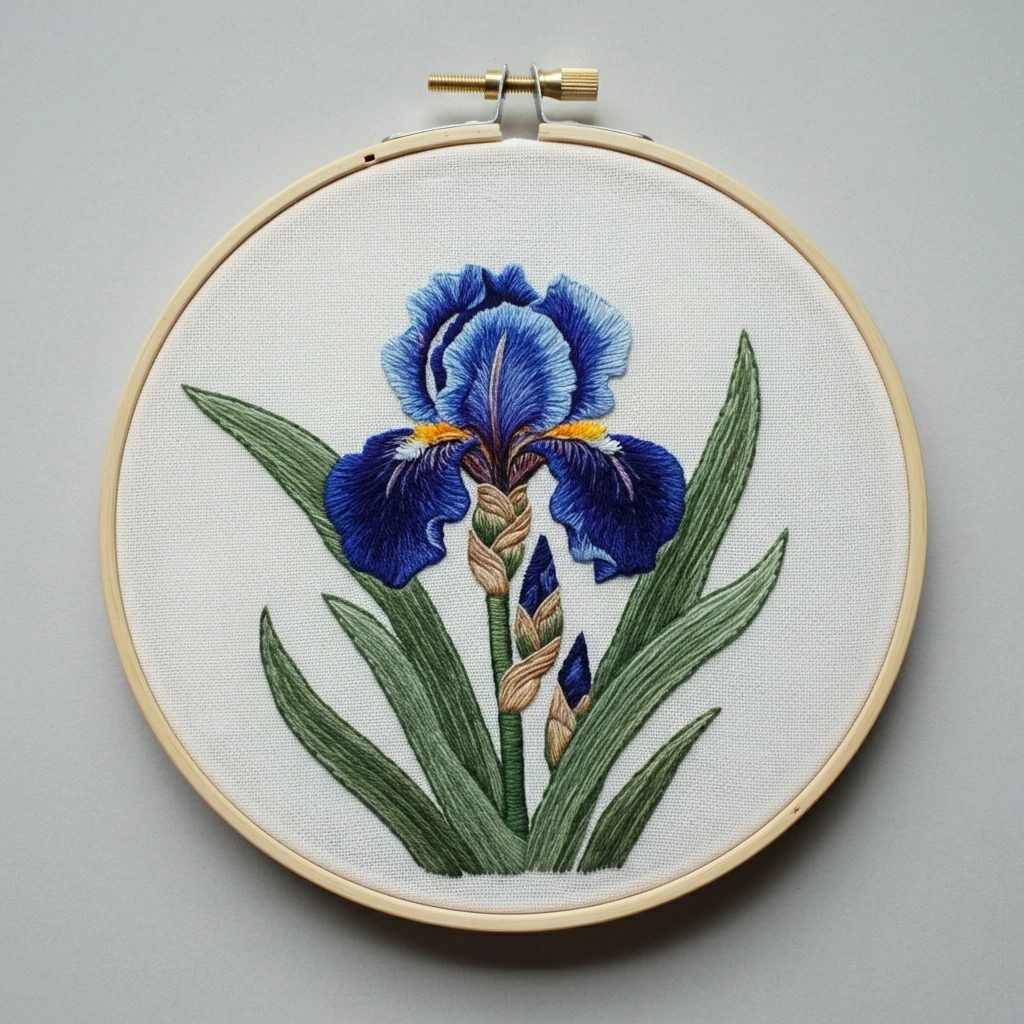

Realistic Blue Iris Flower
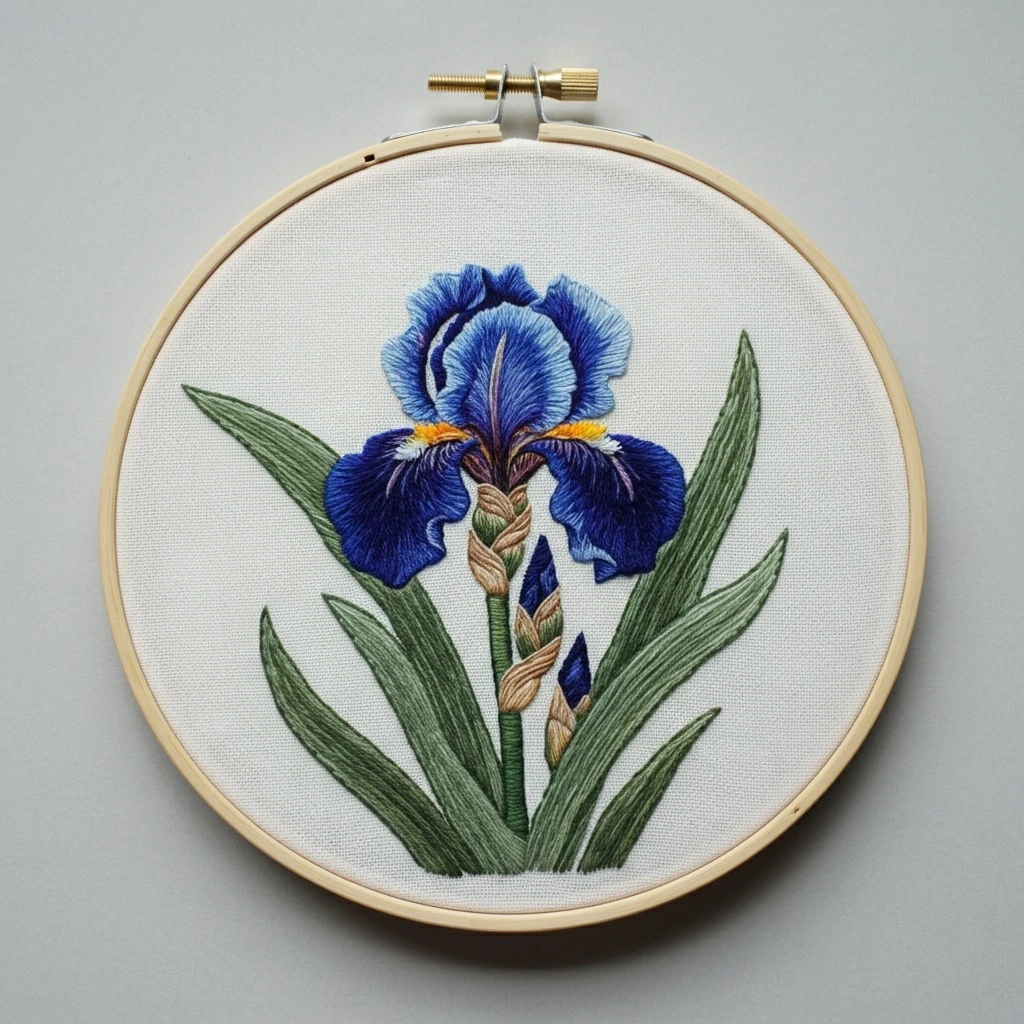
A painterly blue iris worked with long directional stitches: velvety indigo falls, pale blue upright petals, golden beards, deep green sword leaves, and softly twisted tan support details. The goal is a dimensional botanical study with visible thread direction and crisp vein definition.
Design color read
The reference relies on high contrast rather than many objects: cool blues dominate the bloom, with almost-black navy tucked into the petal folds. Light blue thread radiates from petal centers, lavender-purple lines add depth around the throat, warm yellow-orange beards brighten the flower, and muted green leaves frame the composition with long vertical strokes.
Palette strategy: keep the darkest blues for fold shadows and lower petal edges, reserve pale blues for fine highlight strokes, and place golden yellows only in the bearded areas so the iris keeps its realistic focal sparkle.
Suggested DMC palette
Stitch map by area
| Area | Recommended stitches | Thread count & direction | Practical notes |
|---|---|---|---|
| Upper standards | Long and short stitch, split stitch vein guides | 1 strand for shading; occasional 2-strand base rows | Radiate stitches upward from the throat. Alternate 798, 797, 3841, and tiny 3865 strokes so the petal looks curved instead of flat. |
| Lower falls | Dense long and short stitch, satin stitch accents | 1 strand for most; 2 strands only in dark outer blocks | Place 823 and 820 first in the dark folds, then feather 796 and 797 into them. Keep the outer scalloped edge slightly irregular for a natural petal contour. |
| Petal veins | Split stitch, stem stitch, single straight stitches | 1 strand | Use 340 for the strongest violet veins and 341 for soft side veins. Stitch over finished blue fills so the lines stay crisp. |
| Golden beards | Short straight stitches, turkey work loops trimmed low, French knots | 1–2 strands | Layer 742 first, touch the tips with 972, and add a few tiny knots for a fuzzy pollen texture without making the area bulky. |
| Leaves | Long straight stitch, stem stitch, couching for central ribs | 2 strands for body, 1 strand for fine veins | Follow the leaf length from base to tip. Mix 934 in the undersides, 3362 in the body, and 3051/3052 on raised ridges. |
| Stems & tan wraps | Stem stitch, padded satin stitch, rope stitch, chain stitch | 2 strands for padding; 1 strand for highlight lines | Work the green stem first, then overlay tan wrap segments with 420, 436, and 738 so the twist appears to sit on top. |
Thread blending plan
Use blends only where the color changes need to be gradual. Keep outlines and the smallest details as single solid colors.
823 + 820 deepest blue folds
796 + 797 saturated petal midtones
798 + 3841 pale blue petal glow
340 + 341 violet throat transitions
3362 + 3051 realistic leaf body
436 + 738 raised tan wrap highlights
Outlining & definition
Use a fine split stitch outline around the petals before filling, then cover parts of that outline with the long and short stitches for a soft realistic edge. Reinforce only the deepest lower petal edges with DMC 823 or 820. Avoid heavy black outlines; the design’s depth comes from blue value changes, not a cartoon border.
For leaves, outline one side in DMC 934 and the opposite side in 3051 or 3052. This uneven outline makes the leaves look lit from above and keeps them from becoming flat green shapes.
Build order for a clean finish
Beginner-friendly practical tips
- Use a sharp embroidery needle, size 8 or 9, for single-strand thread painting.
- Keep fabric drum-tight in the hoop so long stitches do not sag.
- Separate all six strands before recombining blends; this keeps the surface smooth.
- Use shorter long-and-short stitches near curved petal edges and longer strokes in open petal centers.
- Park unused blue shades on a thread card in dark-to-light order to avoid mixing 796, 797, and 798.
- Do not fill the golden beard as a flat satin block; a few raised knots and tiny straight stitches look more realistic.
- For leaves, change green shades every few stitches rather than completing one solid color area.
- Step back frequently. The iris should read as dark lower petals, lighter upper petals, and crisp yellow focal accents.
Texture & shading notes
The flower’s realism comes from directional sheen. Angle petal stitches like rays moving from the throat outward, and let dark threads tuck beneath lighter strokes. On the lower falls, place the navy and royal blues densely at the outer lower lobes; on the upright petals, increase the number of pale blue and blue-violet stitches to show a lifted, ruffled surface.
Finishing suggestion: press from the back on a folded towel, never flattening the beard knots. Trim any fuzzy thread ends from the dark blue areas because stray fibers show strongly against the light fabric.