
DMC Palette & Stitch Guide
Northern Lights Cabin
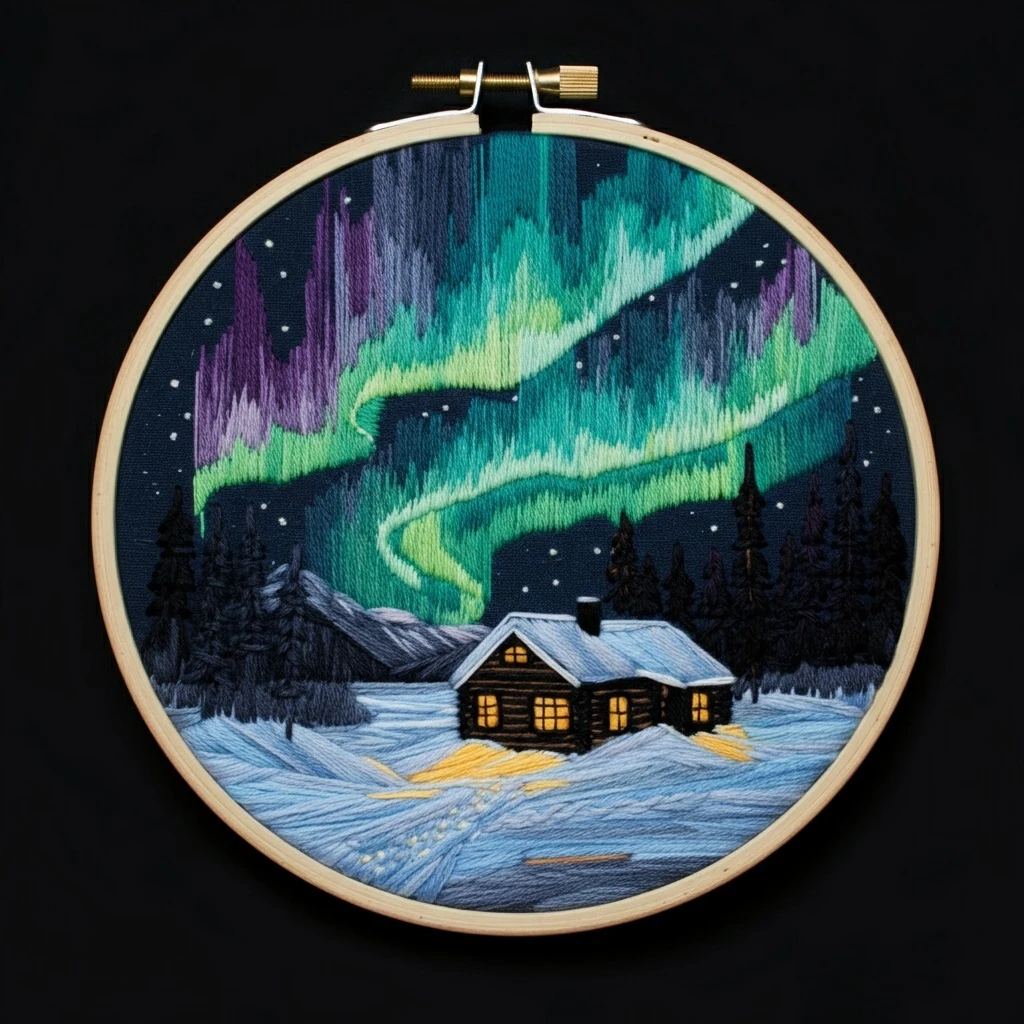
A polished floss palette and practical embroidery plan for a cozy winter cabin under sweeping aurora bands, dark pine silhouettes, snowdrifts, glowing windows, and a star-flecked night sky.
Likely DMC Color Palette
Colors are matched to the visible design theme: a deep blue-black sky, electric green and teal aurora ribbons, purple-pink glow, snowy ground, pine trees, warm cabin wood, and golden window light. Percentages are practical visual estimates, not exact skein usage.
Stitching Suggestions
Work from background to foreground: sky first, aurora bands second, distant trees and mountains, cabin, snow, then final stars and window glow. This preserves crisp edges and keeps pale thread clean.
| Element | Stitch Type | Practical Notes |
|---|---|---|
| Night sky | Long and short stitch, split-stitch fill, or open fabric | If stitching the sky, use 1–2 strands of 939 and 823 in vertical or diagonal strokes. For a lighter project, leave dark fabric exposed and stitch only aurora, trees, and stars. |
| Aurora ribbons | Long and short stitch, satin stitch bands, couching | Use 2 strands for main bands. Curve stitches with the ribbon shape, blending 3818 into 3848, then adding 958 and 955 on the brightest upper edges. |
| Aurora wisps | Single-strand straight stitch and feather stitch | Add fine vertical flicks beneath the ribbons with 3848, 958, and 955. Vary stitch length so the light looks like it is falling through the sky. |
| Pine trees | Fishbone stitch, fly stitch, straight stitch clusters | Build trees from the trunk outward. Use 500 in the center, 890 for branch layers, and touches of 762 or 3865 on snow-tipped boughs. |
| Cabin logs | Stem stitch, backstitch, satin stitch | Work log rows horizontally with 433, then add 977 on the upper side and 3799 under each row for depth. Keep cabin edges squared and tidy. |
| Windows and warm glow | Satin stitch, tiny straight stitches, one-wrap knots | Fill windows with 742, outline with 433 or 3799, then halo the surrounding snow with small 977 stitches. Avoid overusing yellow so the cabin stays cozy, not neon. |
| Snow roof and drifts | Satin stitch, long and short stitch, split stitch | Use 3865 for the raised snow caps and 762 for soft gray shadow. Let stitch direction follow roof slopes and drift curves. |
| Mountain or distant horizon | Short straight stitch and sketchy backstitch | Use 762, 3807, and 823 for icy forms in the distance. Keep stitches shorter and less dense than the foreground to push them back visually. |
| Stars | French knots, seed stitch, tiny cross stitches | Use mostly 1 strand of 3865 with occasional 955 or 762. Place stars unevenly, with a few brighter knots near the upper sky and tiny seed stitches near the aurora. |
| Smoke or mist | Split stitch, couching, loose straight stitch | If the cabin has chimney smoke, use 1 strand of 762 and very loose curves. Keep smoke airy so it does not compete with the aurora. |
Thread Count, Blending & Shading Plan
These choices create a clear night landscape while staying manageable for hand embroidery in a hoop.
Thread-count guidance
- Use 2 strands for aurora fills, cabin walls, major snow shapes, and large pine branches.
- Use 1 strand for stars, smoke, distant tree silhouettes, fine cabin outlines, and delicate aurora wisps.
- Use 3 strands only for raised foreground snow knots or chunky cabin-log texture if the pattern scale allows it.
- For dark fabric, keep lighter floss lengths short so they stay bright and do not pick up lint.
Blending ideas
- For glowing aurora, blend one strand 3848 + one strand 958 in the central ribbon areas.
- For deeper green light, blend one strand 3818 + one strand 3848 where the aurora meets the dark sky.
- For blue-violet shadow, blend one strand 823 + one strand 3807 along the underside of ribbons and mountain shadows.
- For warm cabin light, blend one strand 742 + one strand 977 on window centers and nearby snow reflection.
Shading order
- Place the darkest sky and tree silhouettes before stitching bright aurora edges.
- Work aurora bands from dark underside to light top edge for a luminous layered look.
- Stitch the cabin after the background so the roofline and window shapes stay sharp.
- Add snow highlights, star knots, and window sparkle last to keep them clean and raised.
Texture suggestions
- Use smooth, curved stitches for aurora so the sky feels flowing and weightless.
- Use choppy, angled straight stitches for evergreens to contrast with the smooth sky.
- Use horizontal stem stitches on logs to create a rustic cabin texture.
- Use satin or long-and-short stitches for snow, then add a few gray contour lines for depth.
Beginner-Friendly Working Path
A calm sequence makes this dramatic scene easier: broad shapes first, details last.
Where to start
Start with the aurora ribbons because they determine the movement of the whole composition. Next stitch the tree line, then the cabin, then snow. Finish with window glow, stars, and tiny reflected light stitches.
Practical tips
- Use a hoop stand or firm hoop tension; long aurora stitches look best when the fabric stays drum-tight.
- Turn the hoop as you stitch curves so your hand follows the ribbon direction naturally.
- Do not make every aurora stripe the same width; vary them for a more natural sky.
- For snow, keep the brightest white at the top ridges and switch to 762 as the drift turns away from the light.
- On dark fabric, avoid carrying pale thread across the back of open sky areas because it can shadow through.
Finishing Notes
The key is contrast: cool luminous sky above a warm, sheltered cabin.
Keep the aurora airy by allowing dark sky to show between stitches, and keep the cabin cozy by concentrating the warm colors only around the windows and wood highlights. The final stars should be tiny and irregular; a few crisp knots and short straight stitches will make the sky sparkle without distracting from the sweeping green light.