Tropical Floral

Tropical Floral - DMC Palette & Stitching Tips
Tropical Floral Embroidery Hoop Art
DMC palette & embroidery guide

Tropical Floral

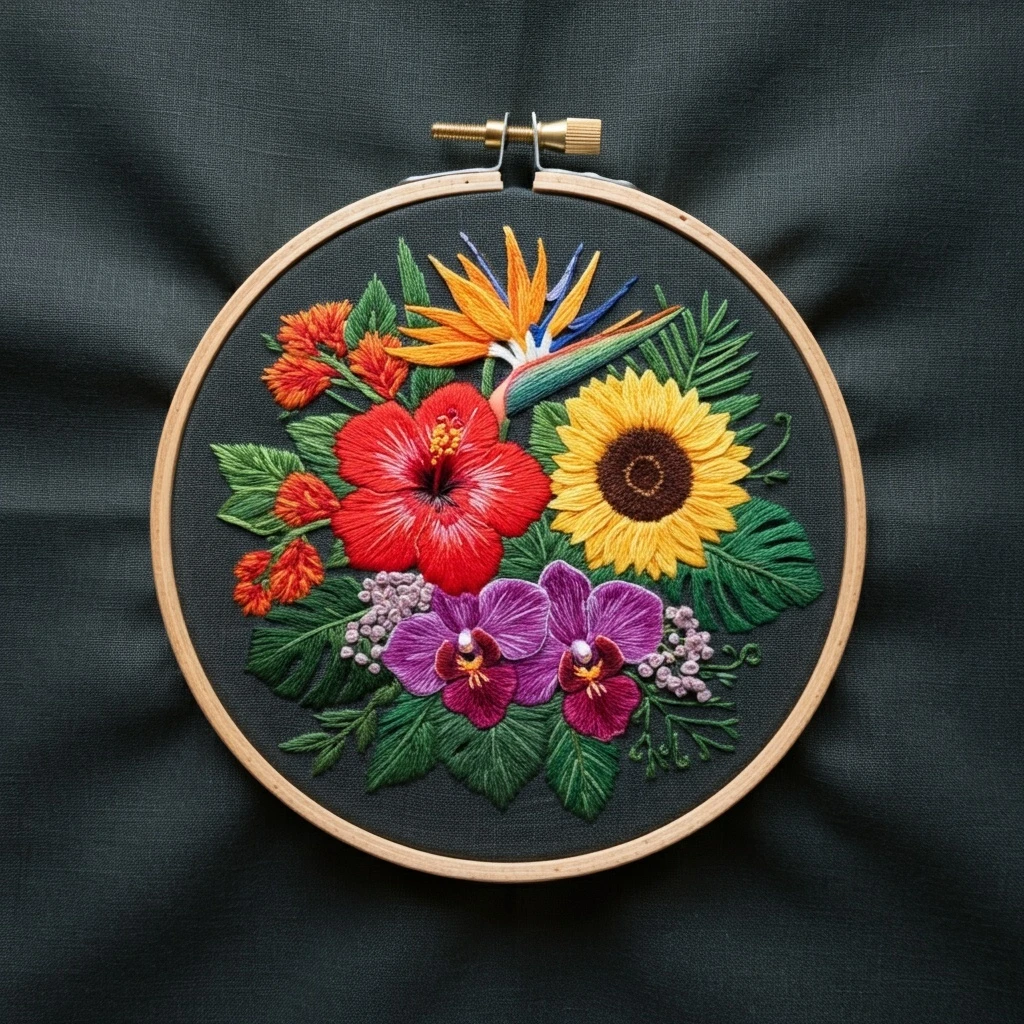
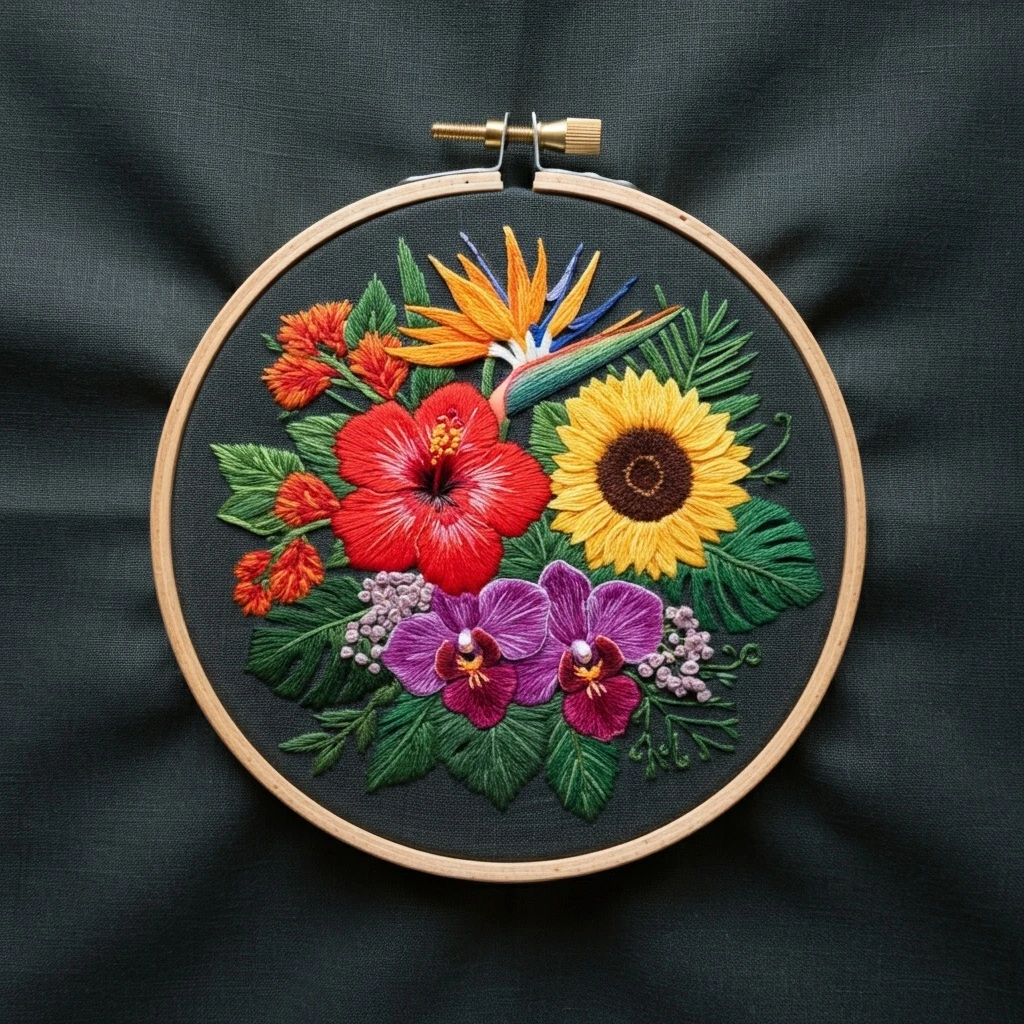
A lush hoop arrangement with hibiscus, sunflower, orchid blooms, bird-of-paradise petals, warm orange filler flowers, berry clusters, and layered tropical leaves on a dark fabric ground.

Tropical florals Bold satin shading Leaf texture Beginner friendly plan

Likely DMC Color Palette

Colors are estimated from the visible hoop preview and matched to close DMC embroidery floss shades. The design depends on saturated flower colors against deep green foliage, so keep the brights clean and use dark values only where shadows or outlines are needed.

321
Red
Main hibiscus petals and bold red tropical flower areas; use as the brightest body red.
12% visual coverage
815
Garnet Medium
Hibiscus throat, petal folds, under-petal shadows, and deepest red-orange accents.
5%
740
Tangerine
Bird-of-paradise petals, orange filler flowers, and warm flashes beside the greenery.
8%
725
Topaz Medium Light
Sunflower petals, golden petal tips, and warm highlights in orange blooms.
11%
433
Brown Medium
Sunflower center ring and warm brown details in flower centers.
4%
3371
Black Brown
Deep sunflower center, darkest petal separations, and tiny high-contrast shadows.
4%
550
Violet Very Dark
Orchid petal shadows and saturated purple lower folds.
6%
552
Violet Medium
Orchid petal body color; blend with light lavender for veins and soft transitions.
7%
153
Violet Very Light
Orchid highlights, pale berry knots, and delicate vein accents.
4%
3803
Mauve Dark
Magenta orchid lips and darker tropical petal throats.
3%
987
Forest Green Dark
Large monstera-style leaves, broad shadows, and dense background foliage.
13%
702
Kelly Green
Medium leaf planes, palm fronds, and visible leaf ridges.
10%
3348
Yellow Green Light
Leaf tips, highlighted veins, and fresh green accents around the flowers.
5%
823
Navy Blue Dark
Blue bird-of-paradise details and small cool accents tucked behind orange petals.
2%
3865
Winter White
Hibiscus radiating strokes, orchid centers, and tiny sparkle highlights.
3%
844
Beaver Gray Ultra Dark
Optional replacement for the dark fabric outline when a stitched edge is needed.
1%

Coverage percentages are visual estimates from the preview, not exact thread usage. On black or charcoal fabric, test a few stitches first: very dark greens may need an extra strand to stay visible.

Stitching Suggestions

Hibiscus petals: use long and short stitch, radiating from the dark throat outward. Keep 321 dominant, add 815 at the center and 3865 as fine white highlight rays.
Sunflower petals: work narrow satin or fishbone-style straight stitches from the center outward. Alternate 725 with a few 740 strokes near the base for warmth.
Sunflower center: fill with dense French knots or colonial knots in 3371 and 433. A ring of medium brown knots gives the center a raised seed texture.
Orchids: shade the petals with long and short stitch using 552 into 550, then place 153 as single-strand veins. Satin stitch works well for the darker magenta lips.
Bird-of-paradise: stitch the orange blades with straight stitches or padded satin stitch. Use the blue as slim backstitch accents behind the orange petals.
Tropical leaves: use fishbone stitch for broad leaves, stem stitch for central veins, and straight stitch for palm fronds. Change direction with each leaf section to create natural movement.
Small berries/filler buds: cluster French knots in 153, 552, and a touch of 3865. Keep the knots uneven for a more botanical look.
Curls and fine tendrils: use one strand of green in stem stitch or backstitch. Couching can help keep long curves smooth on dark cloth.

Thread Count & Layering

  • 2 strands: best for most flower petals, medium leaves, and visible satin-filled areas.
  • 1 strand: use for petal veins, hibiscus white rays, leaf vein highlights, tendrils, and fine outlines.
  • 3 strands: useful for large green leaf bases on dark fabric, especially where the background may swallow the color.
  • French knots: use 2 strands with one wrap for tiny berries and 2 wraps for the sunflower seed texture.
  • Outlining: outline only selectively. Too much black/dark outlining can flatten the tropical softness; use short split-stitch shadows instead.

Blending, Shading & Texture Plan

Start with the darkest recesses first: hibiscus throat, sunflower center, orchid lower folds, and deep leaf pockets. Then fill the midtones and finish with the brightest highlight stitches. This keeps the composition crisp against the dark ground while still looking painterly.

Red blendWork 815 at the hibiscus center, overlap with 321, then add single-strand 3865 rays after the red is complete.
Purple blendUse 550 in the orchid crease, 552 for the body, and 153 as thin curved veins that follow the petal shape.
Green blendBase large leaves in 987, layer 702 along the vein direction, and add 3348 only where light would hit the tips.

Where to Start

Begin with the largest leaves so they sit visually behind the flowers. Next stitch the sunflower center and hibiscus throat, because these define the focal points. Fill the major petals, then add orchids, bird-of-paradise blades, orange filler blooms, berries, tendrils, and final highlight stitches.

Save knots and bright white highlights until the end so they stay clean and raised.

Beginner-Friendly Tips

  • Use shorter satin stitches on wide petals; long stitches snag more easily and can loosen over time.
  • Rotate the hoop while stitching leaves so each stitch follows the natural vein direction.
  • On dark fabric, keep hands clean and avoid dragging pale thread across the surface.
  • If a color feels too flat, add just three to five stitches of a neighboring shade rather than reworking the whole area.
  • Trim thread tails closely on the back so bright colors do not show through open stitches.

Encouraging Finish

This design will look most polished when the flowers are smooth and luminous, while the leaves stay directional and textured. Let the hibiscus and sunflower be the brightest focal points, keep the orchids softly veined, and use the small knots and tendrils as the final lively details that make the tropical bouquet feel full.
Prepared as a practical DMC color and stitch guide for the Tropical Floral embroidery design.

Leave a Reply

Your email address will not be published. Required fields are marked *