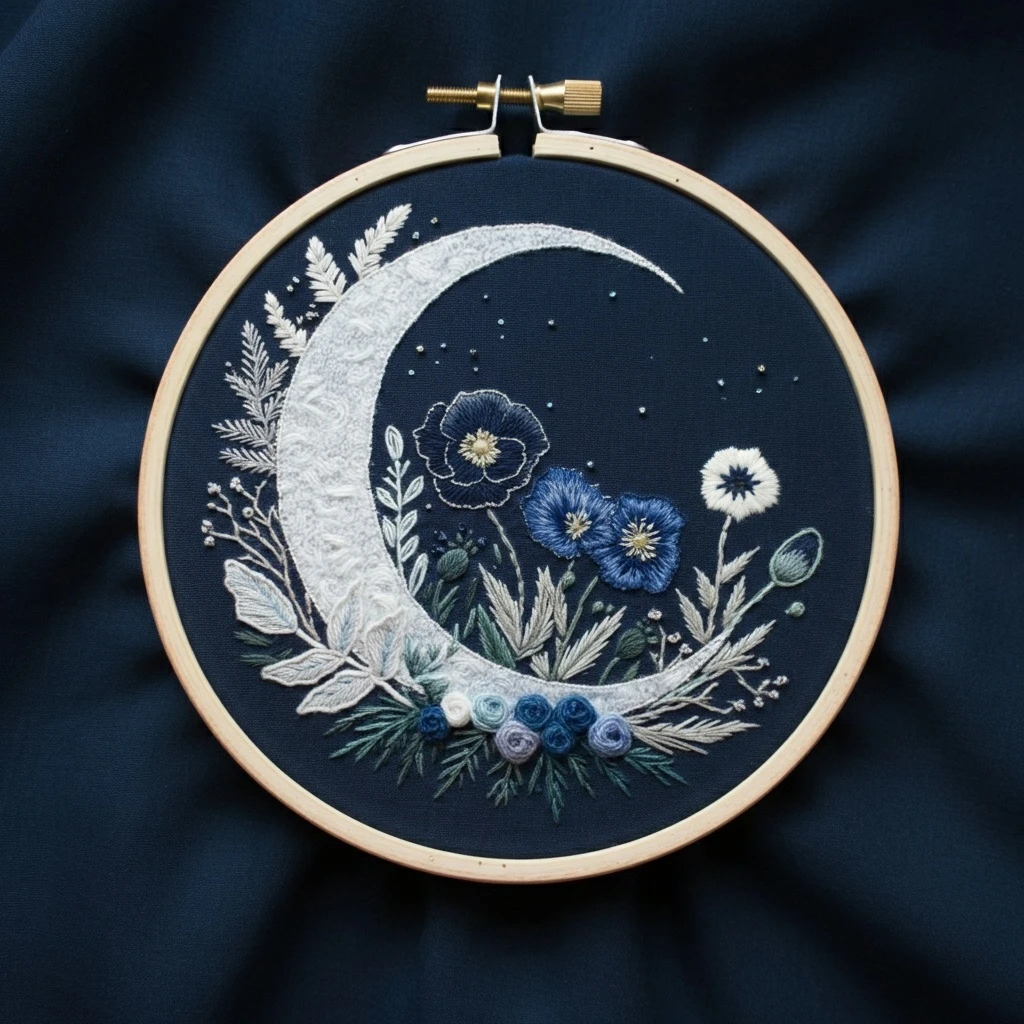

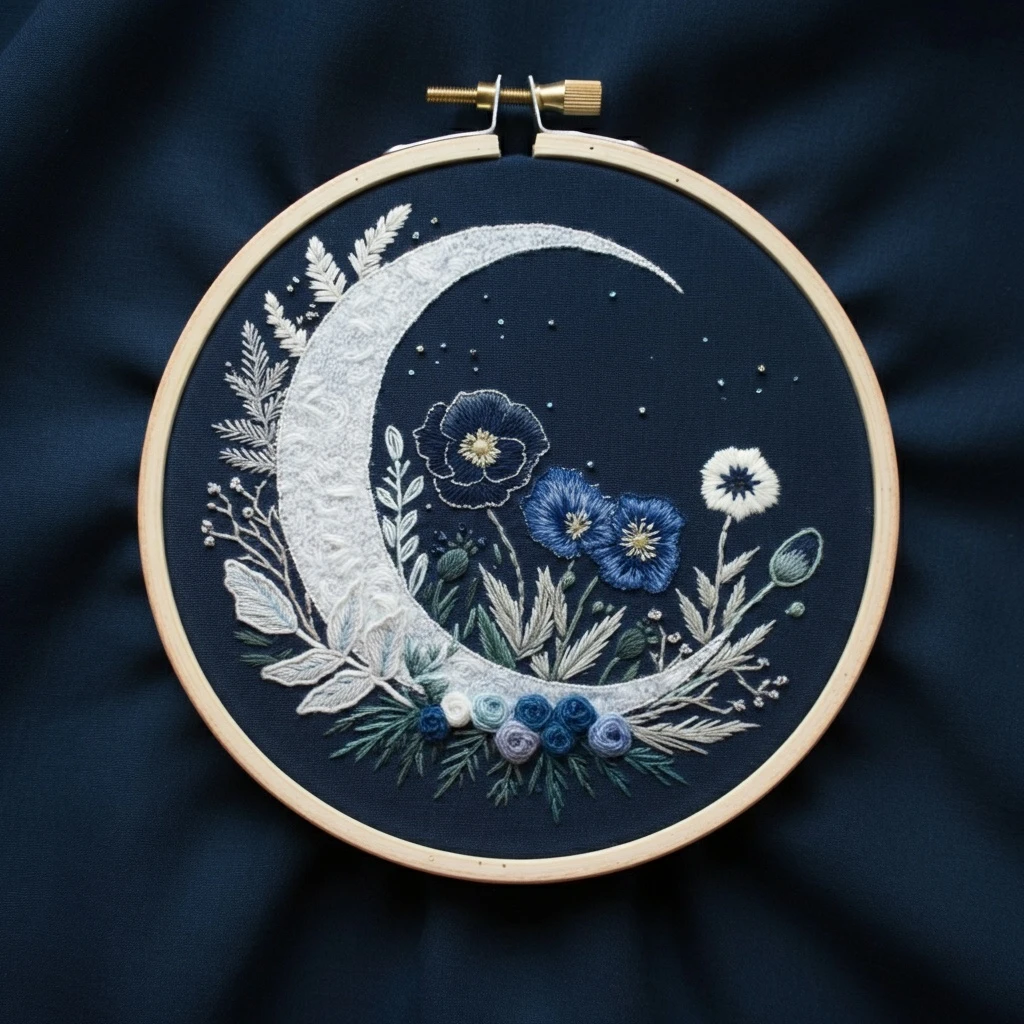
Celestial Moon and Midnight Bloom
This moonlit floral design pairs a luminous crescent or full moon motif with a dramatic midnight bloom, soft leaves, and scattered celestial sparkle. The stitched version should feel elegant and nocturnal: creamy moon highlights, deep plum flower shadows, rose-pink petal edges, muted greenery, and tiny gold stars that brighten the dark floral mood.
Polished DMC Color Palette
This palette balances moonlit creams and golden celestial details with deep plum, mauve, rose, and muted green. Keep the darkest tones close to the flower center and petal overlaps, then use pale cream and gold sparingly to make the moon and stars glow.
Stitch Map by Design Element
Thread Count & Blending Guide
Fine details
Use 1 strand for petal veins, star rays, moon contour lines, stem tips, tiny dots, and final outline corrections. One strand keeps the design elegant and not overly heavy.
Main fills
Use 2 strands for moon fill, petal shading, leaves, stems, and larger star motifs. Two strands give good coverage while still allowing smooth color blending.
Raised texture
Use 2–3 strands for flower-center knots and prominent celestial dots. Three strands works best for the central bloom texture; two strands is neater for tiny stars.
Shading, Outlining & Texture Suggestions
Moonlit contrast
- Keep the moon smoother and lighter than the flower so it reads as a calm focal glow.
- Use 3865 only along the brightest rim and on tiny star points.
- Add 822 in small amounts to shape the moon without making it gray.
- If the moon blends into nearby pale petals, add a fine 783 or 822 edge stitch.
Midnight petal depth
- Shade petal bases darkest and petal tips lightest for a natural cupped bloom.
- Angle stitches toward the center so every petal has clear direction.
- Reserve 154 for the deepest folds; too much can flatten the bloom.
- Add rose or lavender highlights only on the lifted petal edges.
Leaf balance
- Keep leaves muted so they support the moon and flower instead of competing.
- Use darker greens behind petals and lighter greens on outer sprigs.
- Vary leaf length and direction for a botanical, hand-drawn look.
- Use fishbone stitch on larger leaves to create a natural center vein.
Celestial sparkle
- Cluster a few gold dots near the moon, then fade them outward.
- Mix knots, seed stitches, and tiny straight-stitch stars for variety.
- Use lavender dots as a soft night-sky echo around the flower.
- Leave open fabric between sparkle clusters so the composition feels airy.
Beginner-Friendly Stitching Order
- Transfer lightly: mark the moon, main petal shapes, flower center, stems, leaves, and largest stars. Keep transfer marks faint under pale moon and petal highlights.
- Stitch the moon first: fill the moon, add soft shadow, and place the brightest rim highlight.
- Work back leaves and stems: stitch greenery that sits behind the bloom before adding petal layers.
- Fill the midnight bloom: stitch darker petal bases first, then mid-tones, then rose and lavender highlights at the tips.
- Add flower center texture: use knots and seed stitches after petals are complete so the center sits on top.
- Finish with stars: add celestial dots, tiny star rays, final outlines, and small highlight stitches last.
Practical Tips for a Clean Finish
Fabric & hoop
Warm cream cotton, linen, or cotton-linen makes the moon glow and gives the deep bloom colors a romantic softness. Keep the fabric drum-tight so satin moon stitches and petal shading stay smooth.
Needle choice
Use a sharp embroidery needle size 7–9 for one- and two-strand stitching. For three-strand flower-center knots, switch to a slightly larger needle so the wraps pull through cleanly.
Managing dark floss
Do not carry dark plum thread behind the moon, pale petal highlights, or open fabric areas. End and restart threads nearby to prevent show-through and keep the back tidy.
Keeping the mood balanced
If the flower becomes too dark, add a few 3722, 761, or 211 strokes at lifted petal tips. If it becomes too bright, deepen the center with a few 154 knots or short stitches.