
DMC palette & stitching notes
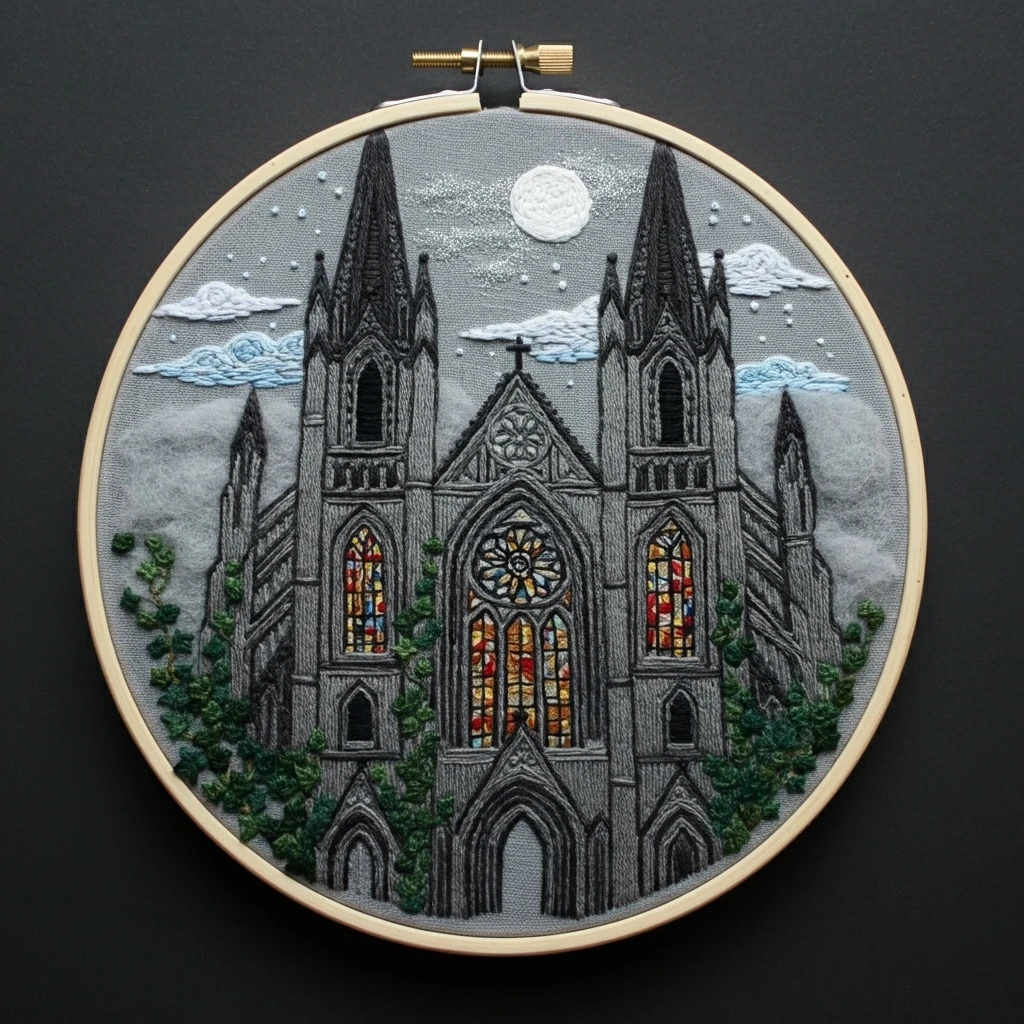
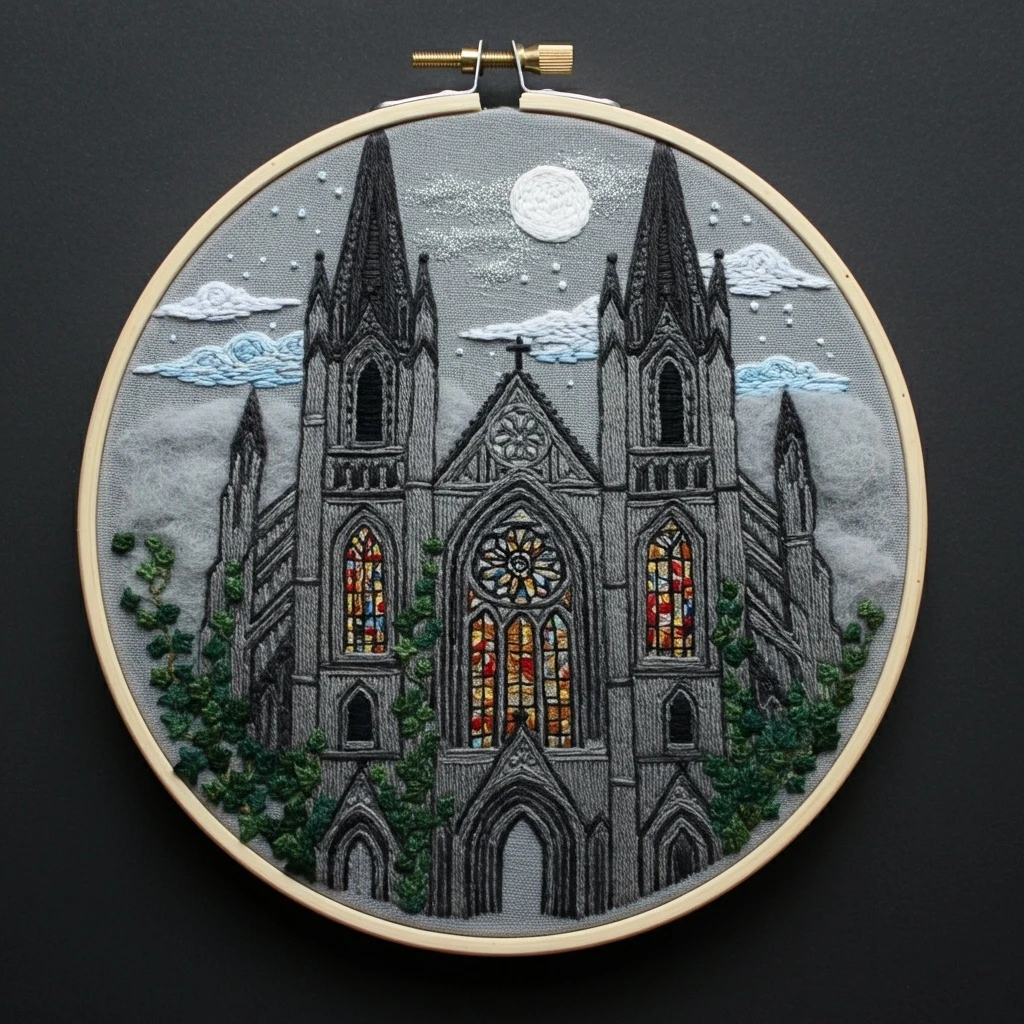
Gothic Cathedral at Night
A dramatic night-sky hoop with twin Gothic spires, smoky gray stonework, luminous stained-glass windows, moonlit clouds, and deep evergreen foliage around the base. The design works best when the cathedral stays crisp and architectural while the sky, moon, and trees are treated with softer texture.
Observed Color Story
The reference image is built around cool grays and black linework: pale gray fabric sky, charcoal spires, layered stone walls, white moon and clouds, icy blue cloud shadows, deep green shrubs, and small jewel-like stained-glass accents in red, orange, gold, and blue. Use the brightest colors only in the windows so they read as light shining through the dark cathedral.
Stitch Map
This design has many thin architectural lines. Keep outlines controlled, use fewer strands for details, and let the stained-glass panes stay small and bright. Softer stitches around the moon, clouds, and foliage will contrast beautifully with the cathedral’s pointed geometry.
| Design area | Recommended stitches | Thread count | Practical notes |
|---|---|---|---|
| Tall spires and roof silhouettes | Backstitch, split stitch, couching for long straight lines | 1 strand for fine lines, 2 for outer silhouette | Use DMC 310 for the sharp roof edges and 3799 for secondary internal ribs so the blackwork does not become heavy. |
| Stone facade and towers | Long-and-short stitch, straight stitch hatching, split stitch | 1–2 strands | Layer 414, 317, and 318 in vertical strokes. Follow the architecture: stitch columns vertically, roof planes diagonally, and arches along the curve. |
| Gothic arches and tracery | Single-strand backstitch, split backstitch, tiny straight stitches | 1 strand | Stitch the arch outline first, then add small inner divisions. Keep tension even so window shapes remain symmetrical. |
| Stained-glass windows | Tiny satin stitch, straight stitch blocks, black backstitch leading | 1 strand color, 1 strand black | Fill red, gold, and yellow panes with short vertical stitches. Add the black leading last to sharpen the glass-grid effect. |
| Rose window | Woven wheel center, tiny straight stitches, seed stitches | 1 strand | Place the center first, then radiate small gold, red, and gray stitches like petals around the circle. |
| Moon | Woven wheel, padded satin, or circular chain stitch | 2 strands | Use B5200 and 762 together or side by side. A spiral chain or woven wheel creates the raised moon texture seen in the reference. |
| Clouds and blue mist | Stem stitch, split stitch, fly stitch, loose satin stitch | 1–2 strands | Work white cloud tops first, then tuck 3753 and 762 underneath for shadow. Keep cloud edges scalloped and relaxed. |
| Stars and falling dots | French knots, colonial knots, single seed stitches | 1–2 strands | Use B5200 or 762. Vary dot size by changing from one to two wraps rather than adding more colors. |
| Evergreen shrubs and ivy | French knots, detached chain, lazy daisy leaves, seed stitch | 2–3 strands | Use 890 in the deepest clusters, then add 935 and a few 987 highlights on top for leafy texture. |
Blending & shading plan
- Stonework: Blend one strand DMC 414 with one strand DMC 317 for the main walls; add single-strand 318 along moonlit edges.
- Deep recesses: Use DMC 3799 inside arches and behind tracery, reserving DMC 310 for final outlines and window openings.
- Clouds: Pair B5200 with 762 for soft white; add 3753 below the cloud line for cool night-blue shadow.
- Windows: Keep stained glass unblended and jewel-like. One-strand red, gold, yellow, and occasional blue stitches will sparkle against black leading.
Creating the nighttime glow
- Stitch the gray cathedral before the bright windows so the glass sits visually on top.
- Add a tiny B5200 or 444 stitch beside the warm panes to mimic reflected light.
- Use more black near the spires and roof peaks; use more 318 near the moon-facing edges.
- Keep the sky mostly open fabric so the moon, clouds, and building details do not feel crowded.
Thread-count guidance
1 strand
Best for tracery, masonry hatching, stained-glass panes, stars, roof ribs, and any line inside the windows. Use this for precision.
2 strands
Use for main outlines, moon texture, cloud curves, larger wall fills, and shrub bases. This is the best default for visible structure.
3 strands
Reserve for raised greenery knots or a padded moon highlight. Avoid 3 strands on architectural details because it can blur the Gothic shapes.
Beginner-friendly stitching order
Outlining details
Use DMC 310 sparingly but decisively. The outer spire silhouettes, doorway openings, and stained-glass leading need the strongest black. For stone cracks, inner tower ribs, and side-wall hatching, switch to DMC 3799 or 414 so the cathedral keeps its layered, carved look instead of turning into one flat black shape.
Texture suggestions
Combine smooth architectural stitches with raised natural details. Straight stitch hatching makes the stone feel carved, woven or circular stitches give the moon a soft glow, loose stem stitches create drifting clouds, and French knots make the shrubbery at the base feel dense and shadowed.
Fabric & needle tips
- Medium gray linen or cotton is ideal because it becomes the night sky and stone undertone.
- Use a size 9 or 10 embroidery needle for single-strand window details; switch to a slightly larger needle for knots.
- Keep the hoop very tight when stitching the long spire lines so the towers do not warp.
- Use short thread lengths for black floss, which can fuzz quickly when pulled through dense areas.
Practical glow accents
- Add one tiny 444 stitch in the center of the largest window panes for a candlelit sparkle.
- Place B5200 French knots unevenly around the sky; perfectly spaced stars can look too mechanical.
- For subtle moon haze, use single-strand 762 seed stitches around the moon rather than a solid halo.
- Do the final black outlines only after fills are complete to clean up small shape irregularities.