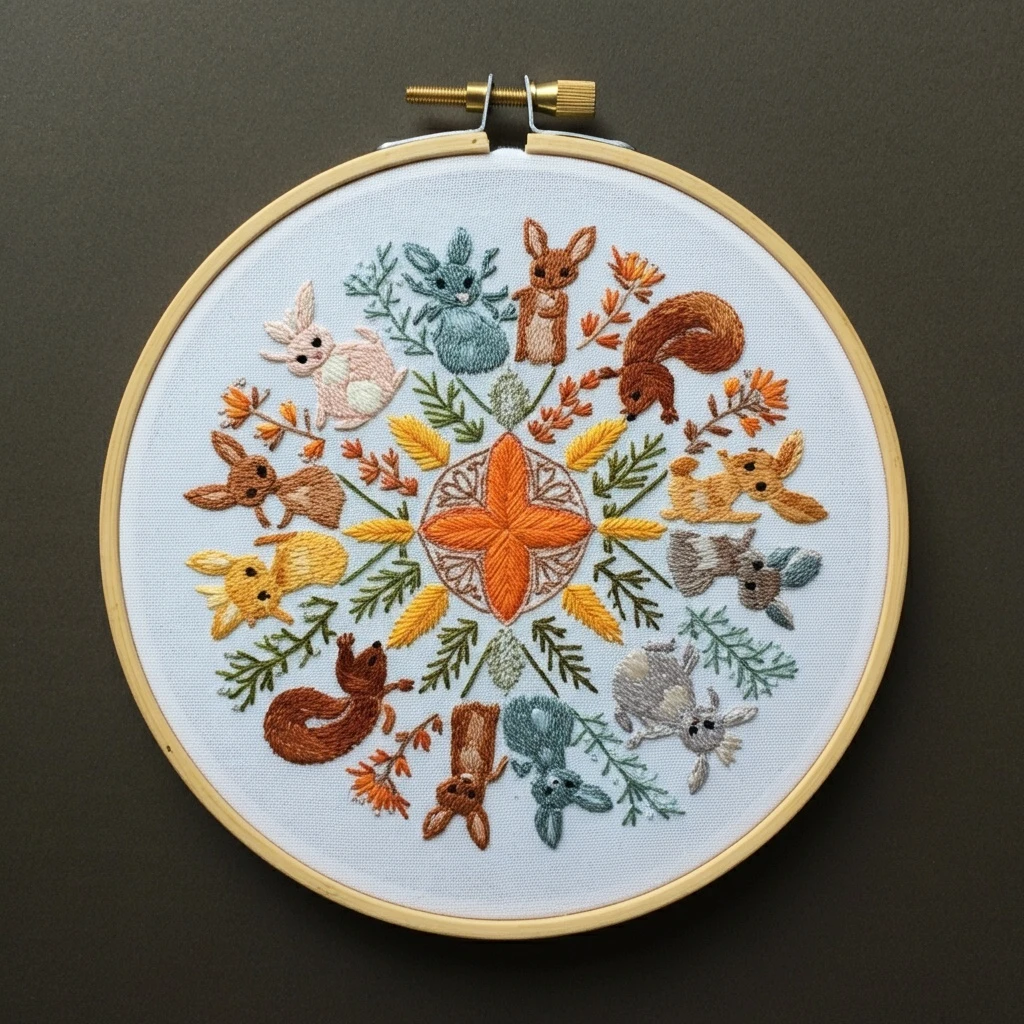

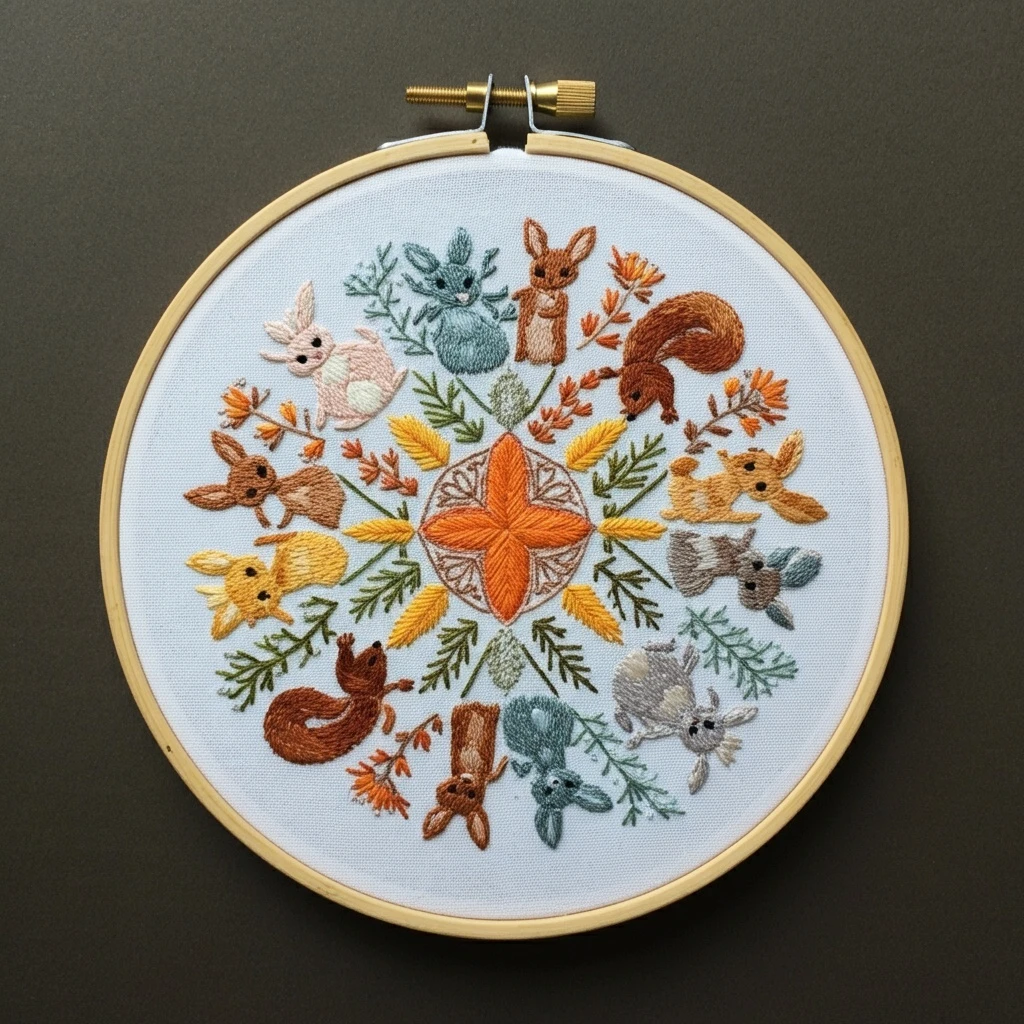
Woodland Creature Circle
A cozy circular forest composition with small woodland animals, layered leaves, berries, mossy greenery, and warm earth tones. This guide focuses on soft fur texture, balanced wreath-like movement, crisp creature outlines, and natural color transitions.
Design read & stitching approach
Treat the design as a gentle woodland medallion: the animals should feel warm and expressive, while the circular foliage frame stays airy enough to preserve the shape. Build the composition from light background elements to darker detail lines so the final outlines remain clean.
Center focus
Use soft long-and-short or satin accents on faces and bodies. Keep eyes, noses, whiskers, and tiny paws sharp with one-strand dark details.
Circle movement
Follow the curve of the wreath with stems and leaves. Angle stitches slightly around the ring instead of straight up and down.
Forest texture
Mix matte browns, moss greens, cream highlights, and tiny berry knots for a layered handmade woodland look.
Suggested DMC floss palette
The palette below balances animal fur, bark, foliage, berries, and soft highlights. Substitute nearby shades if your fabric is darker or warmer.
Stitch plan by design area
| Area | Recommended stitches | Thread count | Practical notes |
|---|---|---|---|
| Animal faces and bodies | Long-and-short stitch, split stitch, tiny satin accents | 1 strand for faces; 2 strands for bodies | Stitch in the direction fur would grow. Blend 3863 into 3862, then add sparse 822 highlights. |
| Eyes, noses, whiskers | French knots, seed stitch, backstitch, straight stitch | 1 strand | Use 938 sparingly. Add one B5200 dot beside the dark eye for life. |
| Leaves and wreath circle | Fishbone stitch, detached chain, fly stitch, stem stitch | 2 strands; 1 strand for fine tips | Alternate 469, 3012, and 3013 so the greenery does not look flat. |
| Branches and twigs | Stem stitch, whipped backstitch, split backstitch | 1-2 strands | Use 3862 for most branches and 938 only under crossing points or deep creases. |
| Berries and small dots | French knots, colonial knots, padded satin dots | 2 strands, sometimes 3 for raised berries | Work berries last so they sit cleanly above leaves and branches. |
| Ground texture and small grasses | Straight stitch, seed stitch, couching, lazy daisy | 1-2 strands | Use varied stitch lengths to avoid a combed or overly regular texture. |
Blending, shading & outlining details
Fur blending
Begin with a base layer in DMC 3863, add 3862 where ears, bellies, legs, or tails tuck under, then place short 822 stitches on the top planes. For fox-like areas, blend 920 with 976, reserving 3777 for deepest red-brown creases.
Outlining
Use one strand of 938 or 3862 for split backstitch around faces and paws. Keep outlines broken in highlight zones so the animals stay soft rather than cartoon-heavy.
Leaf shading
Work larger leaves with fishbone stitch: 934 at the base, 469 through the center, and 3013 along the outer tip. This creates a subtle midrib without adding extra outline.
Circle balance
Repeat each accent color at least three times around the circle. Place red berries and copper leaves in small clusters to guide the eye without overpowering the animals.
Beginner-friendly working order
- Transfer the full circle lightly; keep animal facial features very crisp and minimal.
- Stitch stems and the main circular branch structure first with stem stitch.
- Fill larger animals or central motifs next, using fewer strands near small facial details.
- Add leaves in alternating greens, rotating stitch direction to follow the circle.
- Place berries, knots, eye highlights, and whiskers last so they remain clean.
- Step back often; if one side feels heavier, add only tiny sprigs rather than more large leaves.
Finishing tips
Fabric choice
Natural linen, oatmeal cotton, or warm ivory fabric will flatter the woodland browns and greens. Avoid stark white unless you want a brighter storybook finish.
Hoop presentation
Center the circular motif with at least 1 inch of breathing room. A wooden hoop pairs well with the bark and fur palette.
Needle control
Use a sharp embroidery needle and shorter thread lengths for fur areas; fuzzy thread quickly dulls small animal features.
Pressing
Press face down on a towel after stitching so knots, satin leaves, and padded berries keep their dimension.