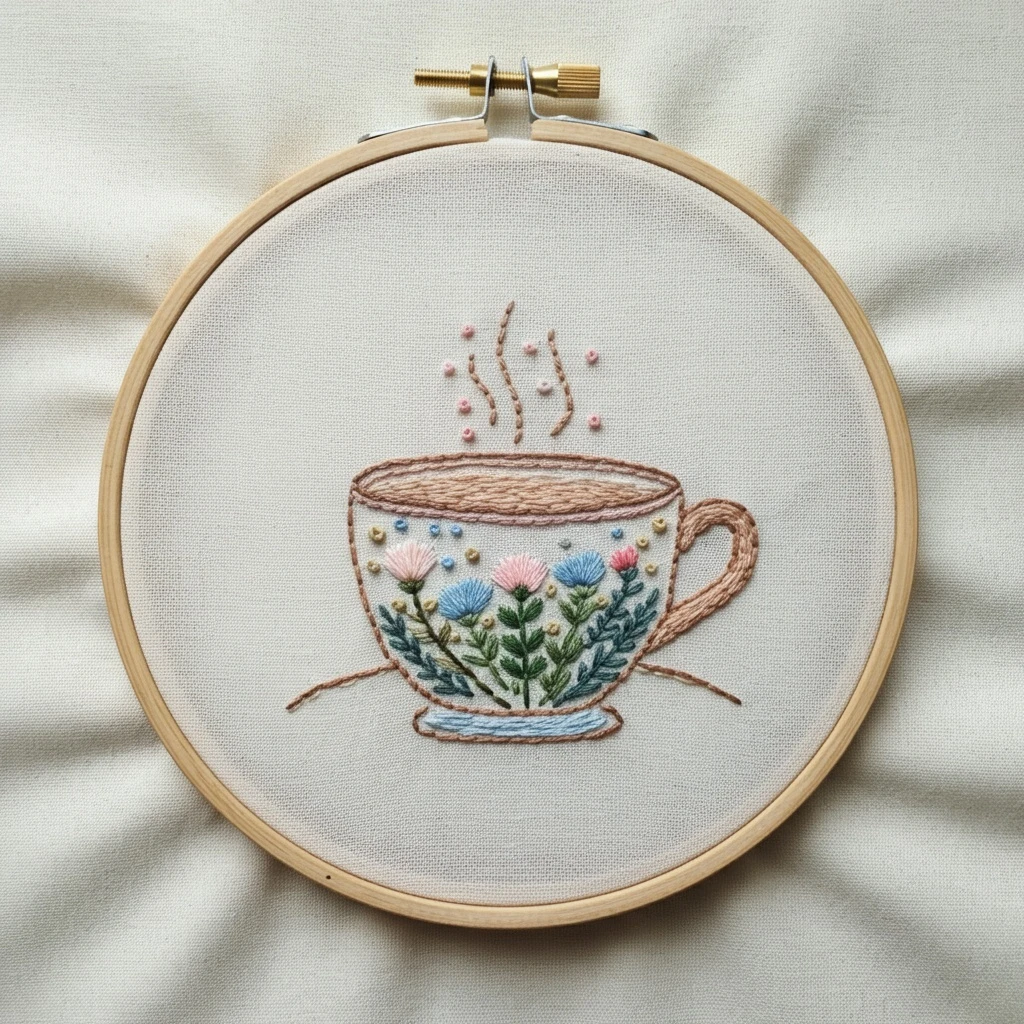

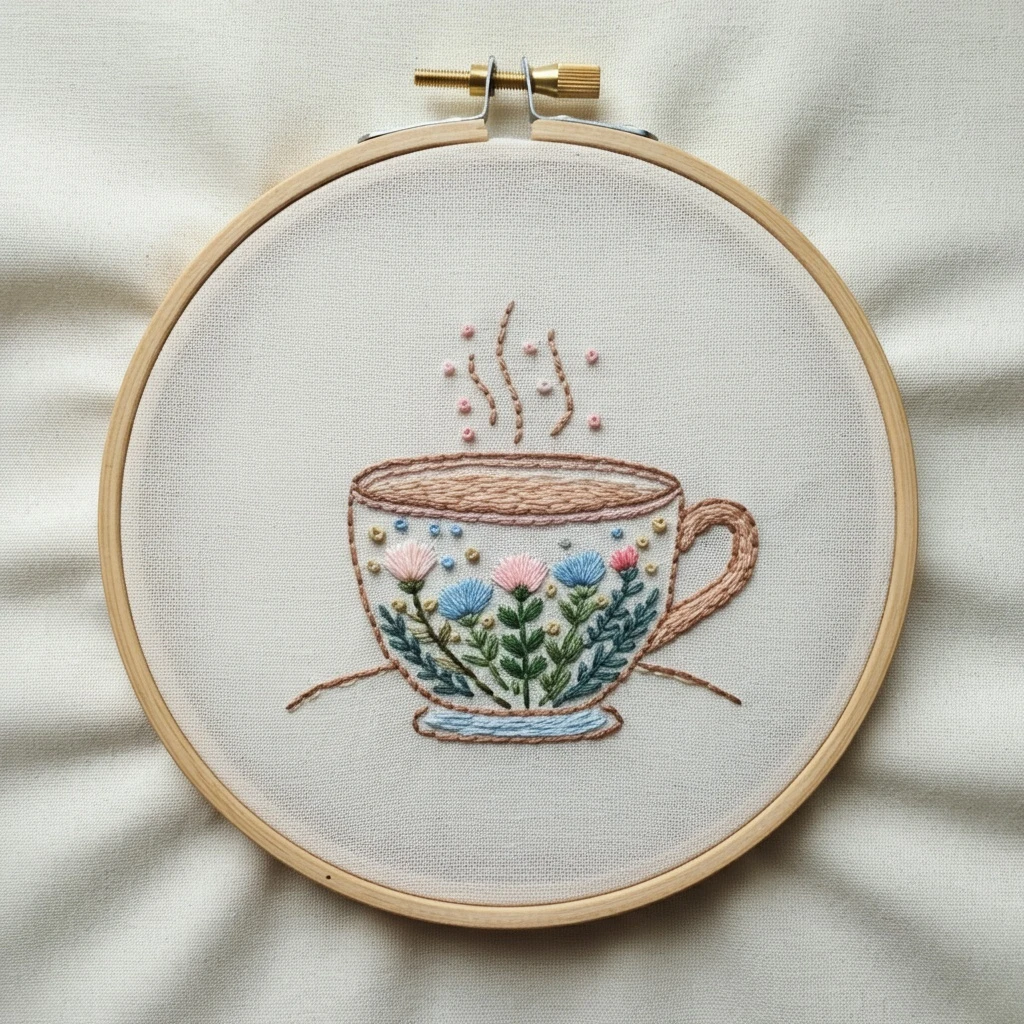
Floral Teacup
A soft cottage-style teacup design with warm brown outlines, pale blue china, rosy and cornflower blooms, dark leafy sprays, gold dot accents, and curling steam. The palette below keeps the piece delicate while giving enough contrast for the cup rim, handle, flowers, and foliage to read clearly on natural linen.
Suggested DMC floss palette
| Color | DMC | Name | Best use in this design |
|---|---|---|---|
| 819 | Baby Pink Light | Pale flower centers, tiny steam dots, and the lightest petal stitches. | |
| 761 | Salmon Light | Main pink fan flowers; blend with 819 for soft petal tips. | |
| 3354 | Dusty Rose Light | Small red-pink bud and occasional petal shadow near the base. | |
| 3752 | Antique Blue Very Light | Cup body wash, saucer highlights, and blue flower highlights. | |
| 932 | Antique Blue Light | Cornflower petals, decorative dots, and lower cup shadows. | |
| 3768 | Gray Green Dark | Deep blue-green stems and the darkest leafy accents. | |
| 3363 | Pine Green Medium | Primary stems and center leaf clusters. | |
| 3052 | Green Gray Medium | Softer leaves, transition stitches, and background foliage. | |
| 3863 | Mocha Beige Medium | Tea surface, cup outline warmth, handle fill, and steam curves. | |
| 3862 | Mocha Beige Dark | Strongest rim line, handle edge, cup base, and grounding line. | |
| 676 | Old Gold Light | Scattered gold knots and warm highlight dots around the cup. | |
| 3865 | Winter White | Optional cup highlights on pale fabric; use sparingly so it does not disappear. |
Stitch map
Thread-count guidance
1 strand
Steam lines, delicate cup contour refinements, tiny petal shadows, and any internal blue cup shading.
2 strands
Main outlines, stems, leaves, flower petals, and most decorative knots. This is the safest default.
3 strands
Only for the thickest handle texture, large knots, or a bolder cup rim on coarse fabric.
Blending, shading, and texture ideas
Soft blue china
- Outline the cup first in 3863, then add a very light fill with scattered one-strand 3752 stitches.
- Use 932 only under the saucer and near the lower cup edge to suggest shadow.
- Leave small gaps of fabric showing; this keeps the cup airy and handmade.
Petal depth
- For pink flowers, work 761 from the base and 819 at the tips.
- Add two or three 3354 stitches near the bud base for a gentle pop of rose.
- For blue flowers, use 932 at the base and 3752 at the outer edge.
Leafy movement
- Alternate 3363 and 3052 leaf by leaf rather than blending every leaf.
- Add 3768 on the left and right sprays to frame the teacup with deeper contrast.
- Use short directional stitches so leaves point naturally toward each flower head.
Warm tea and handle
- Stitch the handle with curved stem stitch rows in 3863; add 3862 along the inside curve.
- For the tea, lay horizontal long-and-short stitches, then skim a few darker ripples on top.
- Keep the grounding line loose and sketchy so it does not overpower the cup.
Beginner-friendly order of stitching
- Transfer lightly: Use a fine erasable pen or water-soluble stabilizer. Mark the cup rim, handle, saucer, flower centers, and steam dots clearly.
- Start with structure: Back stitch the cup, handle, saucer, and ground line before filling flowers. This gives the floral cluster a clean container.
- Add stems next: Stem stitch the main green lines in 3363, then add leaves with 3052 and 3768.
- Work flowers from back to front: Stitch the central taller bloom first, then side blooms, then the small bud.
- Finish with texture: Add French knots for gold, blue, and pink dots after the main stitching so the knots stay crisp.
- Press carefully: Place the embroidery face down on a towel and press from the back so knots and satin petals remain raised.
Quick substitutions
If your stash is limited, choose one soft pink, one clear blue, two greens, one warm brown, and one gold. A simplified version can be stitched with DMC 761, 932, 3363, 3052, 3863, and 676 while preserving the original design’s cozy teacup-and-garden feeling.