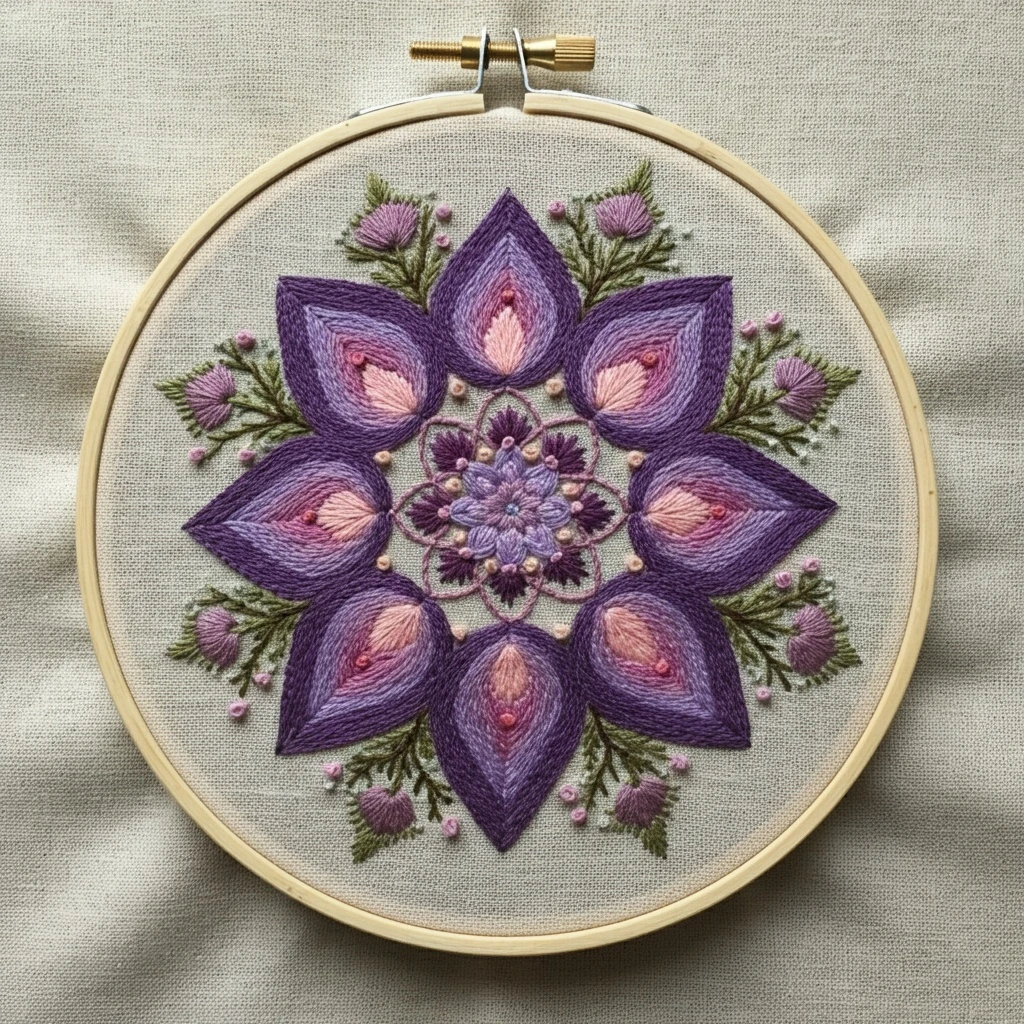

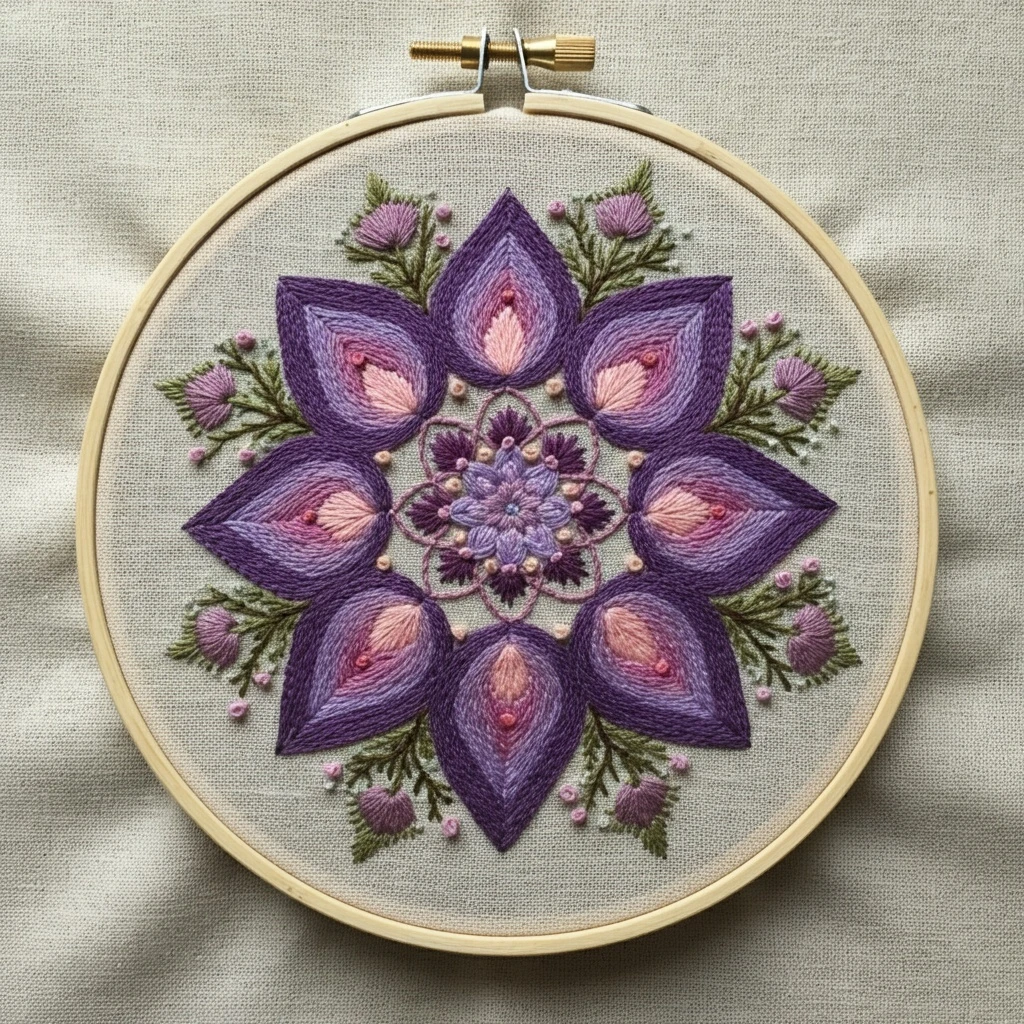
Cosmic Mandala Bloom
This design blends a meditative mandala structure with a blooming celestial flower. The embroidery should feel precise, radiant, and balanced: symmetrical petal rings, deep galaxy shadows near the center, lavender and aqua glow along outer motifs, tiny gold-white star points, and clean radial stitching that keeps every repeated shape crisp and intentional.
Polished DMC Color Palette
This palette supports a cosmic mandala with dark center depth, violet floral layers, cool blue-aqua glow, warm pink accents, and gold-white sparkle. For the cleanest result, repeat colors consistently around the mandala ring by ring.
Stitch Map by Design Element
Thread Count & Blending Guide
Precision details
Use 1 strand for orbit arcs, dot rings, star points, tiny outlines, petal veins, and correction stitches. One strand keeps the mandala symmetrical and refined.
Main petal rings
Use 2 strands for petal fills, radial spokes, larger motifs, and central shape fills. Two strands gives rich galaxy color while staying neat.
Raised center texture
Use 2–3 strands for selected center knots and focal star dots. Use three strands only at the very center or strongest sparkle points.
Shading, Outlining & Texture Suggestions
Symmetry first
- Mark the center point and main ring guides before stitching.
- Work matching motifs opposite each other to keep color and tension balanced.
- Repeat the same stitch direction in each matching petal.
- Check alignment often; small errors show more in mandala designs.
Cosmic bloom depth
- Use darkest purples near the center and underneath overlapping petal shapes.
- Move outward into lavender, blue, aqua, pink, or cream highlights.
- Keep white and gold accents small so they look like light, not fill colors.
- Use a few dark pinpoints to make bright star dots sparkle more strongly.
Mandala texture
- Use satin stitch for smooth filled petals and detached chain for raised petal tips.
- Use knots and seed stitches for dot rings and star clusters.
- Use couching for long orbit lines that need to stay perfectly smooth.
- Keep stitch tension even around the whole circle to avoid distortion.
Outlining approach
- Use dark violet, navy, teal, or pewter for selective separation.
- Outline only the motifs that need crisp edges or overlap definition.
- Use split stitch around petals and stem stitch for curved orbit lines.
- Add final outlines before the last white and gold sparkles.
Beginner-Friendly Stitching Order
- Mark the geometry: lightly draw the center point, main petal rings, radial spokes, orbit arcs, and key dot placements. Accuracy here makes the whole mandala easier.
- Stitch the center: build the core with dark violet, gold, and a few small raised knots.
- Work the inner ring: stitch matching petals in pairs across the center, keeping colors and stitch direction consistent.
- Add outer petals: continue outward with lavender, blue, aqua, pink, and pale highlights.
- Add arcs and spokes: stitch orbit lines and radial accents with one strand or couching for smooth curves.
- Finish with stars: add dot rings, cosmic dust, star stitches, white glints, gold sparkles, and final outline corrections last.
Practical Tips for a Clean Finish
Fabric & hoop
Soft black, navy, pale lavender, warm cream, or natural linen all work. Dark fabric makes the galaxy palette dramatic; pale fabric gives a softer mandala-bloom look. Keep the hoop very tight so radial stitches do not warp the circle.
Needle choice
Use a sharp embroidery needle size 7–9 for one- and two-strand stitching. For raised center knots with three strands, use a slightly larger needle for clean pull-through.
Keeping rings even
Finish one full ring before moving to the next. This makes it easier to keep the mandala balanced and prevents accidentally overloading one side with color or texture.
Avoiding visual clutter
Choose a role for each sparkle: center glow, ring dot, or background star dust. Too many random dots can weaken the precise mandala structure.