
DMC Palette & Stitching Notes
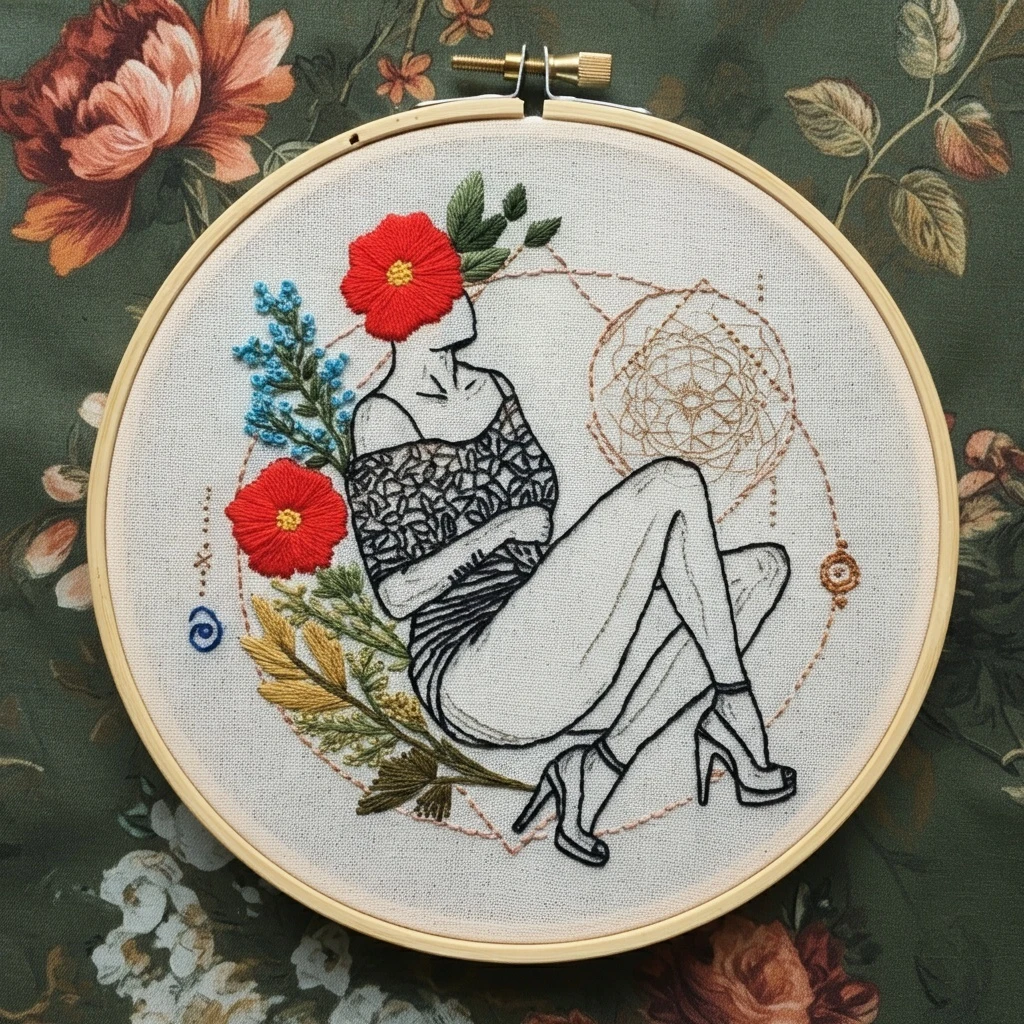
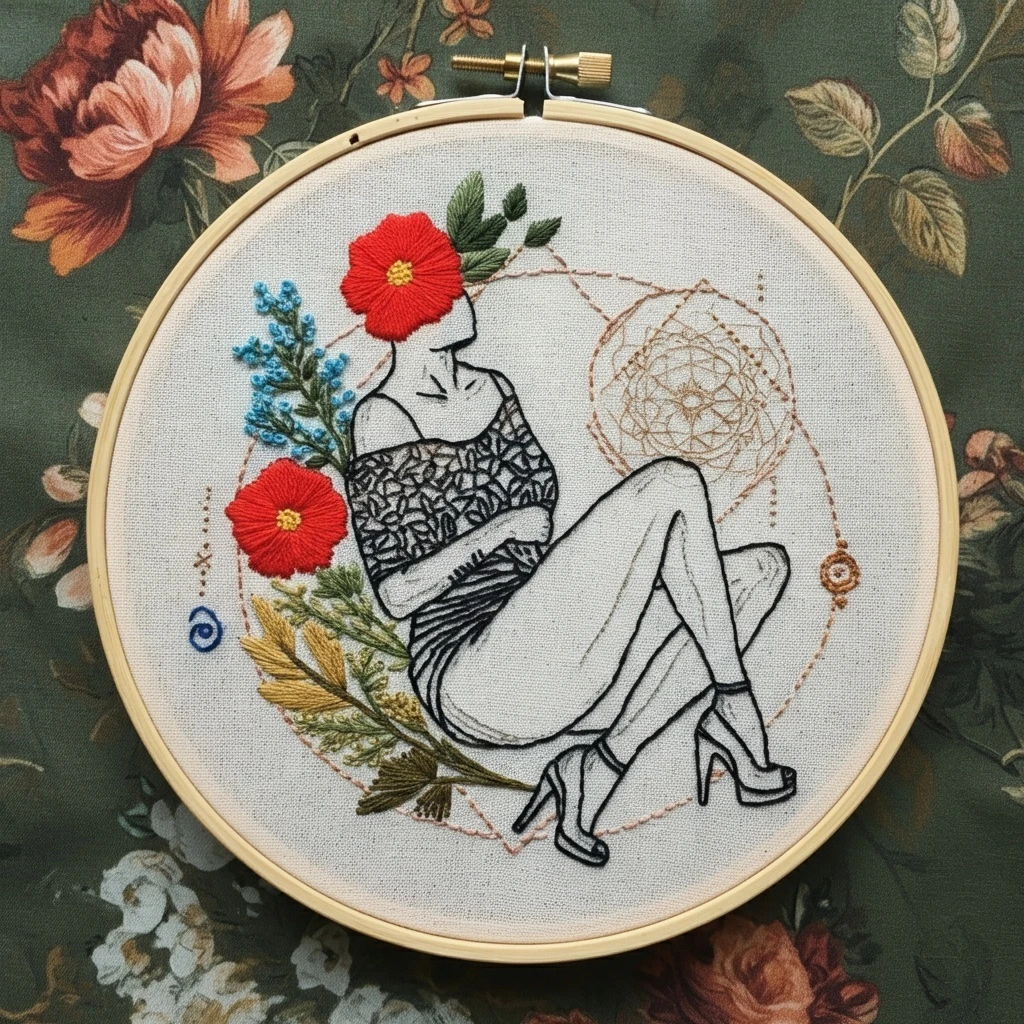
Embroidered Woman With Floral Headdress And Geometric Accents
A refined hoop portrait with clean black linework, two statement red flowers, blue bead-like blossoms, muted greenery, warm gold foliage, and delicate copper geometric accents. The palette below is estimated from the visible preview and matched to practical DMC floss choices for a balanced hand-embroidered finish.
Likely DMC Color Palette
Use the deepest tones sparingly for definition, then let the red flowers and blue floral cluster carry the color focus. Coverage percentages are visual estimates, not exact thread usage.
Stitching Suggestions
The design works best when the portrait is crisp and graphic while the floral areas are more dimensional and tactile.
| Element | Recommended stitch | Practical notes |
|---|---|---|
| Figure outline | Backstitch, split stitch, or stem stitch | Use 1 strand of DMC 310 for most outlines. Use tiny backstitches around curves, hands, shoes, and the neck so the silhouette stays elegant rather than heavy. |
| Dress pattern | Backstitch plus short straight stitches | Keep the black pattern dense but not bulky. Work the outer garment edge first, then fill the internal shapes with short angular stitches. |
| Red flowers | Long and short stitch or satin stitch | Stitch petals from the center outward. Blend 816 at the base, 321 through the body, and 347 on lifted edges. Keep directional stitches radiating like real petals. |
| Flower centers | French knots or colonial knots | Use 3821 with a few 680 knots for depth. Two wraps create raised centers without overwhelming the petals. |
| Blue blossom cluster | French knots, detached chain, and seed stitch | Use 3845 for most knots and 3844 for the brightest tips. Vary knot size to create the beaded, airy texture visible in the reference. |
| Leafy headdress | Fishbone stitch and straight stitch | Use 3363 near veins and 3345 on leaf bodies. For small leaves, one clean fishbone stitch on each side of the center vein is enough. |
| Lower grasses and gold foliage | Stem stitch, straight stitch, fly stitch | Layer olive 3011 under old gold 729. Add a few 680 accents at the base to make the foliage feel tucked behind the figure. |
| Geometric accents | Running stitch, couching, backstitch | Use 1 strand of 435 for fine circles, dotted lines, and polygon shapes. Keep tension relaxed so the thin lines do not pucker the fabric. |
| Bead and pendant details | French knots, satin dots, whipped backstitch | Work the hanging circles with 435, add 437 highlights, and place a tiny knot in the center for a jewelry-like finish. |
| Skin and body shading | Single-strand contour stitch or very light long stitch | Leave most skin unfilled for a modern line-art look. Add only a few 754 stitches under arms, knees, and calves if extra warmth is desired. |
Thread Count & Blending Plan
- 1 strand: face/neck contour, hands, shoe edges, geometric linework, dotted arcs, and the fine spiral accent.
- 2 strands: most red petals, leaves, gold grasses, dress pattern, and medium-weight stems.
- 3 strands: occasional blue French knots or raised flower centers when you want stronger texture.
- Blended needle idea: combine one strand 321 + one strand 347 for softened red petal highlights, or one strand 3345 + one strand 3011 for natural olive-green transitions.
- Depth control: reserve 816 and 680 for the deepest 15-20% of the flower and seed areas so the design remains bright.
Order of Work
- 1. Transfer cleanly: use a fine washable pen; the portrait and geometry rely on delicate placement.
- 2. Stitch the figure outline: complete the black line-art first to anchor proportions.
- 3. Add large flowers: work the red blooms next, then the yellow centers.
- 4. Build foliage: tuck greens and golds around the flowers, stitching from darker base layers to brighter tips.
- 5. Finish accents last: save blue knots, copper geometry, bead dots, and final black touch-ups for the end.
Outlining, Shading & Texture Guidance
The reference mixes graphic linework with soft botanical volume. Keep the contrast intentional: thin lines for the woman, raised knots for flowers, and airy single-strand copper for the sacred-geometry details.
- Portrait clarity: shorten stitches on curves instead of pulling one long stitch around a bend. This prevents angular elbows, knees, and shoe outlines from looking warped.
- Dress density: the patterned top should read as dark and decorative. Use 310, but avoid over-stitching one spot; heavy black thread can distort pale fabric.
- Petal shading: work red petals in wedges. Start with 816 near the center, overlap with 321, then add 347 at the tips using a few longer highlight strokes.
- Geometric softness: use running stitch for dotted lines and backstitch for circles. A single strand keeps the copper motif light and ornamental.
- Botanical texture: mix French knots with detached chain and straight stitches so the blue cluster does not look flat.
- Finishing contrast: after florals are complete, return with one strand of 310 only where lines need sharpening around the shoulder, hands, and feet.
Beginner-Friendly Practical Tips
Use a firm 6-inch or 7-inch hoop and keep the fabric drum-tight before beginning the long portrait lines. If the geometric accents feel intimidating, stitch them as short broken segments rather than continuous curves; the dotted style will still match the artwork. For a clean result, finish each color area before moving to the next, but leave French knots and tiny beads until the very end so they do not catch on your working thread.
- Test red petal blending on scrap fabric before stitching the visible flowers.
- Use a sharp embroidery needle for dense black linework and a slightly larger needle for 3-strand knots.
- Keep the back neat around pale skin areas so dark carried threads do not shadow through the fabric.
- Press from the back on a towel when finished to protect raised knots and textured flowers.
Encouraging Finish
This hoop will look most polished when the woman remains crisp and minimal while the headdress blooms feel lush and dimensional. Let the red flowers be the focal point, keep the copper geometry whisper-thin, and add blue knots only after the greenery is balanced. The final effect should feel modern, feminine, botanical, and slightly mystical.