
Beginner hand embroidery · DMC palette and stitch notes
Embroidered Flower Basket Beginner
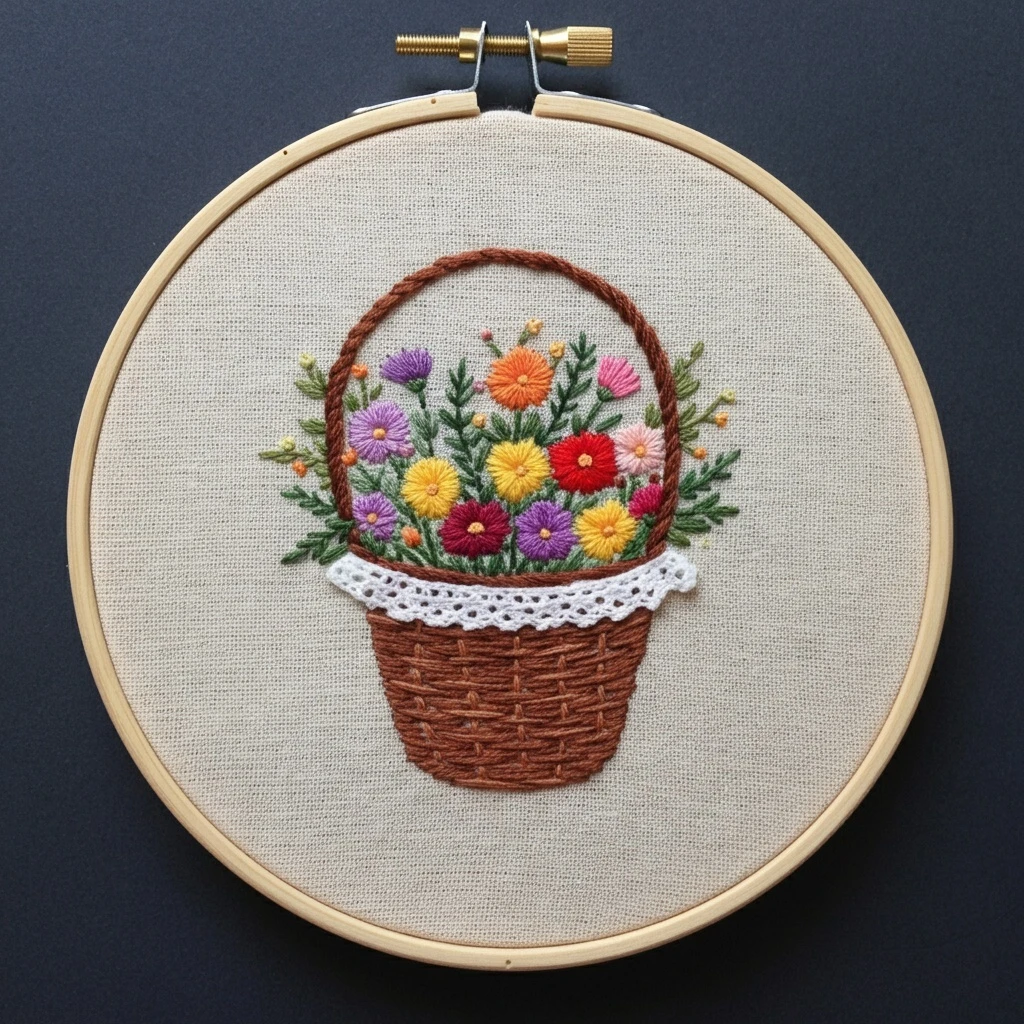
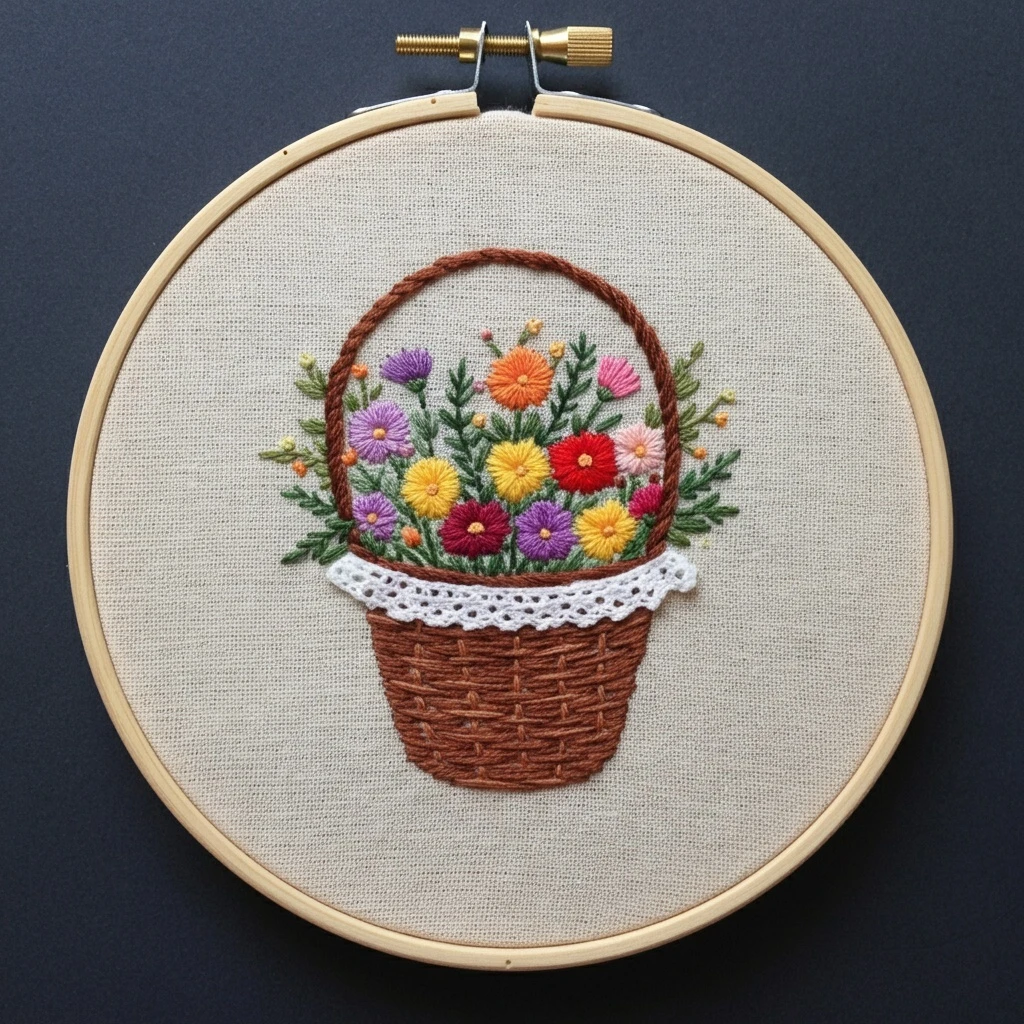
A friendly hoop design built around a warm woven basket, a white lace trim, ferny greenery, and cheerful daisy-style blooms in yellow, orange, red, pink, purple, and lavender. The palette below is estimated from the visible stitched preview and matched to practical DMC floss choices.
Likely DMC Color Palette
Use these shades as a polished working palette rather than an exact thread-count chart. The basket needs several browns for woven depth, while the flowers look best when each bloom has a bright face, a darker inner shadow, and a small raised center.
Main basket fill and handle base; excellent for the warm medium wicker tone.
Basket shadow, handle outline, lower rim, and the deepest weave crossings.
Warm basket highlights and raised wicker stitches over the darker base.
Soft highlight on upper basket rows and occasional handle glints.
Crocheted lace band, small eyelets, and crisp light touches on flower centers.
Primary stems and dark fern fronds behind the flowers.
Mid-tone leaves, side sprigs, and softened transitions in the meadowy filler.
Tiny leaf tips and pale buds so the greenery does not become a solid dark mass.
Golden daisy petals and bright centers; stitch outward from the middle.
Petal tips and sunny highlights on the yellow blossoms.
Orange daisy bloom and tiny orange accent buds around the basket.
Bright red flower head; combine with burgundy for petal depth.
Deep crimson bloom and shadow at the base of red petals.
Hot pink flower and saturated petal strokes near the right side.
Soft pink flower petals, especially the pale blossom beside the red bloom.
Purple daisies and fan-shaped blossoms; use directional stitches to show petal spokes.
Lavender petal highlights and softer purple flowers in the background.
French-knot flower centers and warm dot accents among the greenery.
Stitching Suggestions
Keep the stitch vocabulary simple and controlled. The design reads as detailed because the basket texture, lace trim, and flower centers are layered in separate passes.
| Element | Recommended stitch | Practical notes |
|---|---|---|
| Basket body | Long and short stitch, split stitch, or close horizontal satin rows | Fill the basket with 2 strands of 801, then add 975 highlights and 938 shadow lines. Work rows horizontally so the basket feels woven rather than flat. |
| Wicker weave | Backstitch, whipped backstitch, small straight stitches | Add vertical and horizontal weave marks after the fill is complete. Use 1 strand for fine bars or 2 strands for a chunkier beginner-friendly texture. |
| Basket handle | Stem stitch, rope stitch, or whipped backstitch | Stitch the arch in two rows of brown. Whip a lighter brown over the top to create the twisted handle effect visible in the sample. |
| White lace trim | Blanket stitch, detached chain, tiny straight stitches, French knots | Use 2 strands of 3865 for the band edge, then add small eyelet holes with dark gaps or tiny knots. Keep this area raised and clean. |
| Round daisy flowers | Satin stitch or long and short stitch | Radiate stitches from the center. Use 2 strands for petals; blend a lighter shade at the tips and a darker shade near the flower center. |
| Purple fan flowers | Straight stitch fan, satin stitch, or fishbone-like petals | Anchor stitches at one base point and fan them outward. This makes the purple blooms look full without complicated shaping. |
| Flower centers | French knots or colonial knots | Use 3822, 725, or tiny touches of 3865. One wrap gives a neat dot; two wraps give a more raised, cheerful beginner texture. |
| Greenery and stems | Stem stitch, straight stitch, lazy daisy, small fishbone stitch | Use 1 strand for thin ferny leaves and 2 strands for main stems. Alternate 3363, 469, and 471 so the greenery stays airy. |
| Tiny buds | French knots and seed stitches | Scatter orange, yellow, and pale green knots after all stems are in place. Keep buds irregular for a natural garden-basket look. |
| Final outlines | Backstitch or split stitch | Outline only where needed: basket rim, handle edges, lace edge, and a few petal separations. Too much outlining can make beginner florals look stiff. |
Thread Count & Blending Guide
The preview has a soft, raised hand-stitched feel. Varying strand count is the easiest way to copy that effect.
- Basket fill: 2 strands for coverage; 3 strands only if your fabric weave is open and the basket looks thin.
- Wicker overlay: 1 strand for neat detail, 2 strands for more visible beginner texture.
- Flower petals: 2 strands for most satin and long-short stitches; use 1 strand for tiny background petals.
- Fine leaves: 1 strand in 3363 or 469 keeps the leafy sprays delicate.
- Lace trim: 2 strands of 3865 for the scalloped edge; add 1-strand accents for eyelets.
- French knots: 2 strands with one or two wraps, depending on how raised you want the flower centers.
Shading & Texture Notes
Work from structural areas to decorative details so the small flowers stay fresh and clean.
- Place darkest browns under the basket rim and lower curve to make the basket look rounded.
- Use lighter brown stitches sparingly across the middle rows as raised wicker highlights.
- Keep the lace band bright white; avoid dragging brown thread underneath it where it could shadow through.
- Shade flowers from dark center to light outer petal tips. This is especially helpful for red, pink, and purple blooms.
- Let some green stems disappear behind flowers rather than outlining every leaf. This keeps the design beginner-friendly and less crowded.
- Add French knots last so they do not snag while you are filling surrounding petals.
Beginner-Friendly Stitching Order
A clear order prevents thread snags and keeps the lace and flowers crisp.
Extra Practical Tips
Needle choice
A size 7 or 8 embroidery needle works well for 2-strand stitching. Switch to a finer needle for 1-strand greenery and small lace details.
Neat petals
For each daisy, imagine a tiny clock face and stitch from the center outward. This keeps petals evenly spaced without drawing every petal line.
Basket realism
Do not make every weave line perfectly identical. Slight variations in length and color make the basket look handmade and dimensional.
Avoid bulk
Trim thread tails short on the back, especially under the white lace. Dark carried threads can show through light fabric.
Color control
Repeat each flower color in at least two places. This balances the bright palette and makes the basket look intentionally arranged.
Finishing
After stitching, gently steam from the back on a towel. Keep the iron away from French knots so raised centers stay plump.