
DMC palette & hand embroidery guide
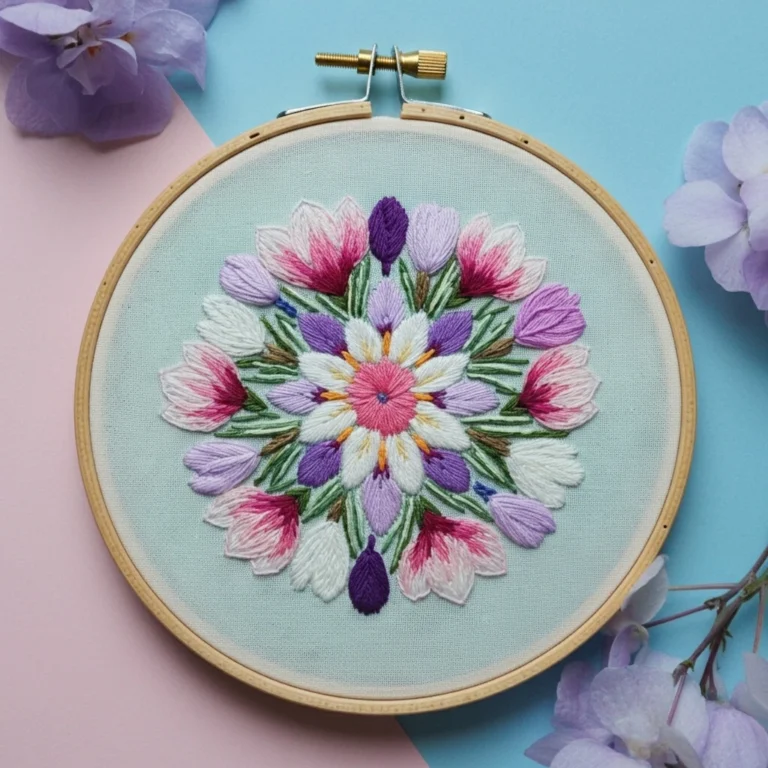
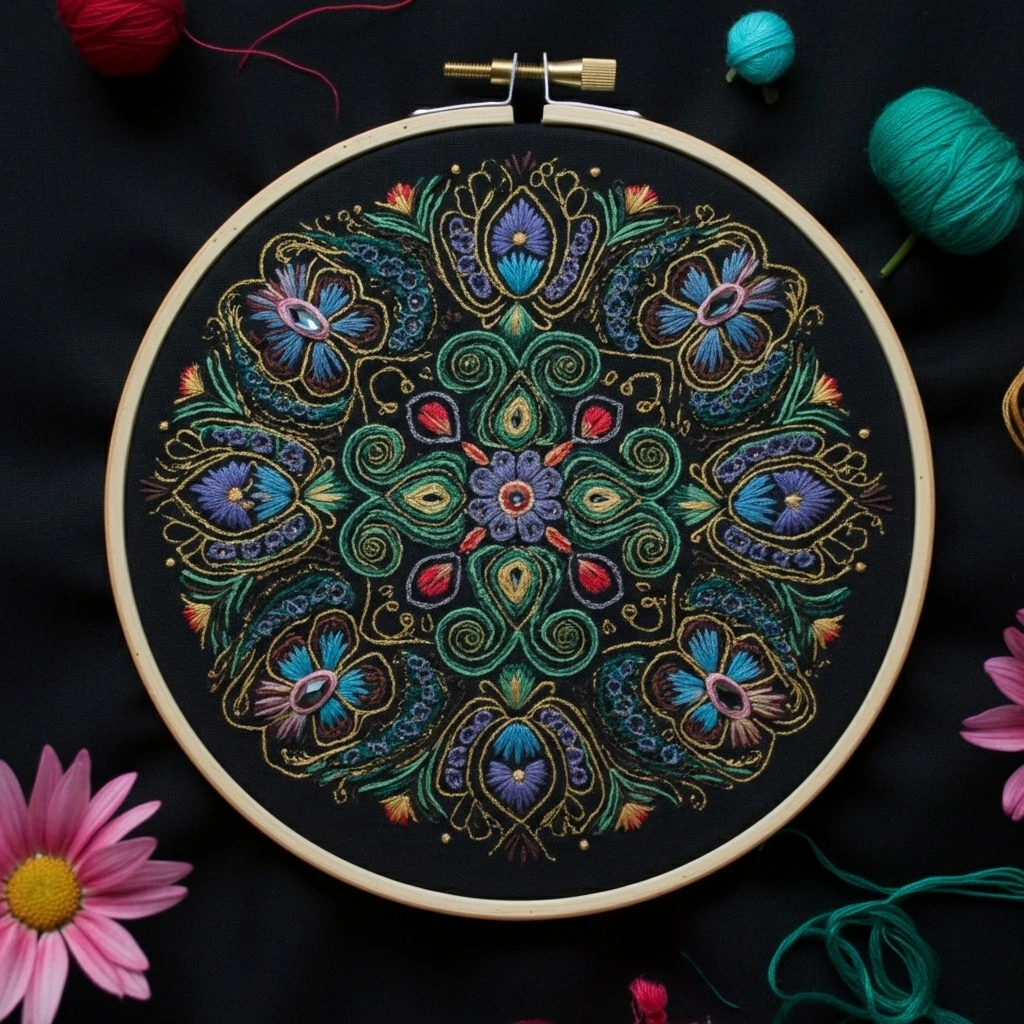
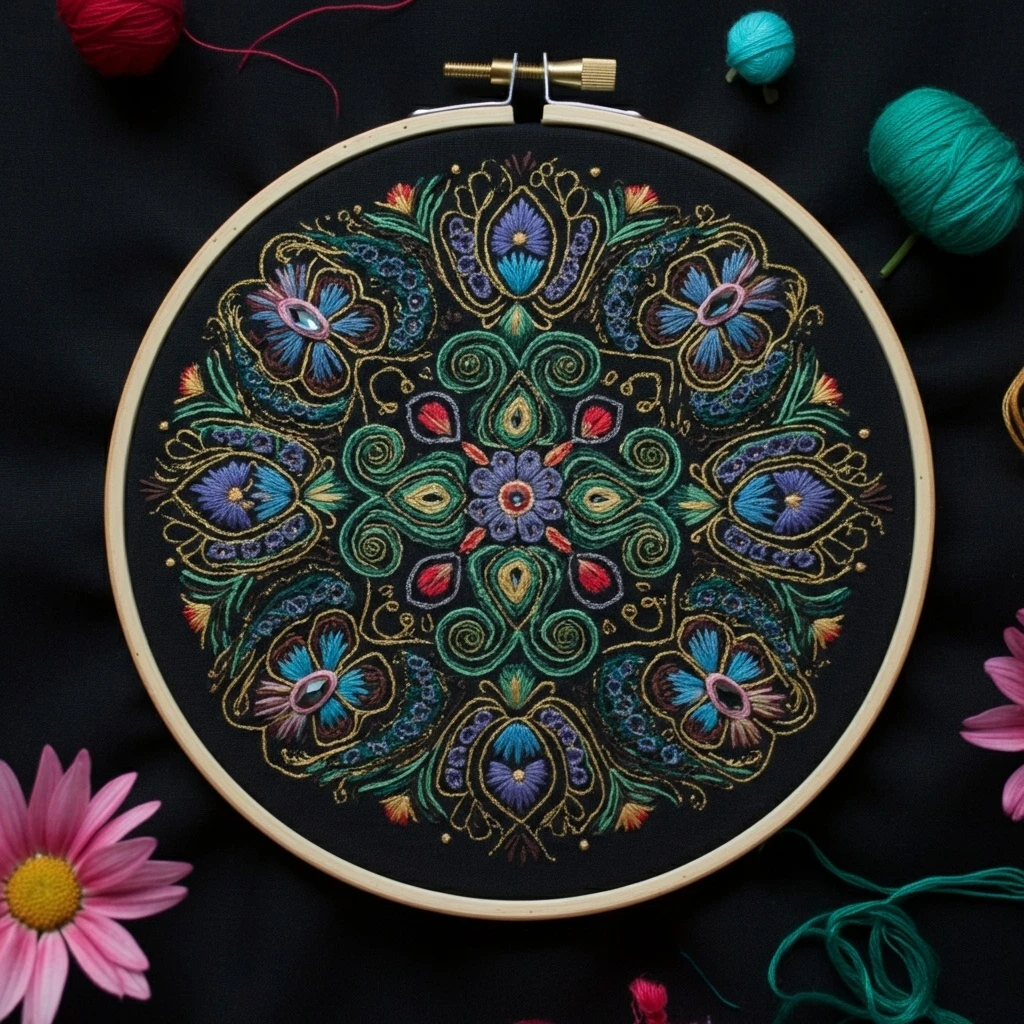
Intricate Hand Embroidered Mandala Hoop Art
A richly patterned hoop built around a symmetrical mandala: jewel-blue and turquoise rings, violet and magenta petal shapes, bright green accents, and small golden details on a pale fabric ground. The finished effect should feel balanced, meditative, and ornamental, with crisp repeated stitches rather than heavy filled areas.
Design color read
The reference reads as a detailed mandala hoop with repeated petal, teardrop, dot, and ring motifs. The strongest colors are cool turquoise and blue, supported by violet-purple, bright pink, leafy green, and small warm yellow-gold accents. The pale fabric background is important: it gives the dense geometry breathing room and makes the saturated floss colors look cleaner.
For the most polished finish, keep each ring consistent: the same motif should use the same stitch direction, strand count, and color order all the way around the circle.
Thread-count snapshot
- Fine outlines: 1 strand for tiny inner details; 2 strands for primary circular borders.
- Petals and teardrops: 2 strands for satin, fishbone, or long-and-short fill.
- Dots and beads of color: 1-2 strands for French knots depending on how raised you want them.
- Outer ring accents: 2 strands for visibility, especially if the hoop is larger than 6 inches.
Suggested DMC palette
Stitch suggestions
Best order of work
Blending & shading guidance
Blue and turquoise motifs
For larger teardrops, use 995 near the base, 996 through the center, and 3846 on the tip. Turquoise petals can shift from 3844 at the lower edge to 3845 in the body and 3811 or 3846 as a fine highlight. Keep these transitions radial so each shape points neatly toward or away from the center.
Purple and pink motifs
Use 552 as the main violet, 333 for a shaded base, and 554 on the light-facing edge. For pink sections, blend one strand of 602 with one strand of 604 where you want softer petal tips. A few tone-on-tone backstitches in 602 or 333 are enough to define the inner petal creases.
Gold accents
Use 726 for the bright top of knots or tiny straight stitches, then add 742 to the lower side of larger gold areas. This small warm value shift makes the center look illuminated without needing metallic thread.
Mandala ring map
Outlining details
Use tone-on-tone outlines rather than a single dark color throughout. Outline turquoise with 3844, blue with 333 or 995, violet with 333, pink with 602, and green with 699. Reserve 310 for only the tiniest center dots or places where the original design has very crisp dark details. For circular borders, split stitch gives the cleanest curve; whipped backstitch adds polish where a ring needs extra emphasis.
Texture suggestions
- Use satin stitch direction as a design feature: every petal should radiate cleanly from the center.
- Add French knots in matching pairs or sets of four so the symmetry stays intentional.
- Vary texture by alternating smooth satin shapes with raised knots and looped chain rings.
- Use seed stitches only in small spaces; dense filler can distract from the crisp geometry.
- Keep the back tidy and avoid long thread carries, especially on pale fabric where shadows may show through.
Beginner-friendly practical tips
- Use a water-soluble pen and a ruler to mark light axis lines through the center before transferring the details.
- Start with the center and work outward; this prevents later rings from crowding the design.
- Cut shorter floss lengths than usual. Repeated tight curves can roughen thread quickly.
- Use a hoop that keeps the fabric drum-tight; loose fabric makes circular outlines wobble.
- Take small breaks to view the design from arm's length. Symmetry issues are easier to spot from a distance.
Thread-count refinements
- 1 strand: fine ring outlines, small backstitch veins, delicate seed stitches, and tiny accent dots.
- 2 strands: most petals, teardrops, detached chains, and visible outer-ring stitches.
- 3 strands: optional for large French knots or raised central dots in bigger hoop sizes.
- Blends: one strand light plus one strand medium is ideal for smooth mandala gradients without needing many extra colors.
Compact stitch plan
Center: satin circle or woven wheel in 726/742 with tiny dark accents. Inner petals: satin or fishbone stitch in 552, 554, 3845, and 3846. Middle rings: split stitch, whipped backstitch, and detached chain in turquoise, violet, and pink. Outer teardrops: long satin shaded 995 to 996 to 3846. Dots: French knots in 726, 602, 907, or B5200/3865 if you want pale highlights. Finish: selective tone-on-tone outlines and a tidy outer border.