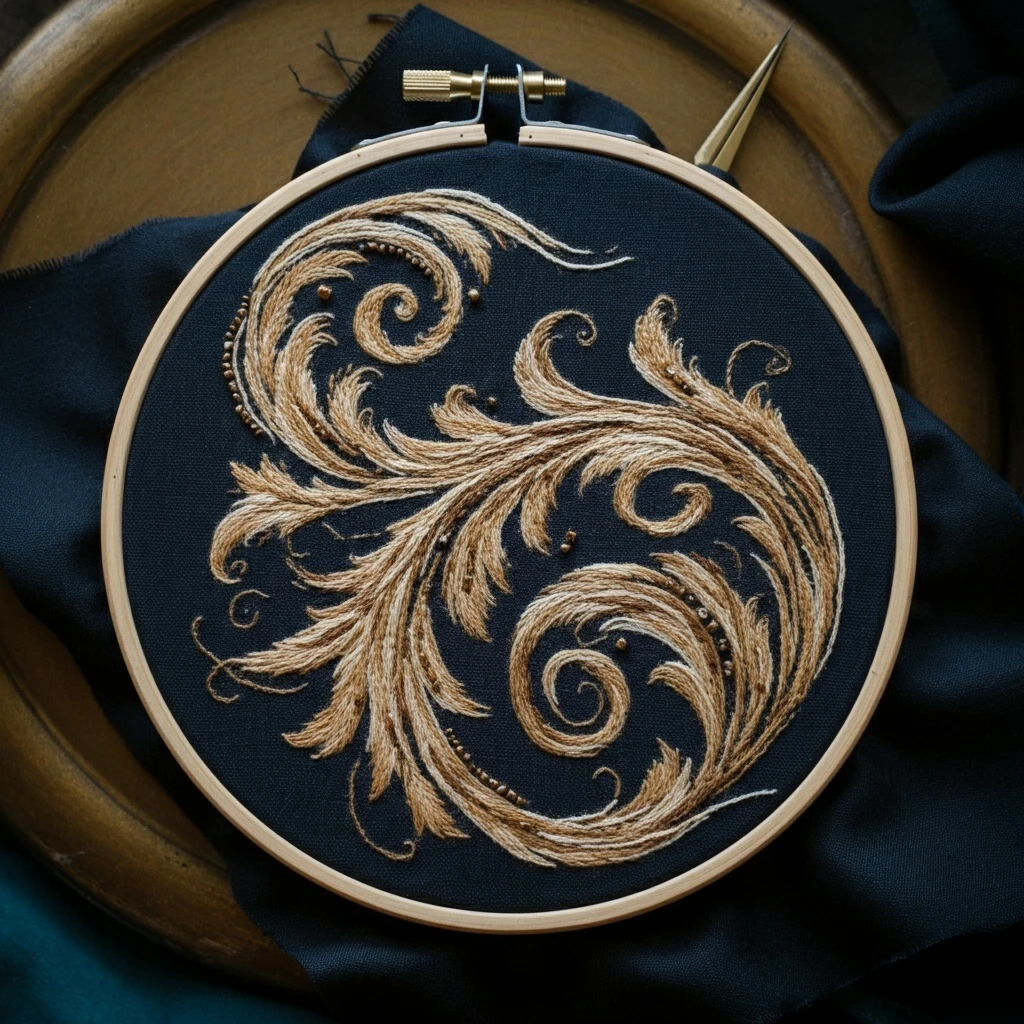

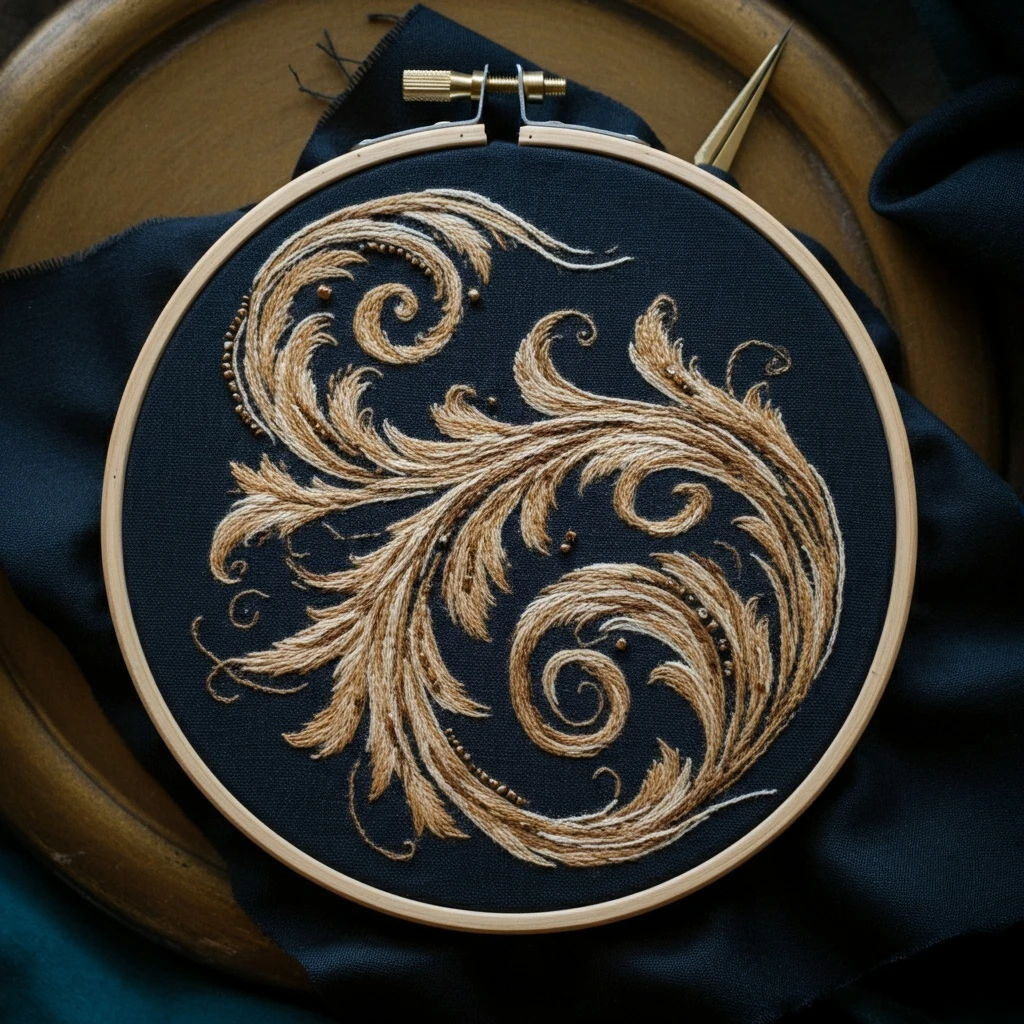
Golden Acanthus Scrollwork on Black Fabric
A dramatic ornamental design built around curling acanthus leaves, sweeping scrolls, gold highlights, and a deep black ground. The stitching approach should feel rich and architectural: crisp outlines, satin-polished leaf lobes, padded golden ridges, and controlled shading that keeps the scrollwork luminous against dark fabric.
Suggested DMC Color Palette
Use the brightest golds sparingly on the raised ridges and leaf tips, then deepen the curves with ochre, bronze, and brown shadows so the acanthus scrolls keep their dimensional look.
Design Reading
The reference has a high-contrast, ornamental feel: warm metallic-looking scrollwork sits on black fabric, with repeated curls, leaf lobes, tendrils, and symmetrical flourishes. Keep the negative black spaces open and clean; they are what make the gold pattern look refined.
Thread count guide
| Outlines | 1–2 strands for split stitch or back stitch; keep curves smooth and even. |
| Large fills | 2 strands for satin, long-and-short, or fishbone-style leaf sections. |
| Raised ridges | 3 strands for padded satin or couch a 4–6 strand bundle for goldwork effect. |
| Tiny accents | 1 strand for dots, vein flicks, and sharp highlight points. |
Stitch Suggestions by Element
Acanthus leaves
- Long-and-short stitch: shade from 3821 at the tips into 3852, 783, and 782 near the base.
- Fishbone stitch: works well on smaller leaf lobes and naturally creates a center vein.
- Split stitch veins: use 680 or 869 in a single strand for recessed lines.
Scroll bands
- Satin stitch: keep stitches perpendicular to the curve for a polished band.
- Padded satin: add a base layer in 783, then cover with 3852 for raised golden arcs.
- Couched bundles: lay 4 strands of 3852/783 and couch with 3821 for a metallic illusion.
Fine tendrils
- Stem stitch: ideal for flowing vine lines and graceful curls.
- Whipped back stitch: gives a smooth corded edge for formal scrollwork.
Dots and small ornaments
- French knots: use 3821 or 744 with one wrap for small bead-like points.
- Seed stitch: scatter sparingly for aged-gold texture.
Shading & Blending Plan
The palette should read as gold, not yellow. Anchor every bright area with a darker warm brown nearby.
Black Fabric Tips
- Use a light-colored transfer pencil, white carbon paper, or water-soluble stabilizer so scroll lines stay visible.
- Work under strong side lighting; gold shades are easier to separate when the fabric is well lit.
- Keep hands clean and store the hoop covered between sessions to avoid dulling the black ground.
Texture Notes
- Vary satin direction between adjacent leaf lobes to create a carved, dimensional look.
- Use whipped stem stitch around main scrolls for a raised filigree edge.
- Add a few single-strand straight stitches in 744 only at the very end for sparkle.
Beginner Order
- Start with the central scroll or largest leaf so your tension becomes consistent.
- Stitch outlines before fills; they act as rails for neat satin edges.
- Do not carry gold threads across open black areas; start and stop cleanly on the back.
Practical Finishing Guidance
For a crisp display piece, press from the back on a towel so raised stitches are not flattened. If the black fabric shows lint, use a gentle lint roller before framing. A warm wood hoop or dark matte frame will suit the antique-gold acanthus style, while a narrow gold inner mat can echo the stitched highlights without competing with them.
Optional upgrade: replace a few couched highlight lines with DMC Diamant D3821 or metallic gold thread, but keep most stitching in cotton floss for easier control and smoother curves.