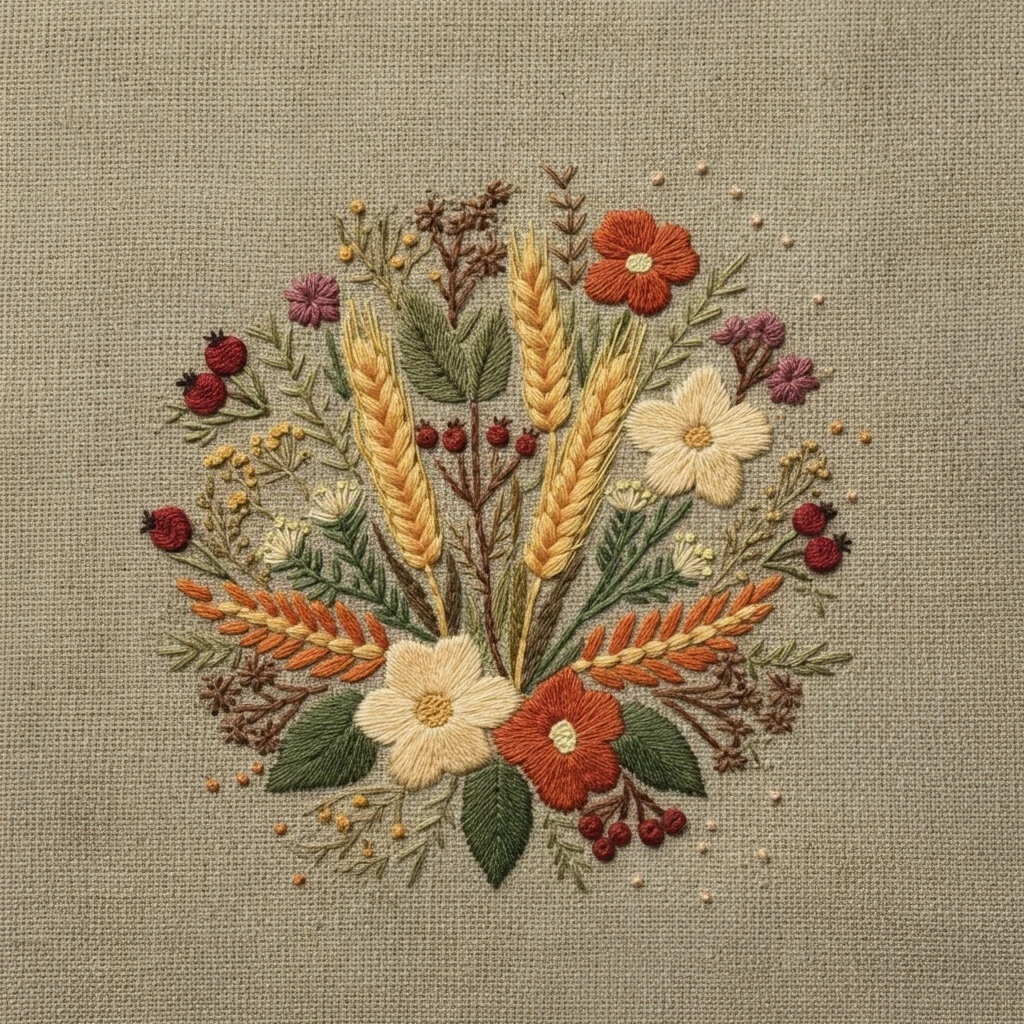

Autumn Harvest Floral
A warm harvest bouquet with wheat heads, cream and rust blossoms, red berries, olive foliage, fine brown twig work, scattered gold seed pods, and a natural linen ground. The palette below keeps the design earthy, textured, and softly dimensional while remaining approachable for beginner stitchers.
Design reading
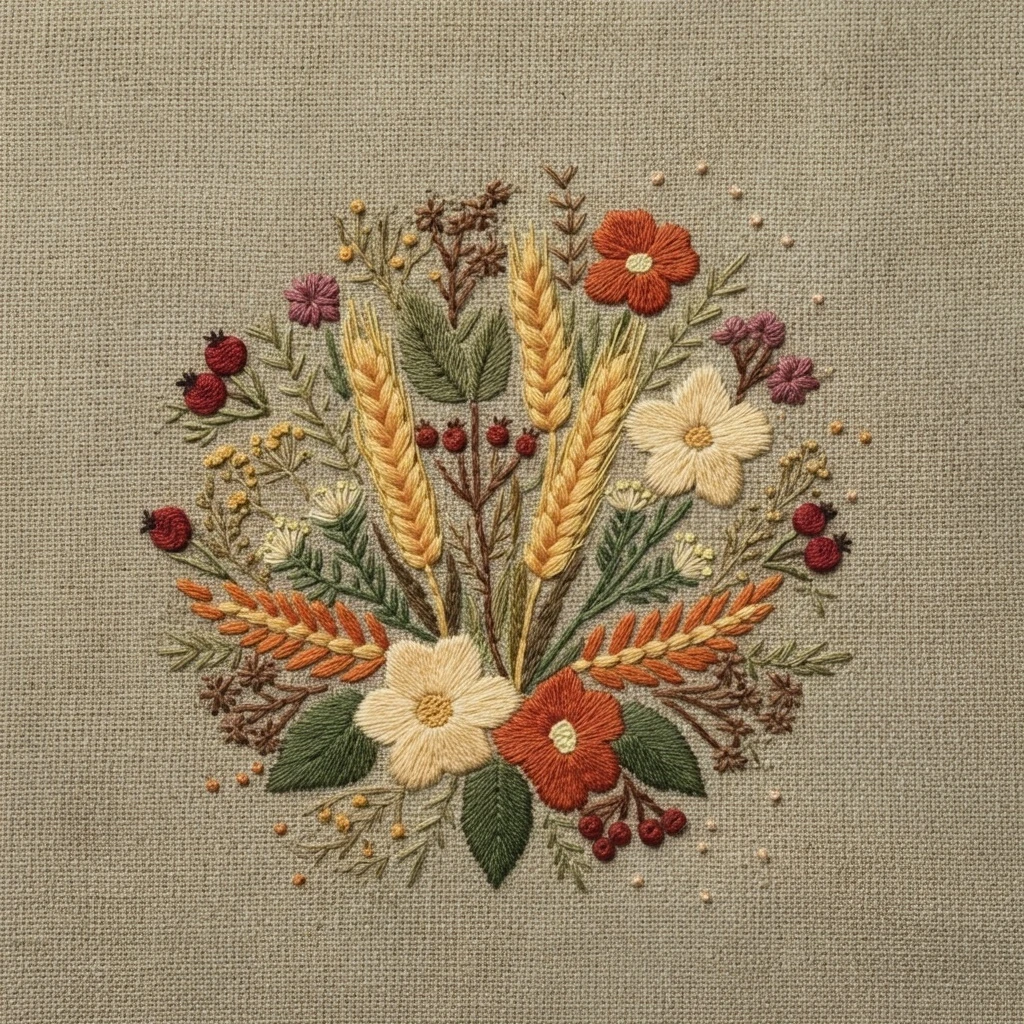
The artwork is arranged as a loose upright bouquet. The eye first lands on the golden wheat, then moves to the rounded cream and rust flowers at the base and right side. Small berries and seed dots create rhythm around the perimeter, while fine green stems keep the composition light instead of crowded.
Keep the stitching direction visible: flower petals should radiate from the center, wheat stitches should stack like small grains, and leaves should angle out from a central vein. This directional stitching is what gives the piece its handworked, dimensional look.
Suggested DMC color palette
Use these colors as a practical floss map rather than a rigid rule. The design benefits from small tonal shifts, especially in wheat, cream petals, berries, and foliage.
Stitch plan by design element
Layered grain heads
Work each wheat kernel with short detached chain, lazy daisy, or fishbone-like pairs. Use 2 strands of DMC 3822 for the first pass, then tuck DMC 782 and 977 at the lower edges for sunlit depth.
Radiating petals
Use long and short stitch with 2 strands. Start at the petal tip and aim toward the center. Blend 746 with 3822 on cream flowers; blend 921 with 920 for rust flowers.
Directional greenery
Use fishbone stitch for larger dark leaves with DMC 934 and a few 3012 highlights. For fine sprigs, use 1 strand stem stitch and tiny straight stitches.
Raised red accents
Use padded satin stitch or clustered French knots in DMC 815. Place DMC 814 on one side for shadow and a small 746 or 3822 dot for a highlight.
Fine brown structure
Use 1 strand of DMC 898 in back stitch, stem stitch, or split stitch. Keep these lines slender so they support the bouquet without overpowering the flowers.
Scattered texture
Use French knots or colonial knots in DMC 782, 977, and 3822. Vary between single-wrap and double-wrap knots to create natural seed-size variation.
Thread-count guidance
- 1 strand: twig outlines, thin stems, tiny leaf veins, small branch details, and delicate filler lines.
- 2 strands: most petals, wheat kernels, medium leaves, rosehip stems, and general satin or long-and-short filling.
- 3 strands: only for plumper berries, dense flower centers, or statement seed knots where extra lift is desired.
- Separate and recombine strands before stitching to reduce twisting and help the satin areas lie smoother.
Blending ideas
- For creamy petals, thread one strand DMC 746 with one strand DMC 3822 for a warm ivory transition.
- For wheat, alternate 3822, 782, and 977 rather than filling each stalk in a single flat color.
- For rust flowers, use 921 at the petal tips and 920 close to the center to create a cupped shape.
- For leaves, mix 934 with 3012 in selected stitches so the darkest leaves still catch light.
Outlining, shading, and texture notes
| Area | Recommended approach | Practical note |
|---|---|---|
| Flower edges | Avoid heavy outlines; use subtle split stitch only where petals need definition. | Let the petal direction do most of the outlining so the flowers stay soft. |
| Flower centers | Small French knots, seed stitch, or tight satin dots in 782 and 898. | Keep centers slightly raised; this helps the surrounding petals look dimensional. |
| Wheat stalks | Stem stitch for long stems, detached chain or short straight stitches for kernels. | Work from the bottom upward so each kernel overlaps naturally. |
| Leaves | Fishbone stitch for broad leaves; straight stitches for narrow botanical sprigs. | Angle both sides toward the central vein for a realistic leaf texture. |
| Berries | Padded satin, woven wheel, or grouped knots. | Use the darkest red on the lower-left or underside to suggest round form. |
| Fine filler | Single-strand back stitch, fly stitch, and French knots. | Leave breathing room between filler motifs; the linen background is part of the design. |
Beginner-friendly stitching sequence
Finishing tips
- Press face down on a clean towel so raised knots and padded berries are not flattened.
- Use short thread lengths, about 35–45 cm, to keep golden and cream shades from looking fuzzy.
- Trim traveling threads on the back when moving between pale flowers and dark leaves.
- For a hoop display, choose a warm wood hoop that complements the wheat and rust tones.
Substitution notes
- If DMC 934 feels too dark, replace part of it with DMC 3363 Pine Green Medium.
- If DMC 921 is too bright, soften it with DMC 922 Copper Light or use fewer rust highlight stitches.
- If the linen is very dark, increase the use of DMC 746 and 3822 so the cream flowers remain visible.
- For a more vintage look, reduce saturated reds and use DMC 816 Garnet instead of bright berry shades.