
DMC color palette · stitch planning · finishing notes
Adorable Corgi Hoop Art
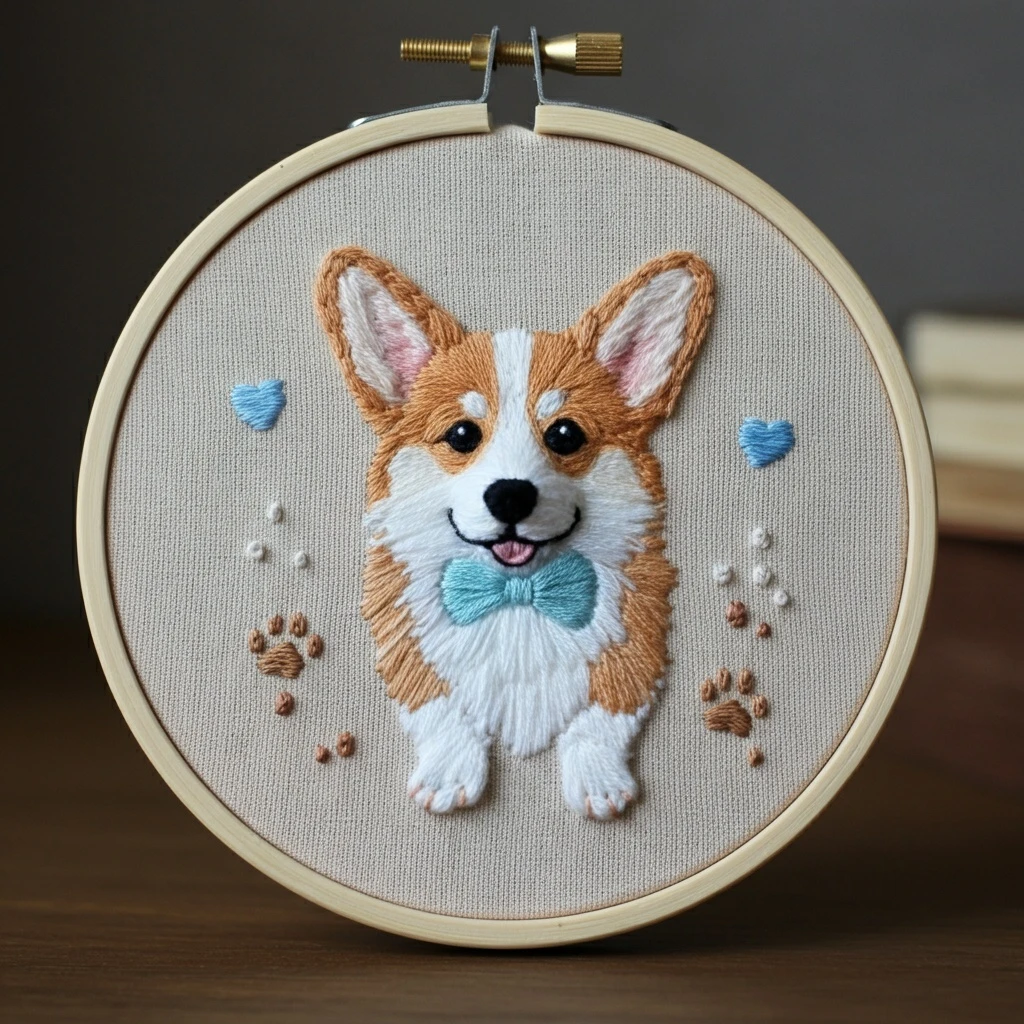
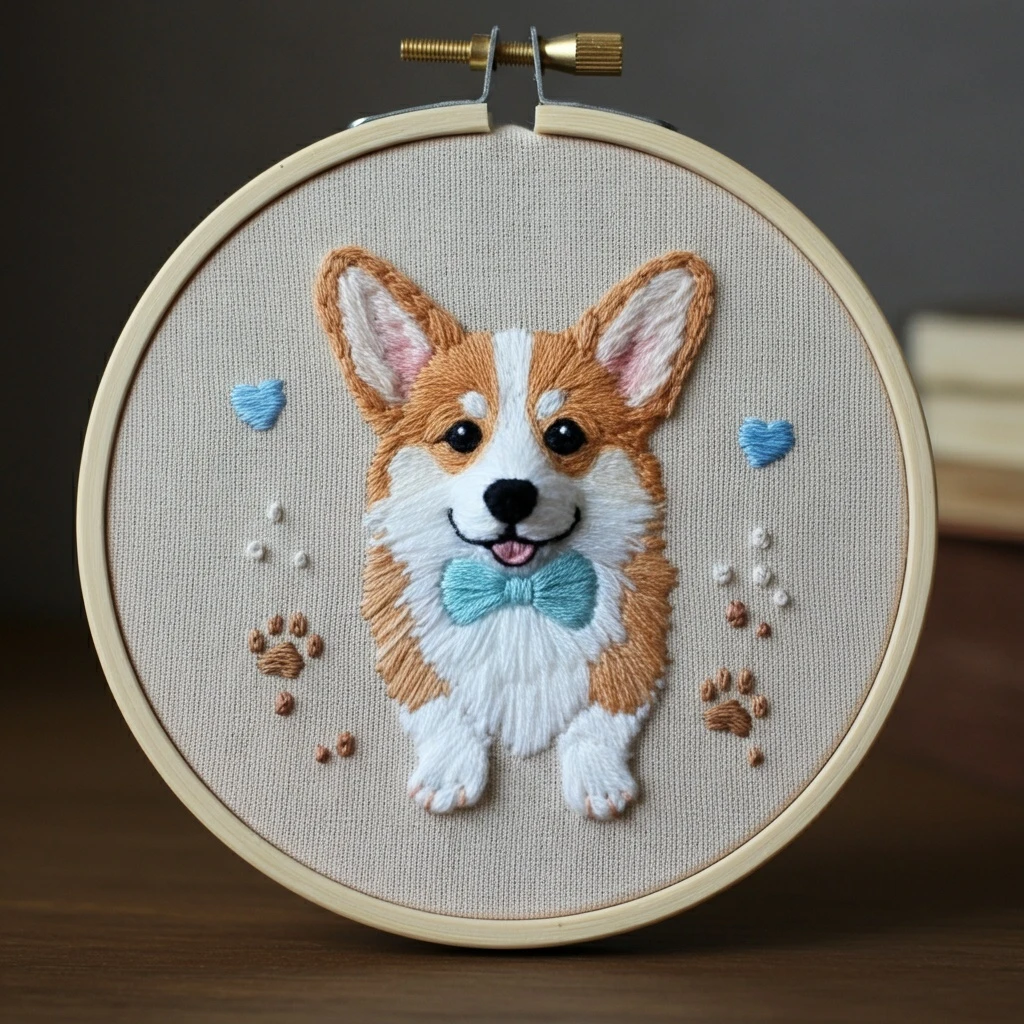
A cheerful pet portrait guide inspired by a smiling corgi with warm caramel fur, plush white chest and muzzle, pink inner ears, glossy black eyes, a sky-blue bow tie, small hearts, and scattered paw prints.
Design Read: What to Capture
Visual mood
The design is playful, friendly, and soft. The corgi face and upright ears dominate the hoop, while the blue bow tie, floating hearts, pale dots, and paw prints add a sweet decorative frame without clutter.
Embroidery priorities
Make the fur directional and plush. The warm tan coat should transition into white muzzle, chest, and paws with soft feathered edges; eyes and nose need glossy dark contrast; the bow should be clean and slightly dimensional.
Suggested DMC Palette
The palette focuses on corgi caramel browns, creamy whites, soft gray shadows, blush-pink ears and tongue, glossy black features, cool blue bow and hearts, and warm paw-print browns.
Motif-by-Motif Stitch Map
| Area | Suggested stitches | Thread count | Notes |
|---|---|---|---|
| Tan fur | Long-and-short stitch, split stitch underlay | 1 strand for shading, 2 for larger fills | Follow fur growth from forehead outward, ears downward, and cheeks toward the muzzle. |
| White muzzle and chest | Long-and-short stitch, satin stitch in small sections | 1-2 strands | Use 3865 as the base and 762 for tucked shadows. Add B5200 only on the brightest central strokes. |
| Ears | Long-and-short stitch, padded satin for inner ear | 1 strand | Work tan outer rims first, then pink inner ear, then add white and tan wisps over the edge. |
| Eyes | Satin stitch, tiny straight stitch highlight | 1 strand | Use 310 or 3371 for glossy eyes. Keep the white highlight tiny and placed consistently. |
| Nose and smile | Padded satin, split stitch, backstitch | 1-2 strands nose, 1 strand mouth | Pad the nose lightly for shine, then outline the smile with a relaxed curved backstitch. |
| Blue bow tie | Satin stitch, long-and-short stitch, backstitch | 2 strands fill, 1 strand details | Stitch each bow wing from outer edge toward the knot. Use dark teal in the center crease. |
| Hearts | Satin stitch, split-stitch outline | 1-2 strands | Keep the heart edges smooth and rounded. A single dark stitch on one side creates a folded look. |
| Paw prints | Satin stitch or French knots | 1-2 strands | Use oval satin pads for the main paw and small knots or tiny satin ovals for toes. |
Blending & Shading Ideas
Caramel fur
Blend 3826 + 977 for sunny cheek and ear highlights, then place 780 in small shadow strokes near the edges.
White fur depth
Use 3865 as the main white, add 762 under the chin and between legs, and finish with a few B5200 strokes.
Ears and tongue
Layer 818 lightly in the ear centers and use 3713 for the tongue, with a darker single stitch under the mouth line.
Bow dimension
Use 3846 as the bright blue base, 3761 for top highlights, and 3844 in the center knot and fold lines.
Eyes and nose
Use 310 for the darkest fill, then soften edges with 3371. Add the tiniest B5200 highlight last.
Paw prints
Use 841 for most pads and add one lower-edge stitch of 838 on each larger print.
Outlining & Fine Details
Fur outline
Avoid a heavy dark outline around the whole dog. Use tan and cream split stitch along the silhouette, reserving dark brown only for small separations.
Face expression
The smile line should be one strand and slightly curved. Keep the tongue small so it supports the expression instead of dominating it.
Bow folds
Backstitch only the center crease and lower fold lines; too much outline can make the bow look cartoon-flat.
Paw print spacing
Place paw prints asymmetrically on each side. Slightly different dot sizes make them feel handmade and playful.
Practical Embroidery Tips
- Separate floss strands before recombining; fur shading depends on smooth, untwisted thread.
- Keep stitches short around the eyes, nose, and mouth so the expression stays crisp.
- For fluffy chest fur, overlap cream stitches in uneven lengths instead of making a hard scalloped edge.
- Do not carry dark thread behind white fur areas; it can show through light fabric.
- Use a laying tool or needle tip to smooth longer bow and ear stitches.
- Finish by trimming stray fibers and pressing from the reverse on a towel to preserve raised nose and bow texture.
Quick Starter Plan
For a simplified version
Use 3826 for all tan fur, 3865 for white areas, 3846 for bow and hearts, 310 for face details, 818 for ears, and 841 for paw prints. Use mostly satin and backstitch.
For a dimensional version
Build the fur with one-strand long-and-short shading, add padded satin to the nose and bow knot, feather tan and cream transition edges, and add tiny highlights only at the end.