
Autumn Floral Harvest
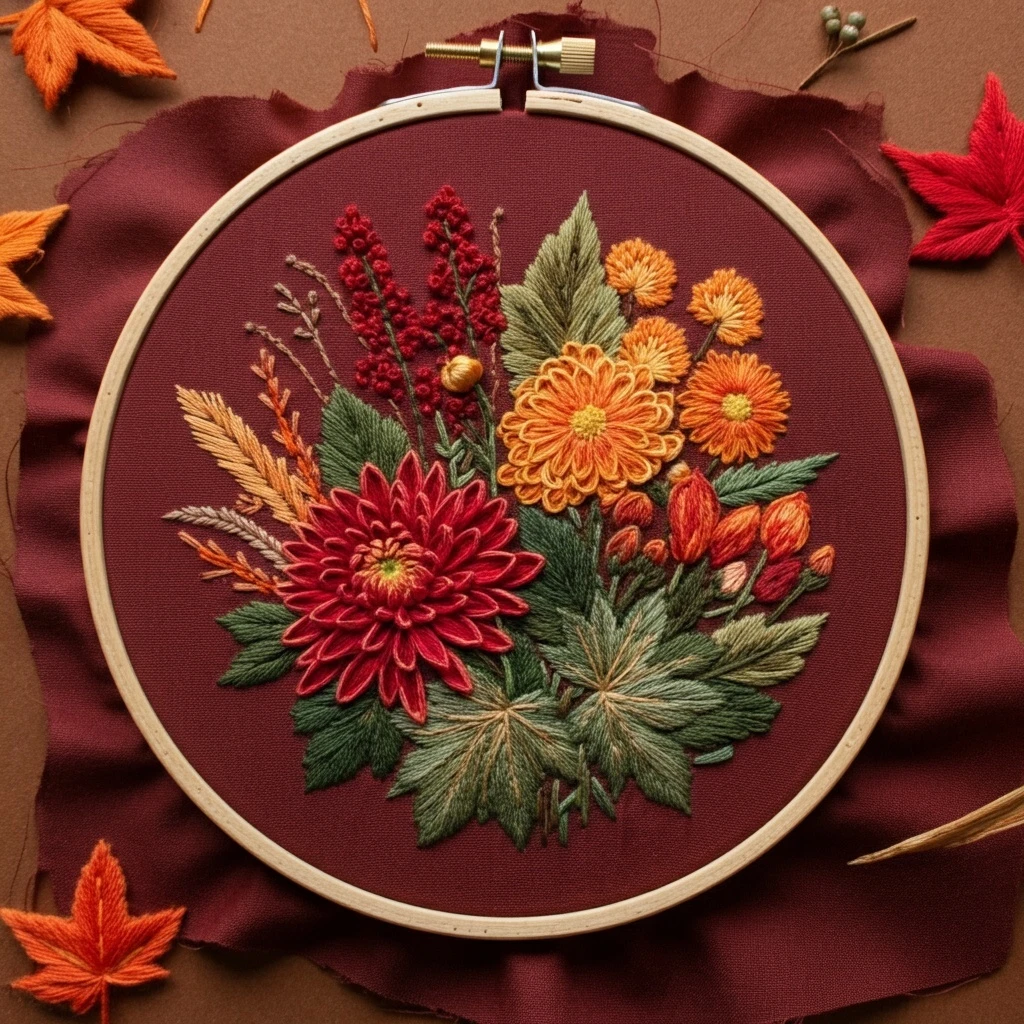
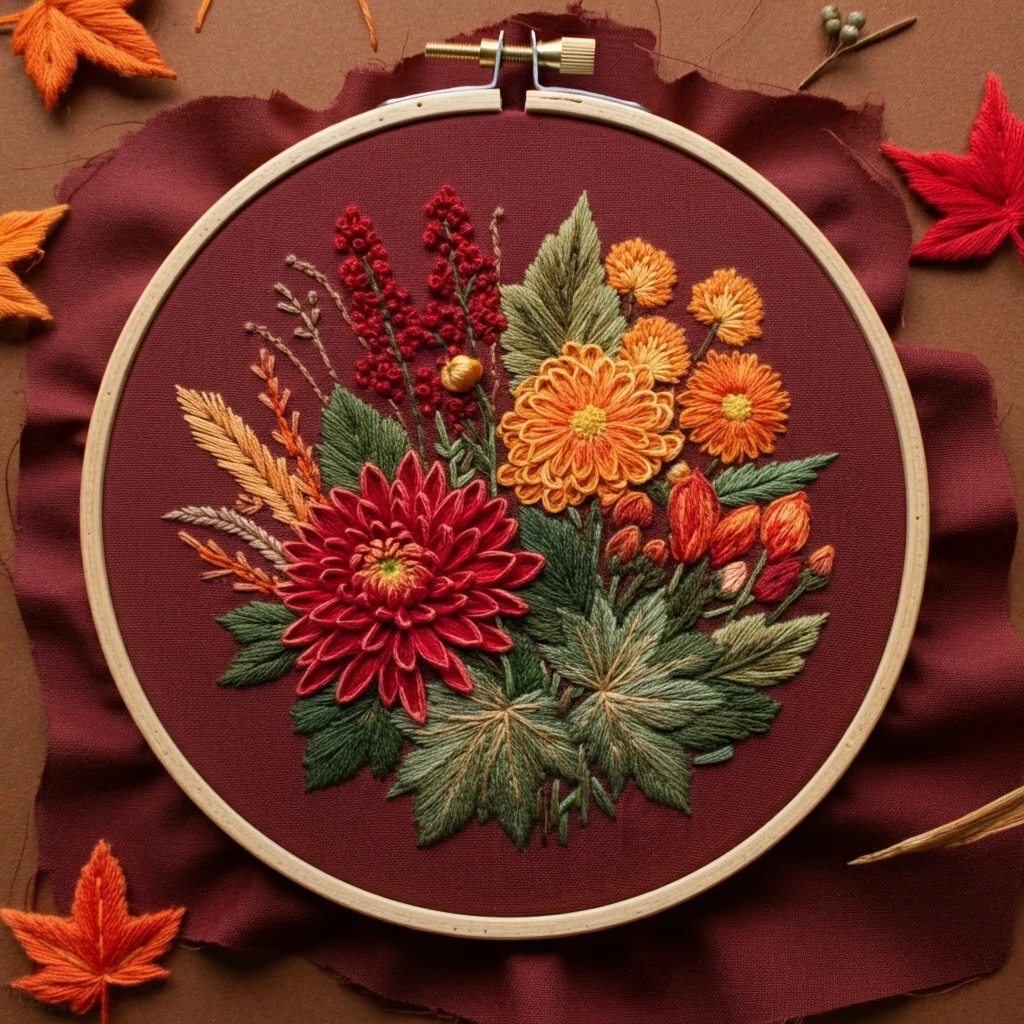
A richly textured hoop design with a burgundy ground, layered dahlias and marigold-like blossoms, berry stems, wheat sprays, rose hips, and deep green harvest foliage.
The design reference centers on a warm autumn bouquet: a deep red focal dahlia, golden-orange flowers, clustered burgundy berries, muted sage leaves, dark evergreen foliage, and wheat-toned grasses arranged in a compact oval composition.
This guide translates those visual elements into a practical DMC floss plan with stitch types, thread counts, color blending, outlining, shading, and finishing suggestions for a dimensional hand-embroidery interpretation.
Design Analysis
The artwork combines floral embroidery and harvest symbolism. Its strongest features are the high-contrast burgundy backdrop, red dahlia petals, golden autumn blooms, knot-like berry clusters, radiating leaf veins, and feathery wheat sprays that create height and movement.
Dominant color story
Wine red, cranberry, orange, marigold gold, pumpkin, dark forest green, muted sage, wheat beige, and soft tan highlights.
Key design elements
Large dahlia-style focal flower, orange daisy blooms, berry plumes, rose hips, wheat stalks, broad veined leaves, and dark supporting stems.
Texture priorities
Dimensional petal edges, raised berry clusters, fine grass/wheat lines, soft leaf shading, and clear separation between warm flowers and cool foliage.
Suggested DMC Color Palette
The palette below echoes the reference image’s harvest warmth and botanical depth: rich reds for the dahlia and berries, gold-orange shades for smaller blooms, several greens for dimensional foliage, and wheat neutrals for grasses and veining.
| Design area | Primary DMC shades | How to use them |
|---|---|---|
| Red focal dahlia | 902, 815, 321, 666 | Start with 902 at the petal bases, layer 815 through the mid-petals, then touch 321 and 666 along raised edges and petal tips. |
| Orange/gold flowers | 919, 920, 721, 742, 743, 744 | Use copper-orange for shadowed petal bases and gold/yellow for flower centers and outer glow. |
| Berry stems | 902, 815, 321, 310 | French knots or colonial knots in layered red tones; add tiny dark knots at the lower side of clusters for depth. |
| Leaves | 934, 936, 469, 3012, 3013 | Build from dark central shadows outward to sage highlights, keeping veins directional and slightly varied. |
| Wheat & dry stems | 3021, 3828, 977, 738 | Use fine straight stitches and detached chain stitches for grain heads, with pale tan highlights at the tips. |
Stitch Types & Recommended Thread Counts
The reference has lots of visible stitch texture, so combine smooth filled areas with raised knots, looped petals, and fine linear stems.
Focal red dahlia
Best stitches: long-and-short stitch, satin stitch, fishbone-style petal fills, or raised woven petals.
Recommended strands: 2 strands for most petals; 1 strand for inner separations and final highlights.
Petal directionStrong contrastFine edge highlightsOrange daisy/marigold blooms
Best stitches: lazy daisy, detached chain, woven wheel, or radiating satin stitches.
Recommended strands: 2–3 strands for looped petals; 1 strand for tiny shadow lines.
Use 743/744 for the centers and orange shades around the petal ring.
Berry clusters
Best stitches: French knots, colonial knots, or padded satin dots.
Recommended strands: 2–3 strands for standard knots; 4–6 strands for bold raised berries.
Vary red tones within the cluster so the berries do not look like flat beads.
Leaves
Best stitches: fishbone stitch, long-and-short stitch, leaf stitch, or split stitch veins.
Recommended strands: 2 strands for leaf fill; 1 strand for veins and final sage highlights.
Work from the center vein outward to keep the leaf structure clean.
Wheat and grasses
Best stitches: straight stitch, stem stitch, couching, and small detached chain stitches.
Recommended strands: 1–2 strands.
Keep these airy and slightly uneven for a natural dried-grass effect.
Stems and fine branches
Best stitches: stem stitch, split stitch, backstitch, or whipped backstitch.
Recommended strands: 1 strand for twig tips; 2 strands for main stems.
Use dark green-brown tones rather than black for a softer botanical finish.
Blending & Shading Ideas
Use blended needles and short overlapping stitches to keep the harvest palette rich and natural. Most elements should move from dark, grounded bases toward warm, light-catching tips.
Red dahlia blend path
- Deepest folds: 902 with a few 310 accents only where petals overlap.
- Main shadow: 815 worked from the petal base outward.
- Petal body: 321 layered over 815 with tapered long-and-short stitches.
- Highlight edges: 666 used sparingly on upper petal ridges.
Golden flower blend path
- Warm base: 919 or 920 at petal roots.
- Main orange: 721 through the middle of each petal.
- Light tips: 742 on petal ends and upper curves.
- Centers: 743 with tiny 744 accents for sparkle.
Useful mixed-needle blends
- 1 strand 902 + 1 strand 815 for deep red floral shadow.
- 1 strand 815 + 1 strand 321 for smooth crimson transitions.
- 1 strand 920 + 1 strand 721 for pumpkin-orange petals.
- 1 strand 742 + 1 strand 743 for bright marigold edges.
- 1 strand 469 + 1 strand 3012 for muted sage highlights.
Leaf shading guidance
Use 934/936 near bases and under overlapping flowers. Move through 469 for leaf body, then reserve 3012 and 3013 for upper veins and tips. On broad leaves, alternate long stitches in two close greens to avoid a flat block of color.
Outlining & Fine Details
The composition has strong color contrast already, so outlines should clarify the bouquet without making the flowers look cartooned.
Where to outline
- Focal dahlia petal bases and a few outer petal rims.
- Edges where red petals meet burgundy fabric.
- Leaves that sit behind flowers but need shape separation.
- Long wheat stems and berry stalks to preserve vertical rhythm.
Best outline colors
- DMC 902 for warm red floral contours.
- DMC 934 for deep leaf edges.
- DMC 3021 for wheat stems and natural twig lines.
- DMC 310 only for the darkest tiny separations.
Recommended outline stitch
Use 1 strand of split stitch or backstitch for detailed contours. For stems, use 1–2 strands of stem stitch so the line feels botanical rather than rigid.
Dimensional accents
Use raised knots for berries, padded centers for orange blossoms, and a few tiny straight stitches in 738 or 744 to add light-catching points after all main stitching is complete.
Practical Embroidery Tips
1) Transfer the main shapes cleanly
Mark petal direction, leaf center veins, berry stems, and wheat stalks. Direction marks are more important than drawing every tiny stitch.
2) Work the bouquet in layers
Start with wheat, fine stems, and background leaves. Then stitch large leaves, focal flowers, berry knots, and final light details.
3) Keep berries varied
Mix 902, 815, and 321 within clusters. Add slightly larger knots in the center and smaller knots at the tips for a natural taper.
4) Avoid bulky flower centers
Use 1–2 strands for small center stitches, then add a limited number of knots. Too much thread in centers can distort surrounding petals.
5) Let the burgundy ground show
Do not overfill every gap. The dark fabric is part of the design and helps the warm flowers glow.
6) Balance warm and cool areas
After the red and orange flowers are complete, add enough green leaf texture to anchor them. The greenery prevents the bouquet from feeling too hot or crowded.