
Enchanted Forest Fungi And Flora
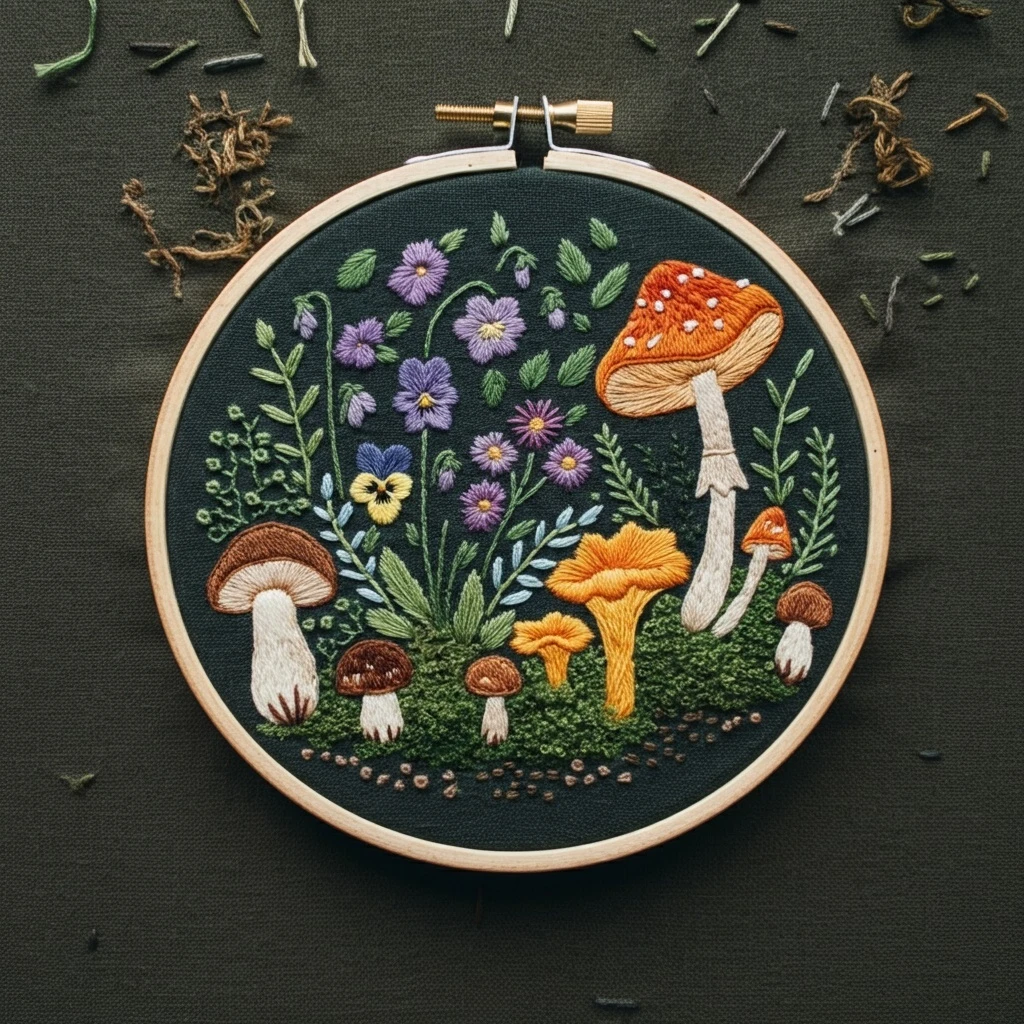
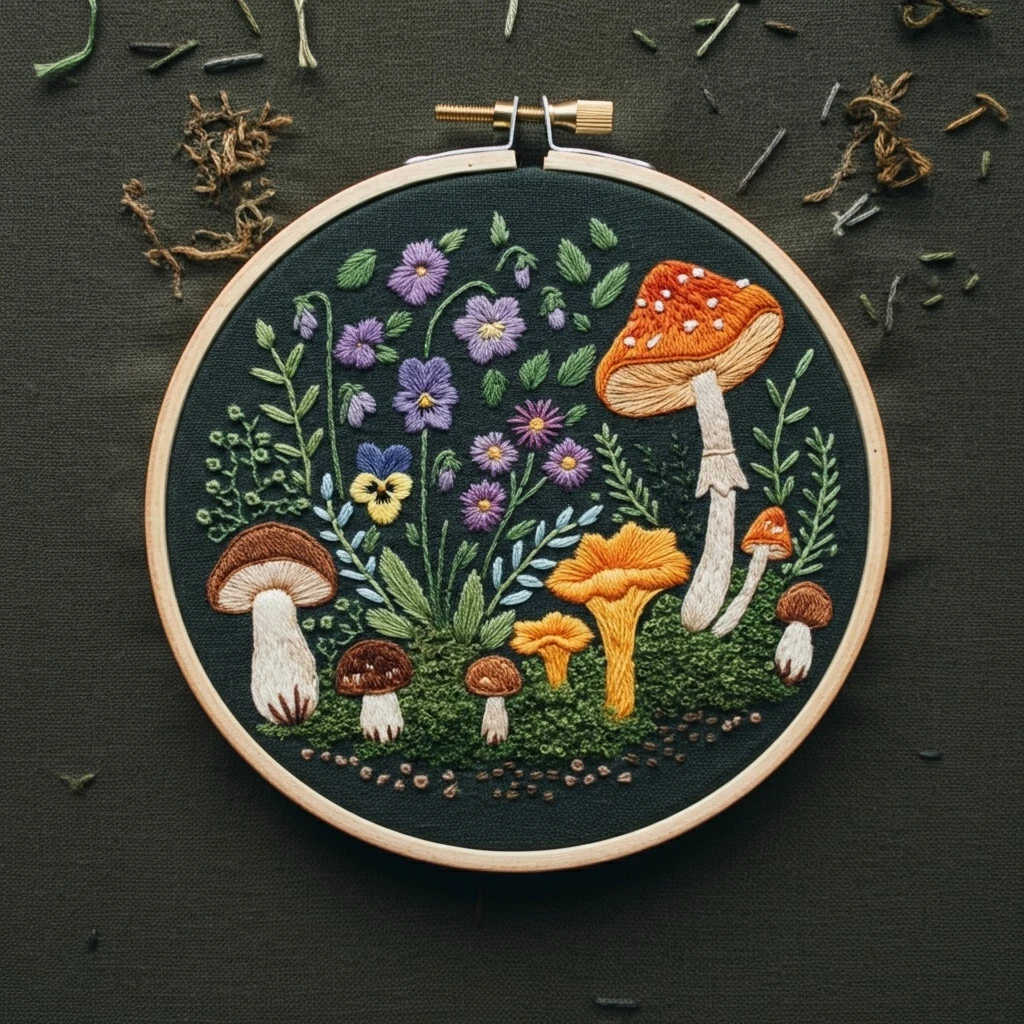
A woodland hoop centered on layered mushrooms, curling foliage, tiny wildflowers, mossy stems, and magical forest-floor texture. The palette leans into earthy bark browns, deep moss greens, red toadstool caps, creamy fungi stems, golden flower centers, and soft violet-pink accent blooms.
Likely DMC Color Palette
Palette based on the visible enchanted forest-floor theme: red mushroom caps, warm cream stems, layered moss greens, brown soil shadows, leafy sprigs, small meadow flowers, and muted magical accents. Treat these as practical DMC substitutions rather than exact manufacturer color sampling.
Stitching Suggestions
Work from the back layer forward: soil and dark moss first, then large mushroom stems and caps, then leaves, vines, small flowers, knots, and fine outlining. This order keeps the fungi dimensional and prevents small floral details from being buried under later stitches.
| Element | Best Stitch Types | Practical Notes |
|---|---|---|
| Large mushroom caps | Long and short stitch, satin stitch, split stitch outline | Use 2 strands. Begin with the cap outline, fill from the center outward, and shade the lower edge with terra-cotta or brown for rounded volume. |
| Mushroom stems | Split stitch, long and short stitch, contour satin | Use cream and tan in vertical curved strokes. Keep the stitches following the stem bend so the fungi look plump rather than flat. |
| Gill lines and underside shadows | Backstitch, straight stitch, couching | Use 1 strand in dark brown. Space lines unevenly and taper them toward the stem for a natural underside. |
| Mushroom spots | French knots, colonial knots, tiny satin dots | Add spots last in winter white. Vary knot size by wrapping once or twice; avoid perfectly even spacing. |
| Moss patches | Seed stitch, Turkey-work accents, French knots | Use dark green first, then mid-green, then sage highlights. Short random stitches create a cushioned forest-floor texture. |
| Fern leaves | Fishbone stitch, fly stitch, detached chain | Use 1-2 strands. Place darker stitches at the base of each frond and lighter stitches on the outward tips. |
| Curling vines and stems | Stem stitch, whipped backstitch, couching | Use 1 strand for fine lines and 2 strands for bolder foreground stems. Whip a lighter green over dark stem stitch for a raised vine. |
| Small flowers | Lazy daisy, woven wheel, satin stitch, French knots | Use pink, violet, cream, and golden yellow in scattered clusters. Keep flower centers as knots to add sparkle without bulk. |
| Ground and leaf litter | Seed stitch, straight stitch, split stitch | Scatter browns and tans under the fungi. Leave small linen gaps so the ground reads textured, not overfilled. |
| Final outlines | Backstitch, split stitch, single-strand straight stitch | Outline only the key overlaps: cap rims, stem edges, front leaves, and a few deep shadows. Over-outlining will reduce the soft enchanted look. |
Thread Count, Blending & Shading
Thread-count guide
Use 2 strands for mushroom caps, stems, larger leaves, and main moss clumps. Use 1 strand for gill lines, vine tendrils, tiny leaf veins, and all delicate outlines. Use 3 strands only for raised knots, berry-like dots, or extra-padded flower centers.
Cap shading blend
Blend one strand DMC 3777 with one strand DMC 347 for a lively red-rust cap. Add DMC 801 at the lower rim or where one mushroom tucks behind another.
Cream stem depth
Work DMC 738 as the base, add DMC 3865 along the light-facing edge, and use DMC 975 in narrow curved strokes near the underside. This creates rounded stems without complicated shading.
Mossy color movement
Alternate DMC 895, 469, and 3052 in short, broken stitches. Put the darkest stitches under caps and leaves, then place sage highlights only where moss would catch light.
Outlining, Texture & Practical Tips
- Keep the fungi rounded: curve stitches around the cap edge rather than pulling all stitches straight across. Direction is what makes a mushroom feel dimensional.
- Use knots selectively: French knots are perfect for spores, flower centers, dew, and mushroom spots, but too many knots can make the design bulky. Cluster them in focal areas.
- Control dark thread: Use DMC 3371 and 310 only in the deepest crevices, small separations, and focal outlines. The design should stay earthy and soft, not comic-book black.
- Leave breathing room: A few open linen spaces between moss stitches and flowers help the forest floor look natural.
- Secure dense areas: When working knots and Turkey-work texture, avoid long carries on the back. Short anchored starts and stops keep the fabric smooth.
- Needle choice: A size 7 or 8 embroidery needle works well for 2 strands; switch to a sharper, smaller needle for single-strand gills and tendrils.
Suggested Stitching Order
- Transfer the major mushroom shapes, cap rims, stems, leaf clusters, and floral placements with a light hand.
- Stitch the darkest ground shadows and background moss patches first.
- Fill the main mushroom stems, then add tan and cream highlights while following the stem curves.
- Complete the mushroom caps with red-rust shading, adding darker lower rims before white spots.
- Add ferns, leaves, vines, and small stems, varying greens to build depth.
- Stitch flowers, seed knots, mushroom spots, and magical highlight dots.
- Finish with single-strand gill lines, selective outlines, and final tiny highlights.