
DMC Palette & Hand Embroidery Notes
Autumn Hedgehog
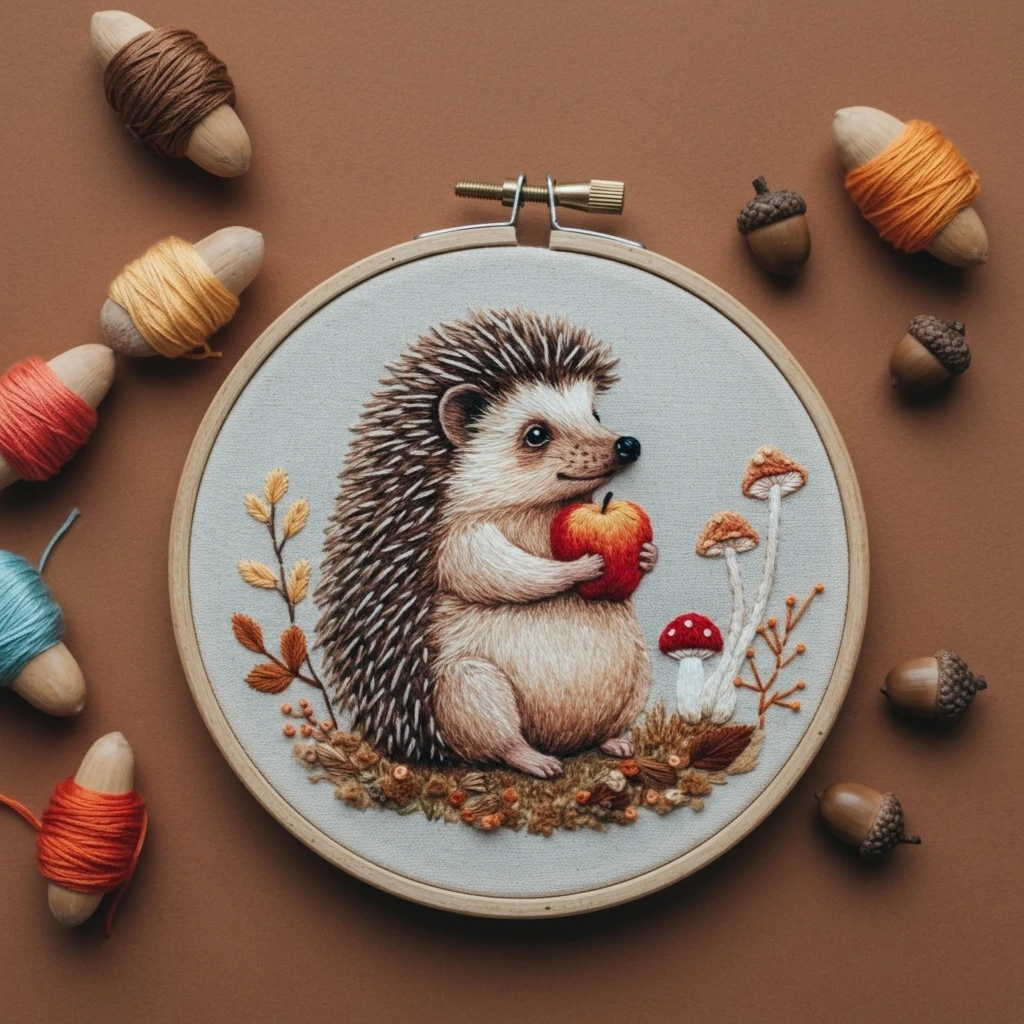
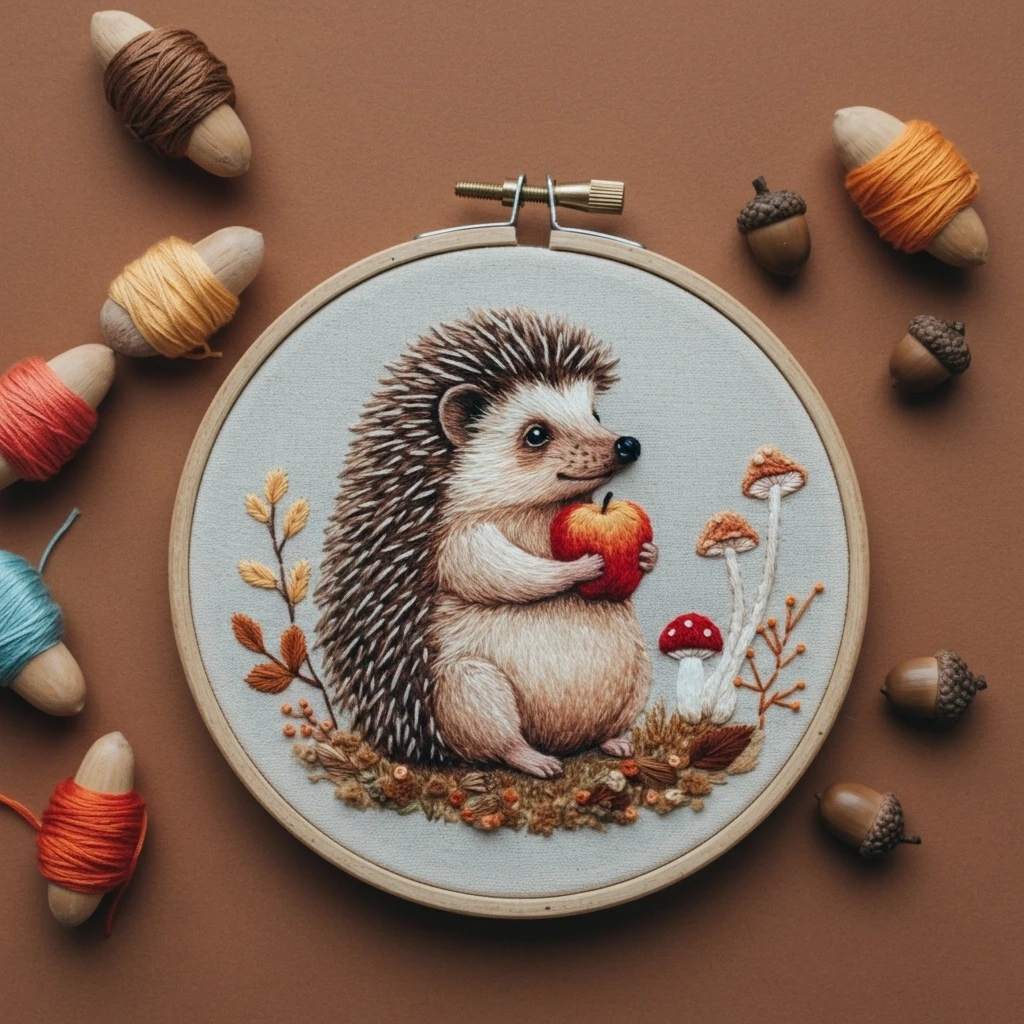
A cozy hoop-art floss guide for a soft cream-and-brown hedgehog holding a red apple, surrounded by mushrooms, acorns, golden grasses, rust leaves, and a pale blue linen-like background.
Recommended DMC Color Palette
This palette keeps the hedgehog warm and dimensional while preserving the playful red apple and mushroom accents. Use the browns in short directional layers, keep the creams soft, and reserve the bright reds and oranges for small focal points.
Deep quill shadows, nose shine outline, eye details, and the darkest acorn-cap texture.
Strong separation between quills; use sparingly in 1-strand strokes so the hedgehog stays soft.
Main quill brown, acorn bodies, twig stems, and ground shadows beneath the hedgehog.
Warm midtone on the face, ear, paws, and highlighted quill tips.
Soft muzzle shading, belly shadows, mushroom stems, and sandy ground texture.
Face, belly, inner ear, paws, and creamy transitions around the apple-holding arms.
Brightest highlights on muzzle, belly, quill tips, mushroom stems, and tiny apple sparkle.
Dry grasses, leaf centers, seed heads, and the warm glow in the forest-floor cluster.
Straw highlights, wheat sprigs, small berries, and golden touches on the left foliage.
Rust leaves, mushroom cap shading, apple warm side, and orange berries near the ground.
Bright orange leaf edges, apple transition into yellow-orange, and pumpkin-toned accents.
Main apple red and red mushroom cap; use clean satin or long-and-short stitching for a glossy focal point.
Apple and mushroom undershadows, the darkest red folds, and tiny berry depth.
Apple highlight, wheat tips, light leaf tips, and small glints on seed clusters.
Optional cool accent matching the blue thread spool/background mood; use only for tiny airy details if desired.
Subtle background-adjacent shadows, pale mushroom stems, and cool balancing stitches near cream areas.
Stitch Plan by Design Area
| Area | Best stitches | Thread guidance | Practical notes |
|---|---|---|---|
| Hedgehog quills | Long-and-short stitch, straight stitch, split stitch base outline | 1 strand for fine quill strokes; 2 strands only for the first soft underlayer. | Work from the back curve toward the face in staggered strokes. Alternate DMC 938, 3371, 433, and 435, leaving small cream tips for sparkle and direction. |
| Face, muzzle, belly | Long-and-short stitch, satin stitch in small patches, split stitch contouring | 1 strand for facial shading; 2 strands for larger belly fills. | Keep the muzzle light with DMC 712 and 738. Add DMC 3863 only under the eye, along the cheek, and beneath the belly to avoid a muddy face. |
| Eye, nose, smile | Tiny satin stitch, French knot, back stitch | 1 strand dark brown; optional tiny 1-strand cream highlight. | Use dark brown instead of pure black for a softer woodland look. A single cream stitch on the nose or eye creates the glossy effect. |
| Apple | Padded satin stitch, long-and-short stitch, stem stitch for the small stem | 2 strands for apple body; 1 strand for highlight and stem. | Shade from DMC 815 at the lower curve to DMC 321 through the center, then DMC 921 and 3821 toward the warm highlight. |
| Mushrooms | Satin stitch caps, long-and-short stems, French knots or seed stitches for spots | 2 strands for cap fills; 1 strand for spots and stem shading. | For the red cap, keep spots crisp in DMC 712. For tan caps, blend DMC 920, 3863, and 738 so they look rounded. |
| Leaves, grasses, berries, ground | Fishbone stitch, detached chain, seed stitch, French knots, couching | 1-2 strands depending on scale; 2 strands for French knots. | Layer ground texture last with broken seed stitch and knots. Mix gold, copper, and brown so the hedgehog appears nestled in autumn litter. |
Blending & Shading Notes
The charm of this design comes from soft fur transitions and crisp, jewel-like accents.
- Quill blend: use DMC 3371 or 938 at the root of each quill, DMC 433 through the middle, and DMC 435 or 738 for the tapered tip.
- Soft belly blend: combine one strand DMC 738 with one strand DMC 3863 in the shadow areas, then switch to two strands DMC 738 and finally a few DMC 712 highlight strokes.
- Apple glow: blend one strand DMC 321 with one strand DMC 921 where red turns orange. Add DMC 3821 only in a small crescent so the apple stays rich.
- Forest-floor blend: scatter DMC 3826, 977, 920, 433, and 3863 in uneven seed stitches rather than filling the ground as a solid band.
Outlining & Definition
Use delicate outlining so the hedgehog remains fluffy instead of cartoon-heavy.
- Outline the main body with 1-strand split stitch in DMC 433 before adding quill texture; this gives the silhouette a stable edge.
- Avoid a heavy outline around the cream belly. Use broken split stitch in DMC 3863 only where the arm, paw, and tummy overlap.
- Use DMC 938 for tiny points: nose underside, eye lash line, acorn caps, mushroom gills, and the deepest spaces between quill clusters.
- For mushroom stems, outline one side with DMC 3863 and leave the opposite side pale to keep the stems rounded.
Texture Suggestions
Use many short, slightly uneven straight stitches. Let neighboring colors overlap; perfect rows will look stiff, while scattered lengths create natural bristles.
For the face and belly, stitch in the direction fur would grow: outward from the nose, downward on the chest, and around the rounded belly curve.
Build leaves, berries, and grasses in layers. Stitch flat leaves first, then raised knots and seed stitches on top for depth.
Thread Count & Handling Guide
- Fine fur and quills: 1 strand is best for individual hairs, facial shading, eyelid detail, and dark quill separations.
- Large soft fills: 2 strands work well for the belly, apple, mushroom caps, and larger leaves on medium cotton or linen.
- Raised accents: use 2 strands for French knots on berries, mushroom spots, acorn caps, and seed clusters; use 3 strands only if the pattern scale is large.
- Blended needle: use two single strands together for soft transitions, especially 738+3863, 433+435, 321+921, and 3826+977.
- Needle choice: a size 8 embroidery needle is comfortable for 1-2 strands; switch to a size 7 needle for thicker knot clusters.
Practical Embroidery Tips
- Keep the hoop tight before stitching the face; small fur stitches look cleaner when the fabric does not loosen.
- Use shorter thread lengths for dark browns. DMC 938 and 3371 can look fuzzy if dragged through the fabric too many times.
- Do not fill the entire quill area with dark thread first. Leave visible gaps for chestnut and cream strokes so the hedgehog has sparkle.
- Stitch the apple with smooth, slightly curved rows. This creates a glossy round shape that stands out against the textured fur.
- For mushroom spots, place the French knots after the red cap is complete; this keeps the white dots bright and raised.
- Step back often and compare both sides of the hedgehog. Add warm DMC 435 and 738 strokes where the fur looks too dark or heavy.
- Press from the back on a padded towel only after all knots and padded details are finished.