
Elegant Blue And White Floral
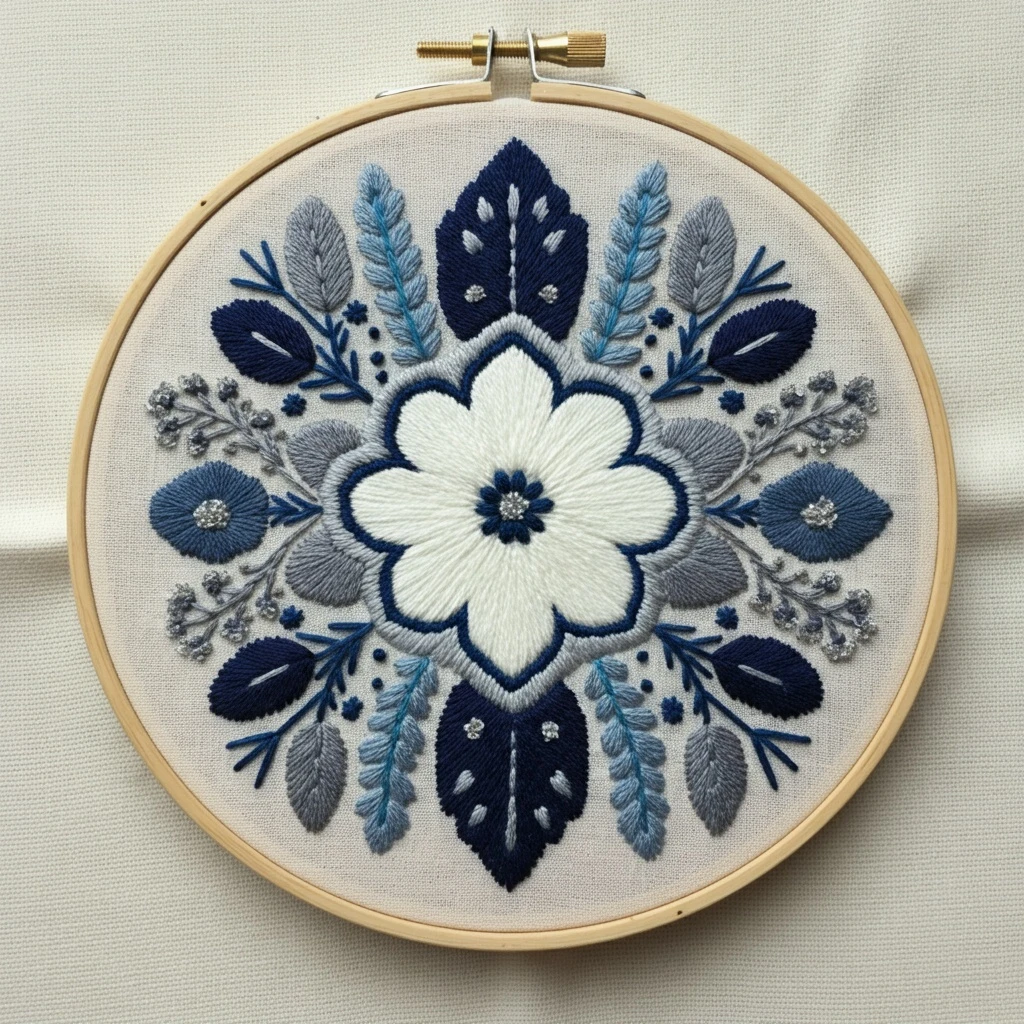
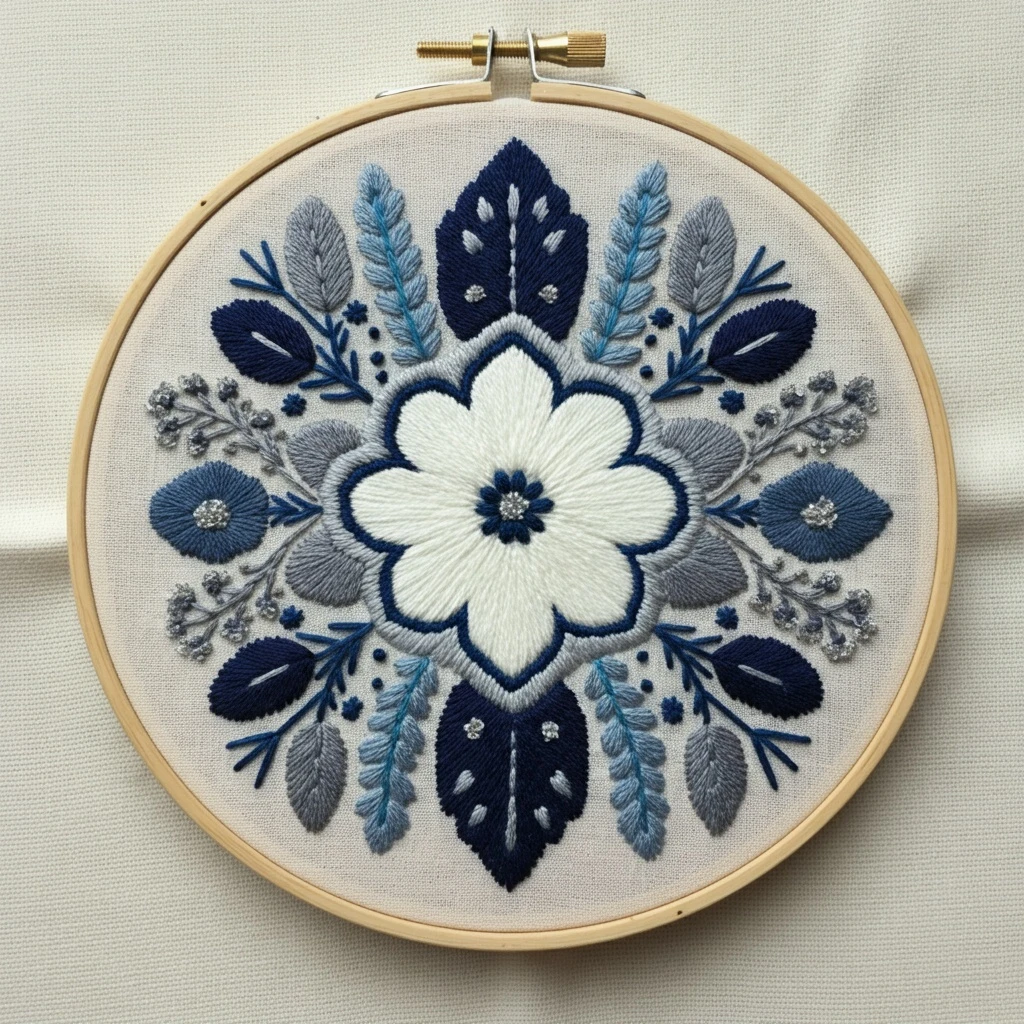
A refined embroidery guide for a cool blue-and-white floral hoop: crisp porcelain blues, airy white petals, soft gray shadows, and muted green stems worked with clean, beginner-friendly stitches.
Design read
The reference has an elegant hoop-art feeling with blue flowers and pale white blossoms balanced by thin botanical stems. The most important effect is contrast: deep navy outlines against soft Delft blue petals and creamy whites, with just enough green to keep the floral spray natural.
Suggested DMC floss palette
Use these shades as a practical working palette rather than a rigid chart. The blues carry the drama, whites create the airy floral feel, and gray-green tones keep the stems elegant without becoming too bright.
Deepest petal folds, tiny shadow pockets, and the darkest line accents inside the blue blossoms.
Main cool blue outlines for petals, bud bases, and selective contour lines where the flower needs definition.
Primary medium blue for petal bodies, shaded flower centers, and graceful blue botanical curls.
Soft transition shade on open petals; blend with 798 for smooth painted-looking movement.
Light petal highlights, airy inner strokes, and small blue accents that should not overpower the white areas.
Cool reflected highlights on white petals and subtle lift beside darker blue stitches.
Brightest petal tips, clean white flower sections, and tiny sparkle stitches on the design's lightest areas.
Warmer white for petal depth so the white flowers do not look flat or chalky.
Gentle cast shadows on white petals, underlapping petals, and pale outlines that need soft definition.
Fine final outlines, deepest center dots, and crisp definition where blue and white elements meet.
Deepest stem shadows and small dark leaf bases for elegant contrast.
Main foliage shade for muted leaves and stems that support the blue-white floral focus.
Mid-tone leaf fill, sprigs, and transitions between dark stems and light leaf tips.
Fresh leaf highlights and delicate stem tips to keep the composition lively.
Color placement strategy
Blue blossoms
Start with DMC 798 as the main petal tone. Add 336 or 823 only where the petal folds turn inward, then pull 799 and 800 toward the petal tips for a soft Delft gradient.
White flowers
Do not fill every white area with pure white. Use 3865 for most satin stitches, B5200 only for bright edges, and 762 or 3756 for tiny shadows near petal overlaps.
Leaves and stems
Keep greenery quiet: 3051 and 3011 for most leaves, 934 for underside shadows, and 3364 for small highlight stitches at tips and new growth.
Thread-count guidance
- Petal fills: 2 strands for satin stitch or long-and-short stitch; reduce to 1 strand for final vein lines.
- Fine stems: 1 strand for split stitch or stem stitch so the lines stay graceful and botanical.
- Large blue petals: 2 strands for coverage; blend one strand 798 + one strand 799 for soft mid-tone areas.
- White highlights: 1 strand B5200 for crisp final glints; too much pure white can flatten the design.
- Centers and accents: 2 strands for French knots, or 1 strand if the flower centers are very small.
Recommended stitch plan
| Design area | Suggested stitches and practical notes |
|---|---|
| Blue petals | Use long-and-short stitch for shaded petals, following the direction of each petal from base to tip. Work dark-to-light: 823/336 at the base, 798 through the center, 799 and 800 at the outer edge. |
| White petals | Use satin stitch for small petals and long-and-short stitch for larger ones. Add a single 762 shadow line under overlapping petals, then finish with a few B5200 highlight strokes. |
| Flower centers | Use French knots, colonial knots, or tiny seed stitches. Mix 3799 with 336 for cool dark centers, or add a few pale blue knots for a softer porcelain-floral look. |
| Stems | Stem stitch or split stitch in 3051 gives a smooth botanical curve. Use 934 sparingly on the lower side of stems to create depth. |
| Leaves | Fishbone stitch works beautifully for small leaves. For narrow leaves, use straight stitches from the center vein outward and alternate 3011 with 3364. |
| Fine outlines | Use 1 strand of 336 or 3799 with backstitch only after the fills are complete. Keep outlines broken in places so the work looks hand-painted rather than cartoonish. |
| Tiny sprigs | Use lazy daisy stitches for small leaflets and detached chain stitches for little buds. A few 800 or 3756 stitches can echo the blue-and-white theme. |
Blending and shading ideas
- Porcelain blend: one strand 798 + one strand 799 gives a graceful medium blue for petal transitions.
- Soft highlight blend: one strand 800 + one strand 3756 is ideal for pale blue areas next to white petals.
- White petal depth: stitch 3865 first, then place 762 in the recessed edge and B5200 on the lifted rim.
- Leaf realism: alternate 3051 and 3011 within the same leaf instead of outlining every leaf in dark green.
- Final contrast: add 823 only after the rest of the blue is complete; it is powerful and should remain selective.
Texture suggestions
- Vary stitch direction inside petals to suggest soft folded fabric and natural floral movement.
- Use seed stitches in 3756 around pale blossoms for a delicate airy texture if the design includes background dots.
- Add tiny couched lines in 336 for decorative blue curls or tendrils without making them bulky.
- Keep leaf stitches slightly shorter and more matte than the petals, so the flowers remain the focal point.
- For a dimensional accent, work a few flower-center knots with 3 strands while keeping petal shading at 1-2 strands.
Beginner-friendly workflow
Before you stitch
- Use a sharp embroidery needle for fine stem lines and a slightly larger needle for 2-strand satin areas.
- Keep fabric drum-tight in the hoop; loose fabric makes white satin stitch look uneven.
- Test the darkest blue on a fabric scrap if stitching on light linen, because navy threads show every misplaced stitch.
While stitching
- Shorten satin stitches on curved petals to prevent snagging and keep edges crisp.
- Park threads on the back carefully; dark blue carried behind white petals may shadow through thin fabric.
- Step back often. The palette should read as elegant blue-and-white, not as heavy navy line art.
Finishing notes
For a polished hoop finish, press from the back on a padded towel after stitching. If using a white or cream ground fabric, leave small areas unstitched inside pale petals; the negative space will make the blue details look cleaner and more elegant.
Mount with even tension and trim the back neatly. A narrow navy or natural wood hoop suits this design especially well because it frames the porcelain-blue florals without competing with them.