
DMC palette & stitching suggestions
Adorable Panda with Bamboo
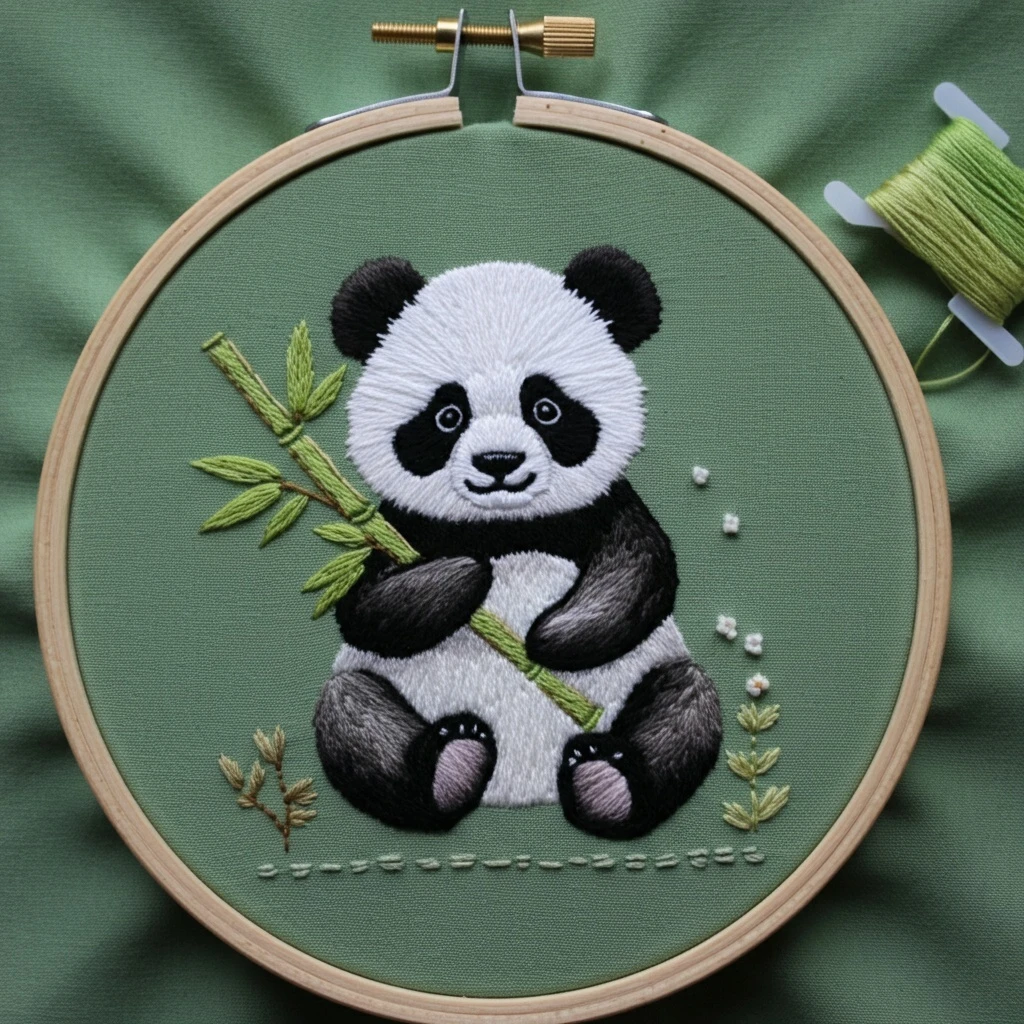
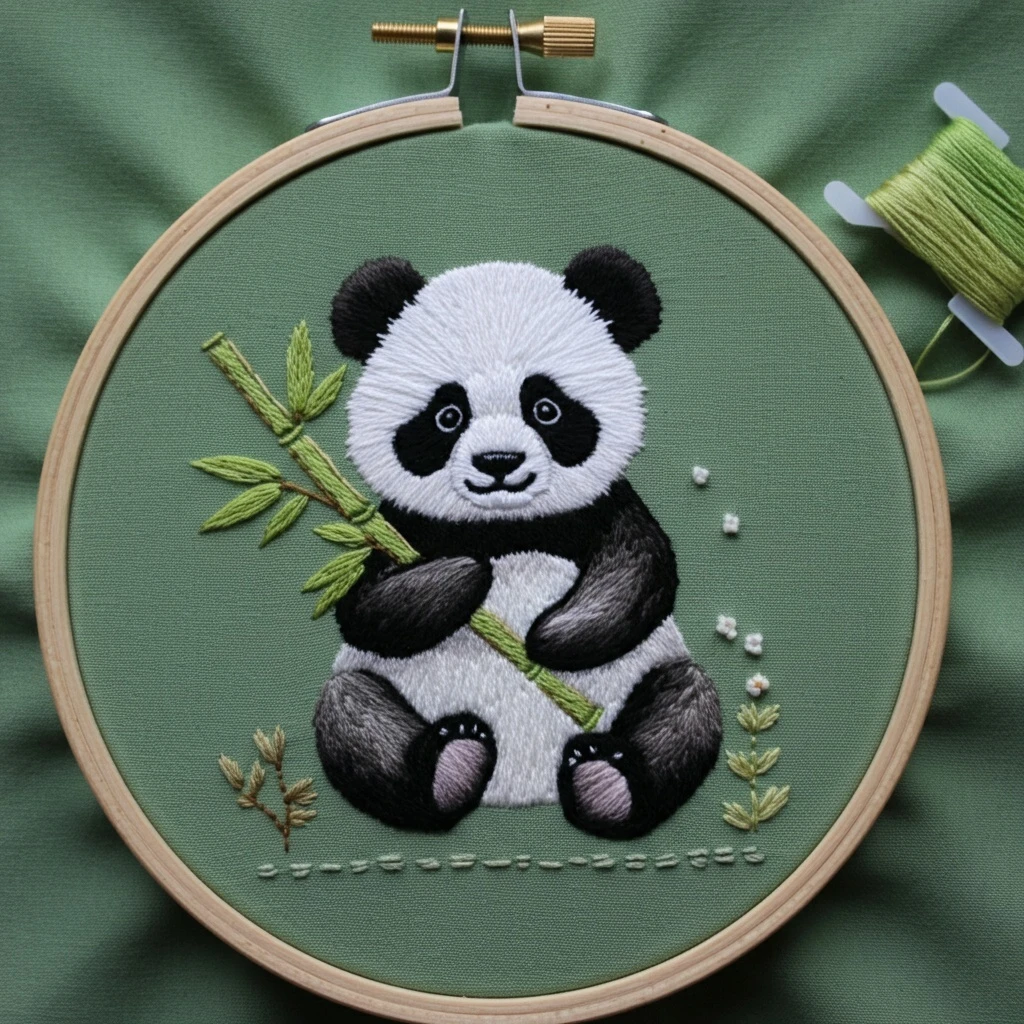
A soft, dimensional guide for stitching a round panda face, fluffy black ears and limbs, creamy white fur, fresh bamboo sprigs, and the calm sage-green fabric backdrop shown in the design reference.
Design Color Story
The reference design is built around a high-contrast panda: bright white facial fur and belly, velvety black ears, eye patches, arms and legs, plus soft charcoal transitions that keep the dark areas from looking flat. The bamboo introduces fresh yellow-green and olive tones, while small floral sprigs and the running baseline add gentle meadow texture. The sage fabric background is important: it softens the black-and-white contrast and makes the bamboo greens feel natural.
Suggested DMC Floss Palette
Stitch Plan by Design Area
| Area | Recommended stitches | Thread count | Technique notes |
|---|---|---|---|
| Panda face and belly | Long and short stitch, split stitch guide line, tiny straight stitches | 1 strand for fur; 2 strands for base padding if needed | Work from the outer contour toward the center so the fur radiates naturally. Mix Blanc with 762 in low-shadow areas, then finish with B5200 on top for sparkle. |
| Black ears, eye patches, arms, and legs | Long and short stitch, satin stitch, directional straight stitches | 1 strand for realistic fur, 2 strands for fuller dark fills | Do not fill everything with flat 310. Lay 3799 first, feather in 413, then reserve 310 for the deepest edges and compact details. |
| Eyes, nose, and mouth | Satin stitch, back stitch, French knots, tiny couching | 1 strand for outlines; 2 strands for nose satin | Add one white catchlight per eye with B5200. Keep the mouth delicate with one strand of 310 so the expression stays sweet. |
| Bamboo stalk | Stem stitch, whipped back stitch, split stitch, couching | 2 strands for stalk; 1 strand for nodes | Use 470 as the main stalk, 469 along the lower edge, and 420 or 936 for node rings. A few angled stitches make the bamboo look segmented. |
| Bamboo leaves | Fishbone stitch, lazy daisy, straight stitch | 1-2 strands depending on leaf size | Point all stitches toward the leaf tip. Use 472 on the top edge and 469/936 at the base for simple dimensional shading. |
| Small side florals and ground line | Detached chain, French knots, seed stitch, running stitch | 1-2 strands | Keep these secondary so they frame the panda without competing. Muted 522, 738, and 420 blend beautifully into sage cloth. |
Blending Ideas
White fur blend
- Soft body base: 1 strand Blanc + 1 strand 762 for shaded white areas.
- Bright face lift: overlay single B5200 stitches following the curve of the cheeks and forehead.
- Muzzle softness: use 762 sparingly beneath the nose and around the chin to prevent a flat white shape.
Black fur blend
- Velvet dark: 1 strand 3799 + 1 strand 310 for the darkest ear and patch edges.
- Visible texture: add 413 strokes through arms and legs so the black areas catch light like fur.
- Clean separation: outline only select edges with 310 rather than tracing every contour heavily.
Outlining & Definition
- Use split stitch as an invisible boundary under the fur fills for the face, belly, ears, and limbs.
- Outline the panda’s nose with a single strand of 310, then satin stitch inward for a rounded, glossy finish.
- Use short directional grey strokes at the edges of the black limbs to avoid a sticker-like silhouette.
- For bamboo crossing over the body, add a fine 936 shadow on the underside of the stem where it touches the panda.
- Keep the tiny baseline in muted 522 or 738 with loose running stitches so it reads as decorative texture, not a hard border.
Shading Guidance
Think of the panda as a rounded plush form. The face is brightest across the forehead, cheeks, and upper muzzle; grey shadows belong under the nose, beneath the chin, along the belly sides, and where the arms overlap the body. The black eye patches should be darkest near the outer edges and slightly softened with 3799 or 413 where they meet white fur. On the bamboo, place highlight stitches on the upper-left side of each leaf and darker green at the leaf base and lower edge.
Practical Embroidery Tips
- Start with the pale areas: stitch the white face and belly first so dark fibers from 310 do not contaminate light floss.
- Use short lengths of black floss: DMC 310 can fuzz quickly; shorter working lengths keep the ears and eye patches smoother.
- Build the panda in layers: outline, add base fills, add directional fur, then finish with highlights and facial details.
- Pad the nose lightly: one layer of tiny straight stitches beneath satin stitch gives the nose a raised, shiny look.
- Keep bamboo crisp: stitch the bamboo after the panda body so the stalk appears in front of the paws.
- Balance the greenery: repeat the bamboo greens in the small side sprigs to make the whole hoop feel cohesive.
- Final grooming: use a clean needle tip to nudge fur stitches into direction before trimming any loose fibers.
Quick Stitching Recipe
Use one-strand long and short stitch for the panda fur, blending Blanc, B5200, 762, 318, 413, 3799, and 310 in soft directional layers. Keep facial features sharp with satin stitch and fine back stitch. Work the bamboo in 2-strand stem stitch with fishbone leaves, then add small French knots, lazy daisies, and running stitches around the panda for a polished hoop-art finish.