
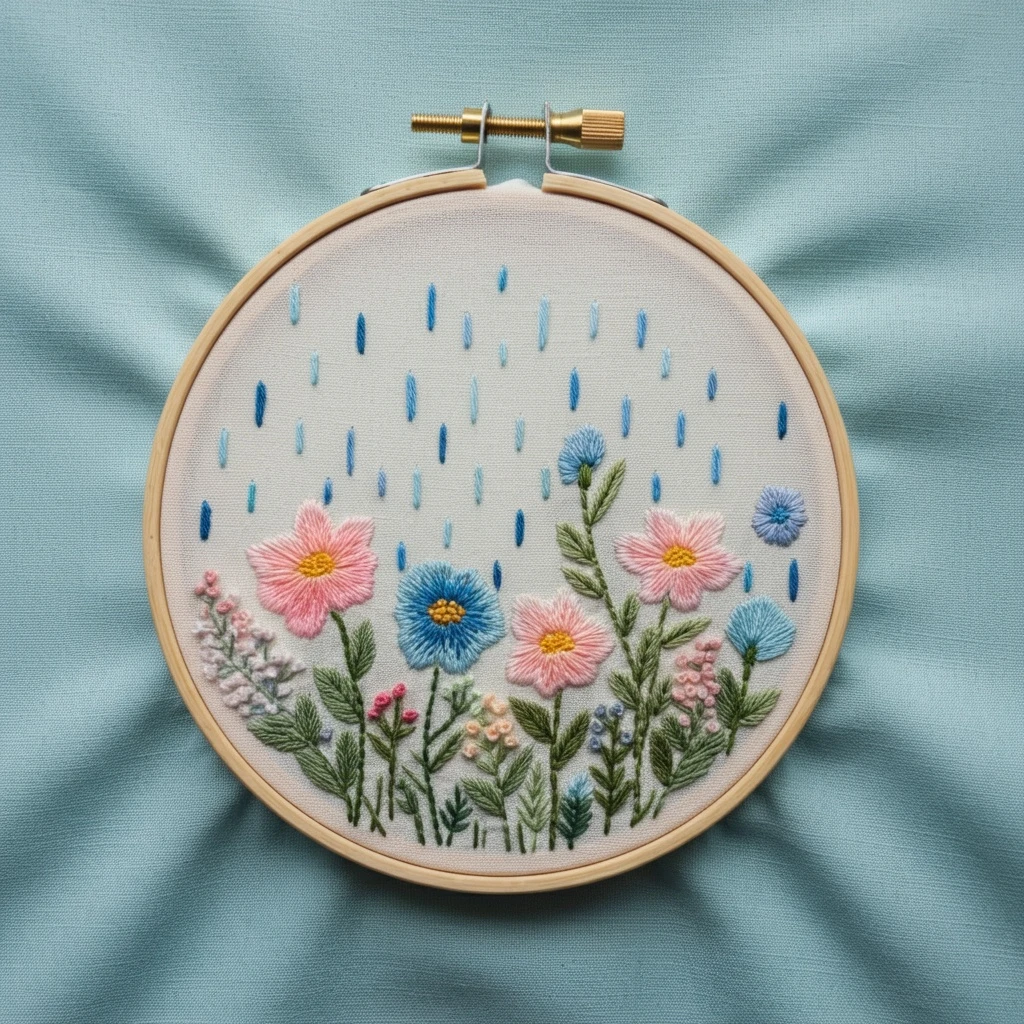
DMC palette & stitching suggestions
April Showers: Flowers in the Rain
A polished thread guide for a spring rain embroidery scene: soft blue-grey showers, fresh green stems, cheerful blooming flowers, bright raindrop highlights, and delicate wet-weather details stitched with airy movement.
Design Color Story
This design works best with a gentle rainy-day contrast: cool watery blues and misty greys for showers, puddles, and droplets, balanced by fresh spring greens and warm flower colors. Keep the rain light and open so the floral elements remain the focal point. Flowers can be stitched in soft pinks, corals, yellows, lavender, and creamy whites, with darker accents only at petal bases and flower centers.
Suggested DMC Floss Palette
Stitch Plan by Design Area
| Area | Recommended stitches | Thread count | Technique notes |
|---|---|---|---|
| Rain lines and falling showers | Straight stitch, couching, tiny back stitch | 1 strand | Keep rain stitches light, spaced, and angled consistently. Use 3756 and 3753 for most drops, adding 3761 only where a line needs to read more clearly. |
| Raindrops and wet highlights | Tiny satin stitch, French knots, seed stitch, single straight stitches | 1 strand; 2 strands for larger drops | Use 3865 and B5200 at the top edge of drops, then a small 3753 or 3761 shadow at the lower edge for dimensional sparkle. |
| Flower petals | Lazy daisy, satin stitch, long and short stitch, woven wheel | 2 strands for petals; 1 strand for veins | Use lighter tones at petal tips and darker tones near centers. Mix 761/760/3716 for pink flowers, 352 for coral petals, and 210/209 for lavender accents. |
| Flower centers | French knots, colonial knots, seed stitch, small satin dots | 2 strands; 3 strands for raised knots | Use 744 for bright centers and 743 for depth. Add a tiny 3371 or 869 dot only if a center needs extra definition. |
| Leaves and stems | Stem stitch, split stitch, fishbone stitch, lazy daisy | 1 strand for stems; 2 strands for leaves | Use 702 for new growth, 700 for main foliage, and 699 at the bases or where leaves overlap flowers. |
| Puddles or wet ground accents | Chain stitch, split stitch, couching, curved straight stitches | 1-2 strands | Curve stitches gently in 3756, 3753, and 3761. Add small B5200 glints sparingly so puddles stay soft rather than glittery. |
Blending, Outlining & Shading Guidance
Blending ideas
- Rain blend: use 3756 for distant rain, 3753 for readable drops, and 3761 or 3841 only behind strong flower shapes.
- Petal blend: work from 761 into 760, then add 3716 only at the petal base or under overlaps.
- Leaf blend: place 702 at the leaf tips, 700 through the center, and 699 at the stem base or underside.
- Puddle blend: stitch pale 3756 curves first, add 3753 midlines, then tiny B5200 highlights where water catches light.
- Cloudy mood: use 318 and 415 very lightly so the design feels rainy without dulling the flowers.
Outlining details
- Use one strand for all rain and most outlines; heavy lines can quickly overpower a spring design.
- Outline flowers selectively with darker petal colors, not black. Use 3716 for pink petals and 209 for lavender accents.
- Use 699 for stem and leaf outlines where greenery crosses pale rain stitches.
- Raindrops look best with partial outlines: a small lower shadow and a tiny bright highlight, not a complete oval.
- Keep background rain broken around blossoms so the flowers remain crisp and readable.
Practical Embroidery Tips
For the rain
- Stitch the lightest rain first so later flowers can sit cleanly on top.
- Keep the rain angle consistent unless the design intentionally shows wind.
- Use short thread lengths for B5200 and pale blues to keep highlights clean.
- Leave breathing room between rain lines; too many lines can make the design look crowded.
- Add final raindrop highlights only after flowers and leaves are complete.
For the flowers
- Build from back to front: rain, stems, rear leaves, flowers, centers, then final water highlights.
- Use 2 strands for most petals and 1 strand for delicate veins or petal separations.
- Vary flower stitches for a polished sampler effect: lazy daisy for small blossoms, satin for simple petals, woven wheels for fuller blooms.
- Keep knots small near the rain details so flower centers do not become bulky.
- Press from the back on a towel to preserve raised knots and raindrop texture.
Recommended Stitching Formula
For the most polished April Showers result, keep the rain in 1 strand, stitch petals mostly in 2 strands, and reserve bright white highlights for the final pass. The design should feel fresh, airy, and springlike: cool water tones in the background, fresh greens in the stems, and cheerful flowers as the focal point.
- Best rain set: 3756, 3753, 3761, 3841, 318, B5200
- Best flower set: 761, 760, 3716, 352, 744, 743, 210, 209
- Best greenery set: 3053, 702, 700, 699
- Best finishing accents: 3865 and B5200 for highlights, used sparingly