
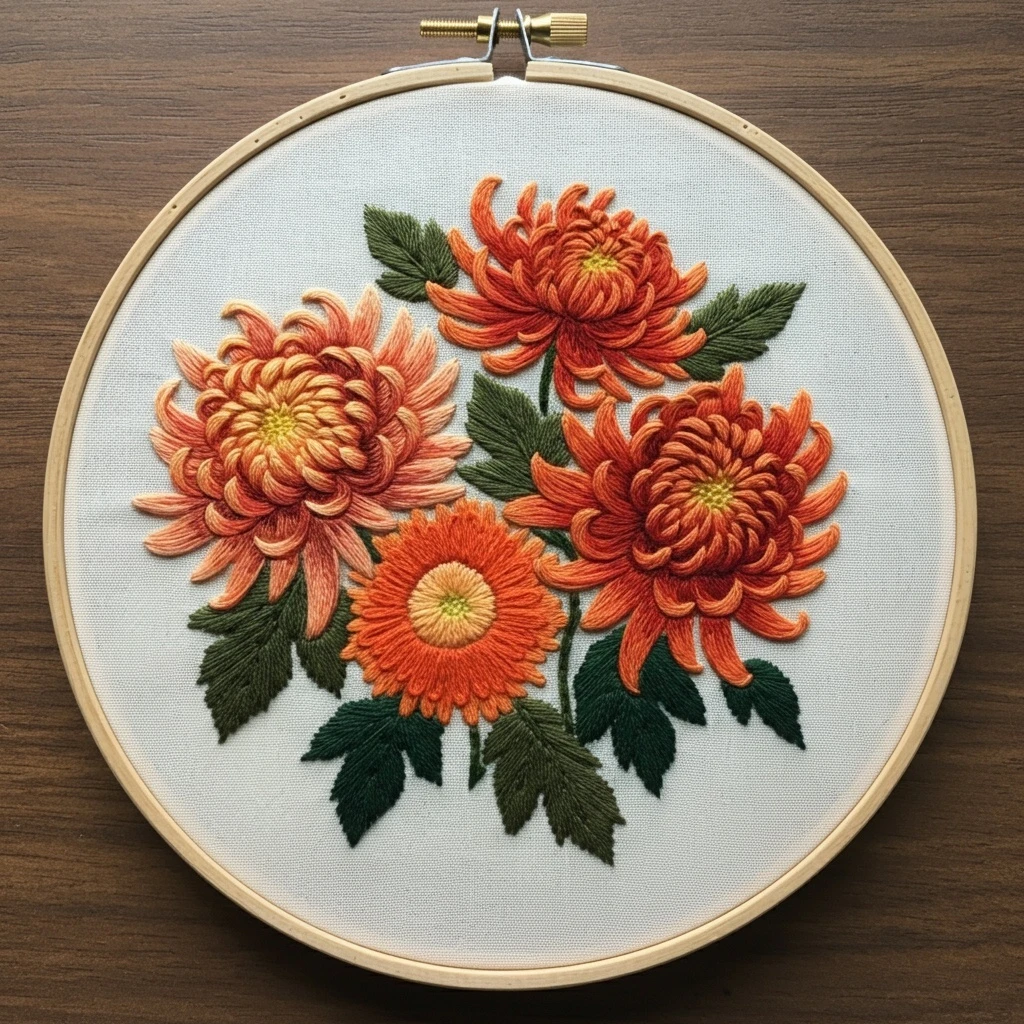
Autumn Chrysanthemum Bloom
A richly layered floral study with curled chrysanthemum petals in pumpkin, copper, coral, and russet, bright golden centers, and deep green leaves worked with strong directional texture.
Design read
Main color story
Build the flowers from soft peach highlights into hot orange, copper, rust, and deep red-brown shadows. Keep centers warm yellow-green so they sparkle against the petals.
Texture focus
The petals should feel curled and overlapping. Use directional stitches that follow each petal arc, with darker stitches tucked at the bases and underside folds.
Composition focus
Let the large blooms dominate, then use the dark leaves and slim stems as visual rests. Keep leaf edges crisp so the floral mass does not become too soft.
Suggested DMC palette
Stitch mapping
Curled chrysanthemum petals
Use long & short stitch in narrow wedges, always changing direction to follow the petal curve.
- 2 strands for main filling.
- 1 strand for thin highlight strokes and shadow separators.
- Add a few raised stem stitches along curled tips for sculptural edges.
Dense inner petals
Work split stitch or stem stitch rings around the center, then tuck darker short stitches between layers.
- Use DMC 3777 sparingly for depth.
- Alternate DMC 922 and 920 to avoid a flat orange block.
- Keep stitches short near the flower heart.
Golden flower centers
Use French knots, seed stitch, and tiny straight stitches to create a raised pollen disk.
- 2 strands, 1 wrap for fine pollen.
- 2 strands, 2 wraps for the outer ring.
- Blend 783 with 3078 for brighter top dots.
Leaves and stems
Use fishbone stitch or closed fly stitch for leaves, with stem stitch for the green vertical stems.
- 2 strands for leaves.
- 1 strand DMC 500 for crisp veining.
- Angle leaf stitches from the center vein outward.
Blending and shading plan
| Area | Recommended blend | How to use it |
|---|---|---|
| Peach outer petals | 1 strand DMC 351 + 1 strand DMC 352 | Use on the lightest left-side flower tips. Keep strokes long and tapered so the tips look soft and translucent. |
| Warm orange petals | 1 strand DMC 920 + 1 strand DMC 919 | Use across the large orange petals as a middle transition from coral highlights to copper shadows. |
| Deep curled folds | 1 strand DMC 922 + 1 strand DMC 3777 | Place only at the petal bases, under curled rims, and between dense inner petals to create overlap. |
| Golden centers | 1 strand DMC 783 + 1 strand DMC 3078 | Scatter in French knots over a base of 783. Add a few pale knots off-center for a natural light source. |
| Dark foliage | 1 strand DMC 3011 + 1 strand DMC 3363, with DMC 500 accents | Blend the leaf body, then add single-strand DMC 500 veins and underside edges for the dark botanical contrast visible in the sample. |
Outlining and detail guidance
Petal outlines
Do not outline every petal equally. Use a broken 1-strand split stitch in DMC 3777 only where petals overlap or disappear into shadow. For highlighted petal tips, use DMC 352 or 351 instead of a dark outline.
Leaf outlines
Leaves can take stronger linework than petals. Use 1 strand DMC 500 for notched outer edges and center veins, then soften with short DMC 3363 stitches along the vein.
Center definition
Ring each center with tiny short stitches in DMC 783 before adding knots. The ring keeps the pollen disk neat and prevents the surrounding petals from visually swallowing the center.
Stems
Use stem stitch with 2 strands DMC 3363. Add a single shadow pass in DMC 500 on the side that sits behind the flowers.
Practical stitching order
Finishing tip
For the most polished result, keep strand counts modest: 2 strands for most fill, 1 strand for outlines and highlights, and 2 strands for French knots. The beauty of this design comes from directional layering and warm color changes rather than heavy thread bulk.