
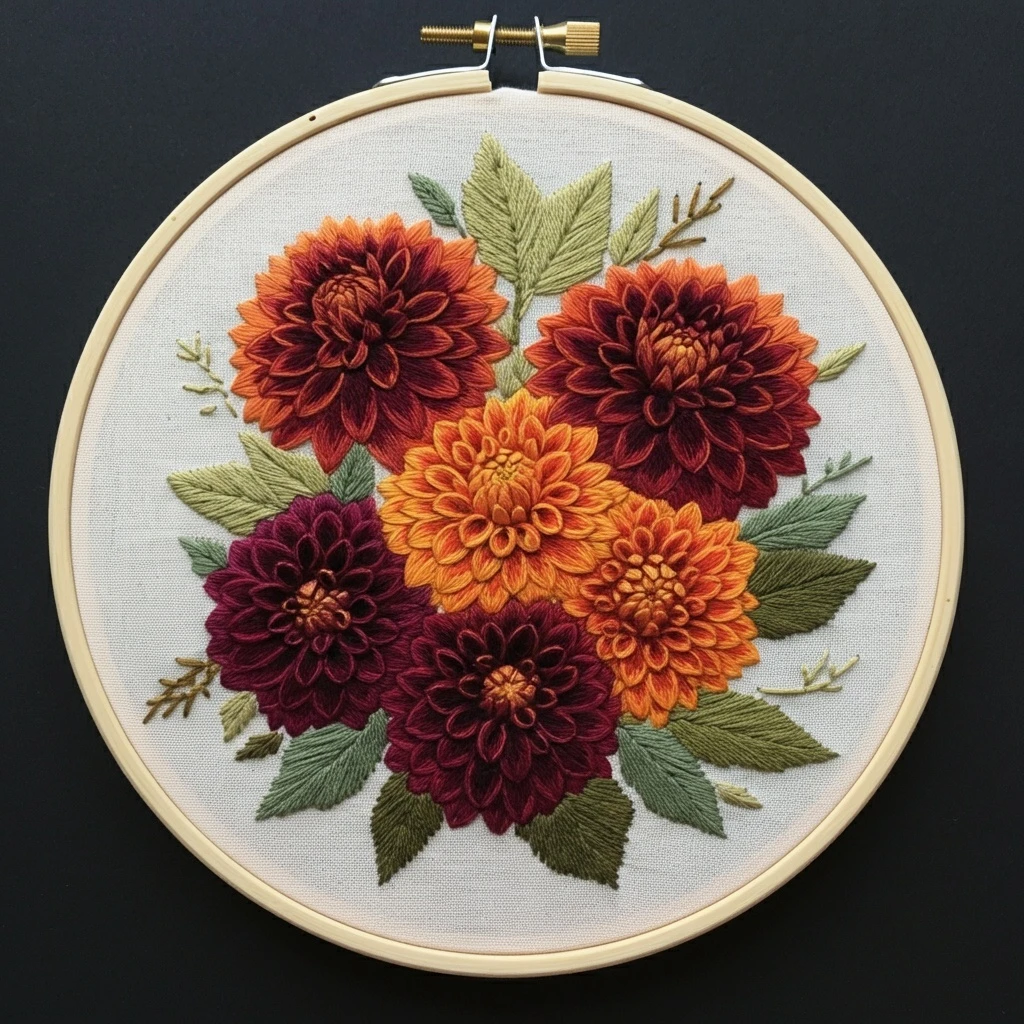
Autumn Dahlia Bouquet
A warm, painterly floral study built around layered dahlia petals, rich autumn oranges, wine-burgundy shadows, soft cream highlights, and muted olive foliage against a dramatic dark ground.
Based on the provided design reference, this interpretation focuses on the image’s strongest visual cues: sculpted petal layers, glowing copper and amber transitions, velvety shadow pockets, and restrained greenery that supports the bouquet without stealing attention.
The palette below is designed to recreate that luxurious autumn depth with DMC floss. It combines warm oranges and terra-cottas for the flower heads, soft neutrals for petal highlights, deep garnets for shadow definition, and olive-to-avocado greens for leaves and stems.
Design Analysis
The bouquet reads as an autumn floral arrangement with full dahlia blooms as the dominant motif. The visual rhythm comes from repeated petal clusters, circular flower heads, and a restrained contrast between luminous blooms and a dark atmospheric background.
Dominant color story
Burnt orange, copper, apricot, antique gold, burgundy-shadowed terracotta, warm cream, olive, and deep leaf green.
Key design elements
Layered dahlia petals, overlapping flower heads, smaller floral accents/buds, supportive foliage, and soft painterly depth rather than hard graphic edges.
Texture priorities
Petal sheen, curved petal direction, shadowed folds, smooth color transitions, and subtle high points that make the blooms appear dimensional.
Suggested DMC Color Palette
These floss choices are chosen to echo the artwork’s warm autumn bouquet palette. Use them as a practical working set rather than a rigid formula; substitute within the same family if you want a slightly lighter, softer, or more dramatic effect.
| Design area | Primary DMC shades | How to use them |
|---|---|---|
| Deep petal shadows | 3779, 814, small touches of 310 or 3799 | Place sparingly at petal bases, between overlapping petals, and where blooms tuck behind one another. |
| Main orange petal body | 919, 920, 921, 3825 | Build the central floral color story with gradual transitions from inner shadow to outer glow. |
| Golden warmth | 3853, 3854 | Layer over orange mid-tones to create sunlight-like warmth and visual richness. |
| Highlights | 3033, 739 | Use short, selective stitches on petal rims, tips, and a few inner curves only. |
| Leaves & stems | 934, 936, 469, 3012 | Keep greens slightly subdued so the bouquet remains the focal point. |
Stitch Types & Recommended Thread Counts
The bouquet benefits from a layered, painterly stitching style. Keep stitch direction intentional and vary strand count to preserve detail in crowded floral areas.
Main dahlia petals
Best stitch: long-and-short stitch
Recommended strands: 2 strands for most petals; 1 strand on small or tightly packed inner petals.
Petal ridges & crisp edges
Best stitch: split stitch or fine stem stitch
Recommended strands: 1 strand
Apply only where petals need definition or where one bloom overlaps another.
Leaves
Best stitch: fishbone stitch or long-and-short stitch
Recommended strands: 2 strands, reducing to 1 strand near tips or for highlighted leaf edges.
Fishbone gives elegant central-vein structure; long-and-short is ideal for a softer painterly leaf.
Stems & bouquet connections
Best stitch: stem stitch or split stitch
Recommended strands: 2 strands
Blend 934 with 936 for darker stems; add a few 469 highlights on the lit side.
Tiny accents, buds & texture
Best stitch: straight stitch, seed stitch, occasional French knots
Recommended strands: 1–2 strands
Use for miniature petal flicks, tiny petiole accents, or any textured central detail.
Optional background emphasis
Best stitch: leave the background fabric exposed, or add ultra-sparse seed stitches
Recommended strands: 1 strand if used
Negative space helps the bouquet breathe. Avoid overfilling the dark ground.
Blending & Shading Ideas
This design looks best when colors move gradually from dark inner folds to softly glowing petal tips. Blend in short transitions rather than solid stripes of color.
Suggested petal blend path
- Deepest base: 3779 + 814 (or a few stitches of 3799 for cooler shadow)
- Transition into warmth: 919 to 920
- Main light plane: 921 to 3825
- Golden glow: 3853 to 3854
- Final highlight: 3033 with tiny touches of 739
Useful blending combinations
- 1 strand 919 + 1 strand 920 for a smooth red-copper transition.
- 1 strand 920 + 1 strand 921 for broad petal mid-tones.
- 1 strand 921 + 1 strand 3853 for a glowing orange-gold effect.
- 1 strand 469 + 1 strand 3012 for soft leaf highlights.
- 1 strand 3779 + 1 strand 919 when you want warmth inside shadows instead of a flat dark edge.
Shading direction
On dahlias, begin shading near the petal origin and let the light expand outward. Keep darkest values tucked into overlap points. Reserve the lightest stitches for petal tips, slightly turned edges, and upper-facing planes.
How much contrast to keep
Use more contrast in focal blooms and less contrast in secondary flowers. This helps the bouquet feel layered and keeps the eye centered on the main flower heads rather than spreading evenly across every bloom.
Outlining & Fine Details
The reference artwork feels painterly, so outlining should be selective. Think “guided definition,” not hard cartoon lines.
Where to outline
- Outer edges of the foremost petals only where they risk blending into adjacent petals.
- Petal bases that need depth or separation.
- Leaf edges and stems when they disappear into the dark background.
Best outline colors
- DMC 3799 for softened dark outlining.
- DMC 3779 for warm floral contouring.
- DMC 934 for leaves and stems.
- DMC 310 only in the deepest, tiniest accents.
Recommended outline stitch
Use 1 strand of split stitch, backstitch, or fine stem stitch. A broken outline often looks more natural than a continuous one in floral embroidery.
Highlight detailing
Add a few single straight stitches in 3033 or 739 along the upper petal rims or on sharply turned petal points. Keep them sparse so the bouquet stays rich rather than chalky.
Practical Embroidery Tips
1) Work bloom by bloom
Complete one major flower at a time, including shadows, mid-tones, and highlights. This helps you keep color balance consistent and reduces the risk of mismatched contrast.
2) Start with background flowers
Stitch rear blooms and hidden leaves first. Then build foreground petals on top to preserve the bouquet’s layered depth.
3) Keep petals directional
Even short stitches should follow the petal’s natural flare. Random stitch direction is the fastest way to flatten a dahlia.
4) Use fewer strands in crowded areas
Switch from 2 strands to 1 strand for inner petal whorls and fine overlaps. This keeps the center crisp instead of bulky.
5) Blend before you outline
Finish your shading first, then add selective contouring only where the flower needs separation. Over-outlining too early can make the piece look stiff.
6) Test highlight intensity
Try 3033 first; if you still need more sparkle, add just a touch of 739. Too much pale floss can break the warm autumn mood.