
DMC palette & hand embroidery guide
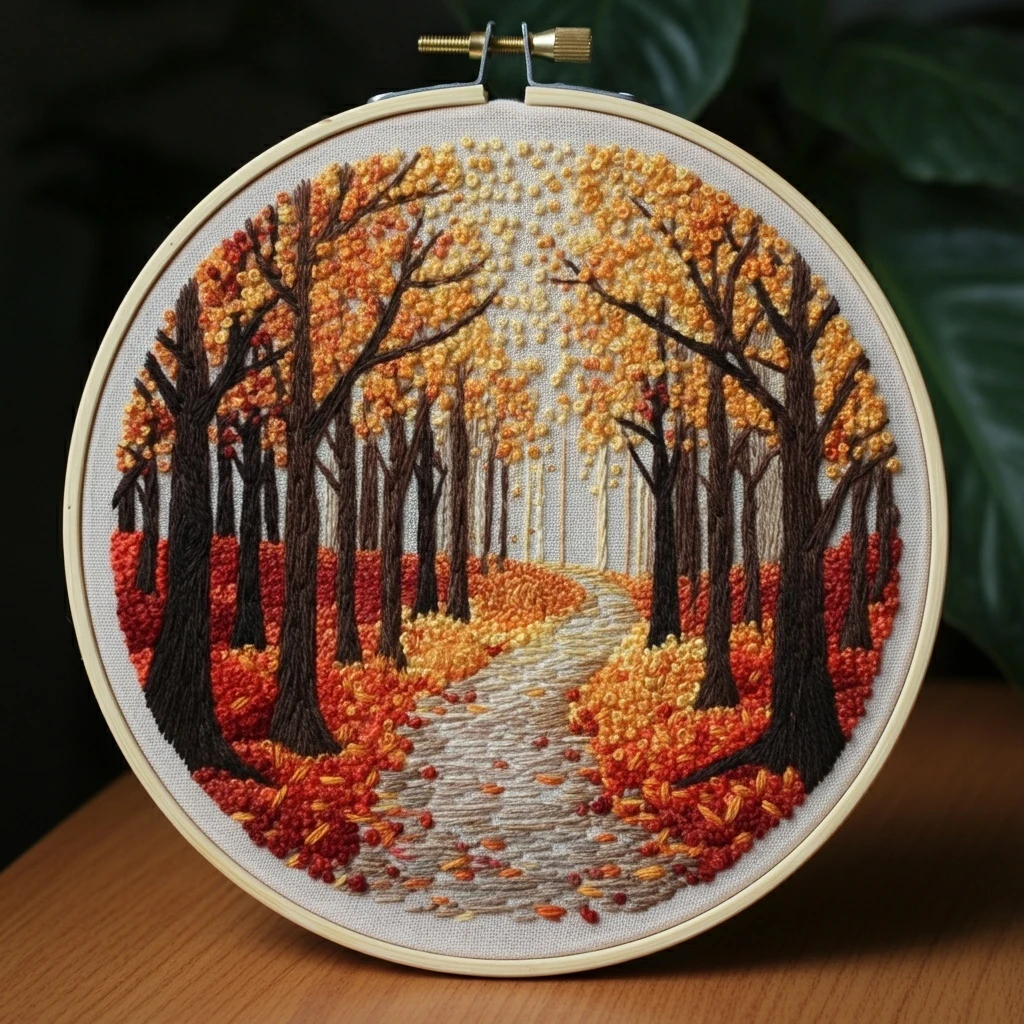
Autumn Forest Path
A warm woodland hoop with a winding pale path, dark tree silhouettes, dense French-knot foliage, and a glowing carpet of red, russet, ochre, and golden leaves.
Design read
The image is built around strong contrast: almost-black trunks and branches frame a soft gray-beige path, while the canopy and forest floor use clustered dots and seed-like marks in gold, pumpkin, rust, and crimson.
Keep the path calm and smooth so the textured leaves feel lively. Use the deepest browns sparingly but decisively for the tree structure.
Polished DMC palette
Use this as one cohesive palette rather than a strict paint-by-number list. The design benefits from varied spacing, mixed strands, and tiny value shifts inside each leaf cluster.
Stitch plan by design area
| Area | Recommended stitches | Threads | Practical notes |
|---|---|---|---|
| Large tree trunks | Stem stitch, split stitch, satin stitch, a few long straight stitches | 2-3 strands | Work the trunk edges in DMC 3371, then add 938 and 898 inside as narrow bark streaks. Follow the trunk direction so the stitches grow upward naturally. |
| Fine branches | Whipped back stitch, couching, single straight stitches | 1 strand | Keep outer branches thin and irregular. Let a few lines disappear under foliage knots for a natural layered look. |
| Golden canopy | French knots, colonial knots, seed stitch | 1-2 strands | Use 783, 3826, 977, and 922. Vary knot wraps: one wrap for distant leaves, two wraps for foreground clusters. |
| Red forest floor | French knots, seed stitch, detached chain, short straight stitches | 2 strands | Anchor the darkest reds near the hoop edge and tree bases, then brighten upward with 921, 900, and 304. |
| Winding path | Long & short stitch, horizontal straight stitch, split stitch edging | 1-2 strands | Blend 644, 3024, 612, and 3865 in soft horizontal strokes. Avoid too much texture here; it should feel quieter than the leaves. |
| Scattered fallen leaves | Tiny lazy daisy, single straight stitches, small knots | 1 strand | Place them unevenly along the path edges, not in a perfect line. Use 900, 922, 783, and 815 for visual rhythm. |
| Distant trees and haze | Fine back stitch, straight stitch, very light seed stitch | 1 strand | Use lighter browns and gray-beiges. Shorten stitches as the path recedes to make the center feel farther away. |
Blending and shading guidance
Beginner-friendly stitching order
1. Map the quiet shapes
- Transfer the hoop outline, path, main trunks, and canopy boundary first.
- Mark only the largest tree branches; add tiny twigs later by eye.
- Use a neutral fabric such as oatmeal linen or cotton in the 28-32 count range.
2. Stitch from back to front
- Start with distant pale trees and the path.
- Add main trunks next so they sit clearly over the background.
- Finish with leaf knots and scattered foreground leaves for raised texture.
3. Control thread count
- Use 1 strand for fine branches, distant trees, and path highlights.
- Use 2 strands for most leaf knots and seed stitches.
- Use 3 strands only on the thickest foreground trunk sections.
4. Keep knots organic
- Do not grid the French knots. Cluster them loosely, leaving small fabric gaps.
- Mix colors within each cluster rather than making separate color blocks.
- Vary knot size so the canopy looks leafy instead of beaded.
5. Outline selectively
- Outline trunks and big branches with dark brown, but avoid outlining every leaf.
- Use split stitch along the path edge only where leaves meet the trail.
- Let some background trees fade without outlines to create distance.
6. Finish neatly
- Step back often and check whether the path still reads as the focal curve.
- Add final bright gold knots near the upper canopy after all darker stitches are in.
- Press from the back over a towel to protect raised knots.
Extra practical notes
For a hoop similar to the reference, a 6-8 inch hoop works well. Use a sharp embroidery needle for split and stem stitch, then switch to a slightly larger needle for repeated French knots so the thread passes through the fabric cleanly.
When the red foreground starts to feel heavy, add small yellow and copper stitches across it. When the upper canopy feels too bright, tuck in a few 975 or 921 knots to bring back autumn shadow.