
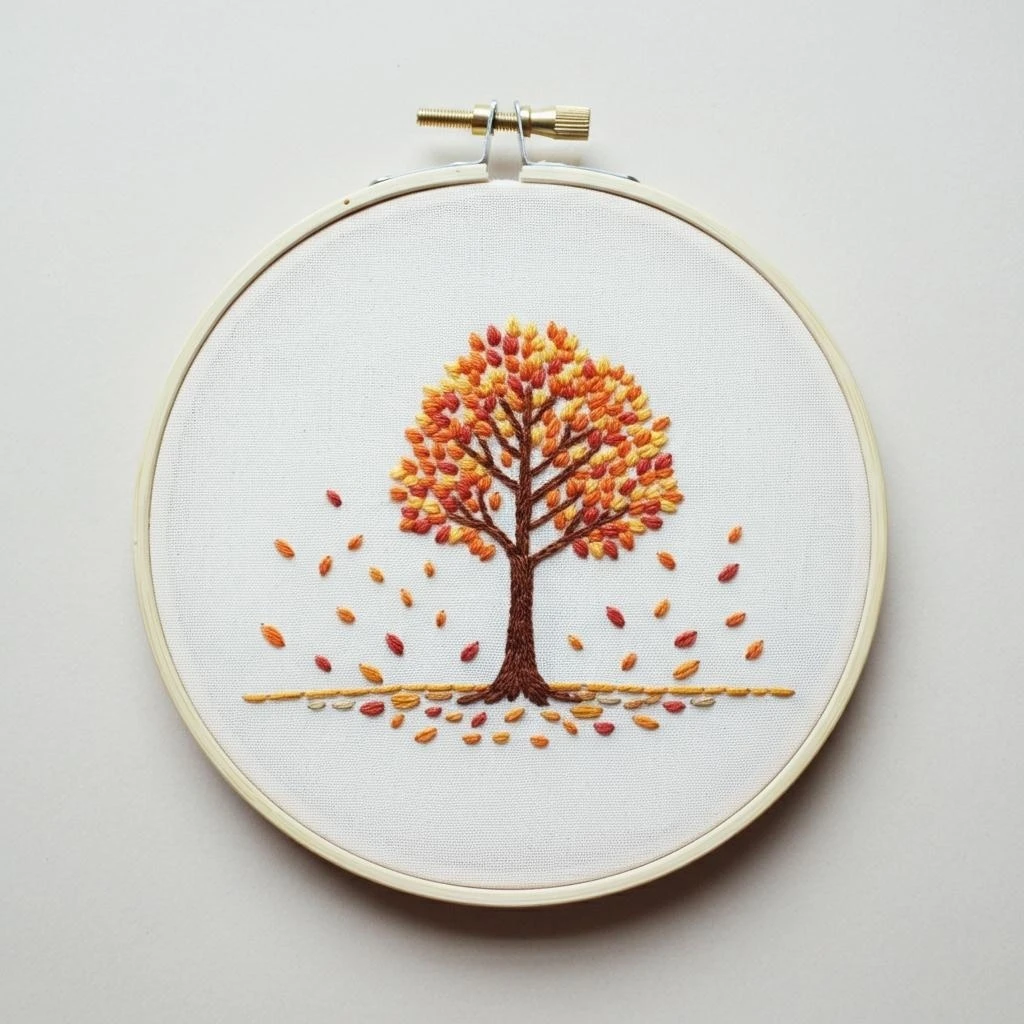
DMC palette & hand embroidery notes
Autumn Tree
A warm, polished guide for stitching a graceful autumn tree with glowing foliage, textured bark, delicate branches, and softly scattered fallen leaves. The palette leans into russet orange, honey gold, walnut brown, olive shadow, and cream highlights for a balanced seasonal hoop.
Design read
The design centers on a single autumn tree, so the stitching should feel airy rather than heavy. Treat the trunk and main limbs as the anchor, then build the canopy in loose clusters of orange, gold, copper, and muted brown.
Keep the outer leaf edges irregular and lively. A few darker leaf groups near the trunk will make the brighter golds look sunlit, while soft olive-gray accents prevent the palette from becoming too flat or overly orange.
Suggested DMC palette
Use these flosses as a practical, autumn-rich palette. The notes explain where each color works best in the tree design.
Stitch map
| Area | Recommended stitches | Working notes |
|---|---|---|
| Main trunk | Stem stitch, split stitch, couching | Use 2 strands for structure. Vary 801, 975, and 938 in uneven vertical lines so the bark does not look striped. |
| Fine branches | Back stitch, split stitch | Use 1 strand for twig tips. Taper branch ends with shorter stitches and a lighter brown on sunlit sides. |
| Leaf canopy | Detached chain, fly stitch, small satin stitches | Work in scattered clusters rather than rows. Mix 921, 922, 783, 3820, and 918 for natural autumn variation. |
| Leaf veins | Straight stitch, tiny back stitch | Add only a few visible veins on larger leaves; too many lines can make the canopy busy. |
| Ground leaves | Lazy daisy, seed stitch, straight stitch | Scatter loose stitches at the base in copper, gold, and straw tones. Keep spacing irregular. |
| Base shadows | Seed stitch, split stitch | Use 3051 and 3012 sparingly to cool the lower edge and make the tree feel rooted. |
Thread-count guidance
- Trunk and thick limbs: 2 strands for coverage; add occasional 1-strand dark cracks on top.
- Outer branches: 1 strand to keep the silhouette delicate and avoid bulky twig ends.
- Leaf clusters: 2 strands for medium leaves, 1 strand for tiny leaf tips and scattered specks.
- Highlights: 1 strand of 3820 or 739 is enough; place these last so they stay crisp.
- Fabric choice: cream, oatmeal, warm linen, or pale taupe fabric will flatter the autumn palette and soften contrast.
Blending ideas
- Blend one strand 921 with one strand 783 for glowing orange-gold leaves.
- Blend one strand 975 with one strand 801 for bark transitions.
- Blend 918 with 921 in a few inner canopy areas for russet depth.
- Use 3012 with 3820 for faded late-season leaves.
Outlining details
- Outline the trunk with broken, not continuous, lines so the bark stays organic.
- Use 938 only for the deepest joins and undersides of branches.
- For leaf outlines, choose 918 or 975 instead of black for a softer autumn look.
- Keep the outer canopy lightly defined; let individual stitches create the edge.
Texture suggestions
- Mix detached chain and small straight stitches for natural leaf variety.
- Add tiny seed stitches between clusters to imply distant leaves.
- Use slightly uneven stem-stitch rows for bark grain.
- Leave small fabric gaps inside the canopy for air and light.
Shading plan & practical stitching tips
| Step | What to do | Why it helps |
|---|---|---|
| 1. Anchor the form | Stitch the trunk and main branches in 975 and 801, then deepen key joins with 938. | The tree has a clear skeleton before the colorful leaves are added. |
| 2. Place midtones | Add most foliage in 921, 922, and 783, spreading colors evenly across the canopy. | Midtones create fullness without making the design too dark. |
| 3. Add shadows | Use 918 under leaf clusters and near branch intersections; add 3051 near the base. | Darker areas give the tree dimension and stop the bright colors from floating. |
| 4. Add highlights | Use 3820 and tiny touches of 739 on upper leaf tips and selected bark ridges. | Light stitches create sparkle and a warm autumn glow. |
| 5. Finish cleanly | Check the silhouette, add a few fallen leaves, and trim thread tails before hooping. | Final details make the piece polished without overworking the design. |