
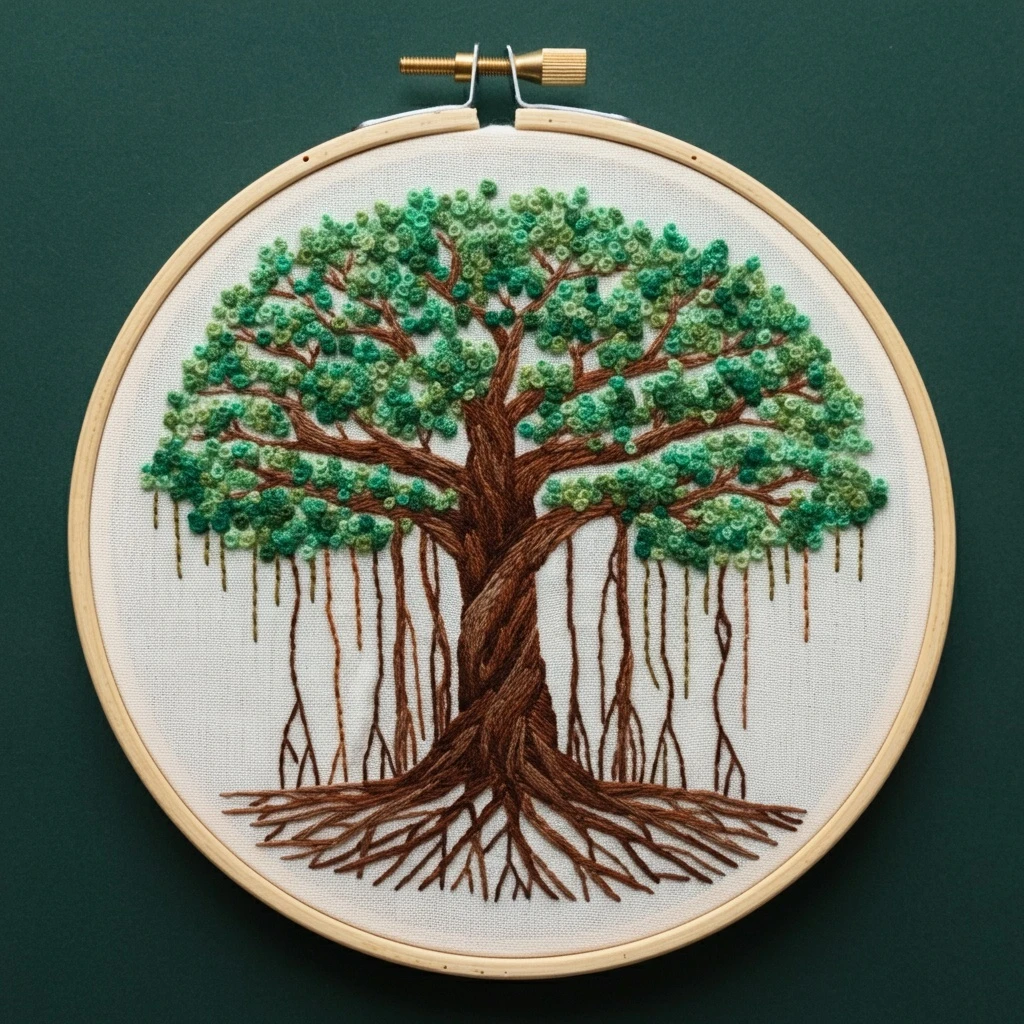
Banyan Tree of Life

Banyan Tree of Life - DMC Palette & Stitching Guide
Banyan Tree of Life Embroidery
DMC palette & hand embroidery tips

Banyan Tree of Life

A polished stitching guide for a symbolic banyan tree design with spreading roots, sculptural trunk lines, layered foliage, and warm earth-toned accents. The palette leans into bark browns, shaded rootwork, mossy greens, fresh leaves, golden highlights, and quiet deep outlines.

Tree & root textureEarthy DMC paletteBeginner-friendly thread planLayered shading notes

Design reading

The Banyan Tree of Life motif works best when the trunk and aerial roots feel grounded and dimensional while the canopy stays light, rhythmic, and living. Treat the roots as the visual anchor, the trunk as the central movement, and the leaves as small repeated color notes. Use darker browns sparingly under root overlaps and branch forks, then soften outward with tan, golden brown, and moss green.

Keep the embroidery elegant by limiting heavy fill. Let stem stitch, split stitch, long-and-short shading, and small leaf stitches build texture without flattening the design.

Suggested DMC floss palette

DMC 3371
Black Brown
Deepest root creases, branch forks, tiny shadow accents.
DMC 938
Ultra Dark Coffee Brown
Main trunk outline, underside of roots, carved bark lines.
DMC 801
Dark Coffee Brown
Primary bark color and strong root curves.
DMC 400
Dark Mahogany
Warm mid-tone bark, root transitions, branch warmth.
DMC 434
Light Brown
Raised bark highlights and exposed root edges.
DMC 437
Light Tan
Soft highlight stitches on trunk ridges and root tips.
DMC 3011
Dark Khaki Green
Deep leaves, shaded canopy clusters, moss near roots.
DMC 3012
Medium Khaki Green
Main foliage and balanced leaf fill.
DMC 3013
Light Khaki Green
Leaf highlights and small new-growth tips.
DMC 977
Golden Brown
Warm glow on leaves, sunlit knots, decorative accents.
DMC 920
Copper
Autumn leaf notes and warm root shading.
DMC 738
Very Light Tan
Tiny sparkle highlights and optional negative-space softening.

Stitch map

Trunk: Stem stitch for curved outlines; split stitch for inner grain; long-and-short stitch where the trunk widens.
Aerial roots: Use whipped back stitch or couching for strong hanging lines, with 1 strand for fine roots and 2 strands for foreground roots.
Leaves: Lazy daisy, detached chain, fishbone stitch, or tiny satin stitches. Alternate greens so the canopy does not look flat.
Ground/base: Seed stitch, short straight stitches, and small knots in browns and moss greens for soil texture.

Thread-count guidance

  • 1 strand: delicate root hairs, fine bark cracks, leaf veins, and final detail lines.
  • 2 strands: most outlines, branch curves, leaf shapes, and medium trunk texture.
  • 3 strands: bold outer root segments or decorative focal outlines only.
  • 6 strands: reserve for French knots or chunky texture tests; avoid heavy fill on small motifs.

Blending, shading & texture suggestions

1
Bark gradient: Shade from DMC 3371 and 938 in crevices to 801, 400, and 434 across the trunk. Add a few DMC 437 stitches on raised curves so the tree looks rounded.
2
Root depth: Place the darkest color where roots cross or tuck under the trunk. Work the foreground roots with 2 strands and background roots with 1 strand to create natural perspective.
3
Leaf variation: Stitch leaves in small groups: two medium green leaves, one dark green leaf, then one light green or golden brown accent. This makes the canopy lively without needing complex shading.
4
Warm life-tree accents: Add DMC 977 and 920 sparingly near leaf tips, branch ends, and decorative dots. These colors give an autumnal glow while preserving the banyan’s green strength.

Outlining details

Use DMC 938 for the cleanest outer trunk line. Switch to DMC 801 or 400 on sunlit edges so the outline does not become too harsh. For leaves, outline only a few focal shapes; too much outlining can make the canopy stiff.

Beginner workflow

Start with the trunk skeleton, then large roots, then branch arms, then leaves. Add shading only after the structure is secure. This prevents the many root lines from becoming confusing.

Finishing tips

Press from the back over a folded towel to preserve knots and raised root texture. If hooping, keep the trunk centered and allow the outer root tips to breathe inside the frame.

Practical embroidery notes

  • Use a sharp size 7 or 8 embroidery needle for dense root intersections; switch to size 9 for 1-strand leaf veins.
  • Keep satin stitches short on narrow roots so they do not snag. Long satin areas are better replaced with split stitch rows.
  • For a softer heirloom look, blend one strand DMC 400 with one strand DMC 434 in selected trunk sections.
  • For extra dimension, couch a 3-strand brown foundation thread with 1 strand DMC 938 along the thickest lower roots.
  • Test leaf colors on scrap fabric first; greens can look brighter once stitched in clusters.

Leave a Reply

Your email address will not be published. Required fields are marked *