
Beginner Wildflower Jar and Bumblebee
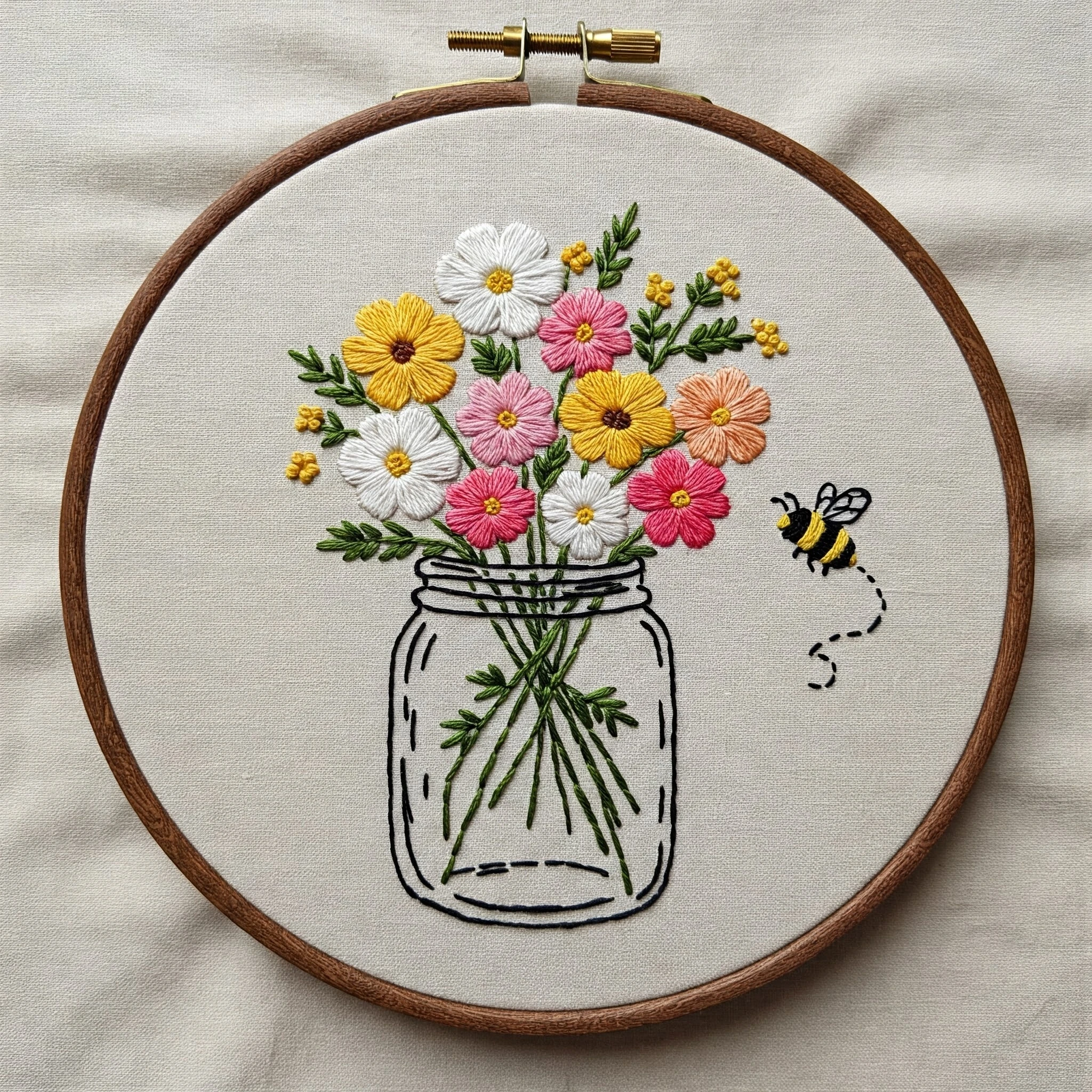
A fresh beginner palette for a sweet mason-jar garden hoop: clear pale glass, relaxed green stems, small meadow flowers, honey-yellow bee stripes, and delicate dark details that make the bumblebee and wildflowers easy to read.
Suggested DMC Palette
This selection keeps the design soft and bright while providing enough contrast for glass edges, tiny flower centers, bee details, and layered greenery.
Thread Count Guide
Use light strand counts so the jar stays transparent and the flower cluster does not become bulky.
| Area | Strands | Why |
|---|---|---|
| Jar outline and glass shine | 1–2 strands | Thin blue lines keep the mason jar light, clean, and glass-like. |
| Main stems | 2 strands | Enough structure to support the bouquet without overpowering the flowers. |
| Small leaf veins | 1 strand | Gives delicate detail and prevents the greenery from looking heavy. |
| Flower petals | 2 strands | Balanced coverage for lazy daisy, satin, and small straight-stitch petals. |
| Bumblebee body | 2–3 strands | Use 3 strands for plump stripes, 2 for a smaller, neater bee. |
Blending Ideas
Soft glass: blend one strand 747 with one strand B5200 for subtle jar highlights. Use 3846 only on the lower curve and water line.
Sunny bee: alternate 307 and 742 across the body, then add 310 stripes last so they stay crisp and raised.
Meadow flowers: pair 3326 with 3354 for pink flowers and 209 with 208 for purple sprigs. Add centers with 307 or tiny 310 knots.
Layered greens: stitch stems in 936 first, then add 470 leaves over the top for fresh, dimensional foliage.
Stitch Types by Design Element
A beginner can complete this design with a short list of dependable stitches. Keep the jar simple, then let the flowers and bee add texture.
Use for the jar outline, stem lines, bee antennae, and any thin drawn details. Short stitches make the jar curves smoother.
Good for slightly thicker stems or the jar base if you want a continuous, rounded line instead of separate back stitches.
Ideal for simple flower petals and small leaves. Anchor each loop with a tiny stitch so the petals keep their shape.
Use for the bee body, larger leaves, small buds, and any filled petal shapes. Keep stitches short on the bee so the stripes stay neat.
Add flower centers, pollen dots, seed textures, and tiny garden speckles. Two wraps are best for a beginner-friendly knot size.
Use for loose wildflower sprigs, grass-like filler, and tiny wing highlights around the bee.
Outlining & Shading Notes
Outline the jar with 1 strand of 747 for the palest lines, then strengthen only the base and water level with 3846. Leaving some gaps in the outline helps the glass look transparent.
For the bee, stitch the yellow body first in 742 or a 307/742 blend, then add 310 stripes in short satin or straight stitches. Keep the wings pale with B5200 and just a touch of 747.
Shade flowers by placing the darker color at the petal base: 3354 beneath 3326 for pink blooms, and 208 beneath 209 for purple flowers.
Texture Suggestions
Mix lazy daisy loops with small straight stitches so the bouquet looks like loose wildflowers rather than formal roses. Vary petal length slightly for a natural garden feel.
Use French knots in small clusters near flower centers and around the bee path to suggest pollen. Scatter them sparingly so the beginner design stays airy.
Add a few 1-strand blue highlight stitches inside the jar and over crossing stems to suggest glass without filling the whole jar shape.
Beginner-Friendly Stitching Order
- Transfer the design lightly, especially the jar edges, water line, flower stems, and bumblebee placement.
- Back stitch the main stems first in 936 so the bouquet structure is clear.
- Add the jar outline with 747, keeping the stitches small and leaving a few tiny breaks for a transparent glass effect.
- Stitch leaves in 470 and add 1-strand veins in 936 only where extra definition is needed.
- Work the flower petals with lazy daisy or satin stitch, grouping pinks and purples evenly across the bouquet.
- Add flower centers and pollen dots with French knots after the petals are finished.
- Stitch the bumblebee body last: yellow fill first, black stripes second, then wings, antennae, and eye dot.
- Check the hoop from arm’s length and add only a few final highlights so the jar and bouquet remain light and clean.
Quick Reference Plan
| Design part | DMC choices | Best stitches | Finish note |
|---|---|---|---|
| Glass jar | B5200, 747, 3846 | Back stitch, split stitch, straight stitch | Keep lines thin and leave open fabric for a transparent look. |
| Wildflower stems | 936, 470 | Back stitch, stem stitch, straight stitch | Stitch stems before petals so flowers sit neatly on top. |
| Pink and purple blooms | 3326, 3354, 209, 208 | Lazy daisy, satin stitch, French knots | Use darker shades at petal bases for gentle depth. |
| Bumblebee | 307, 742, 310, B5200 | Satin stitch, straight stitch, back stitch | Add black stripes and antennae last for crisp contrast. |