
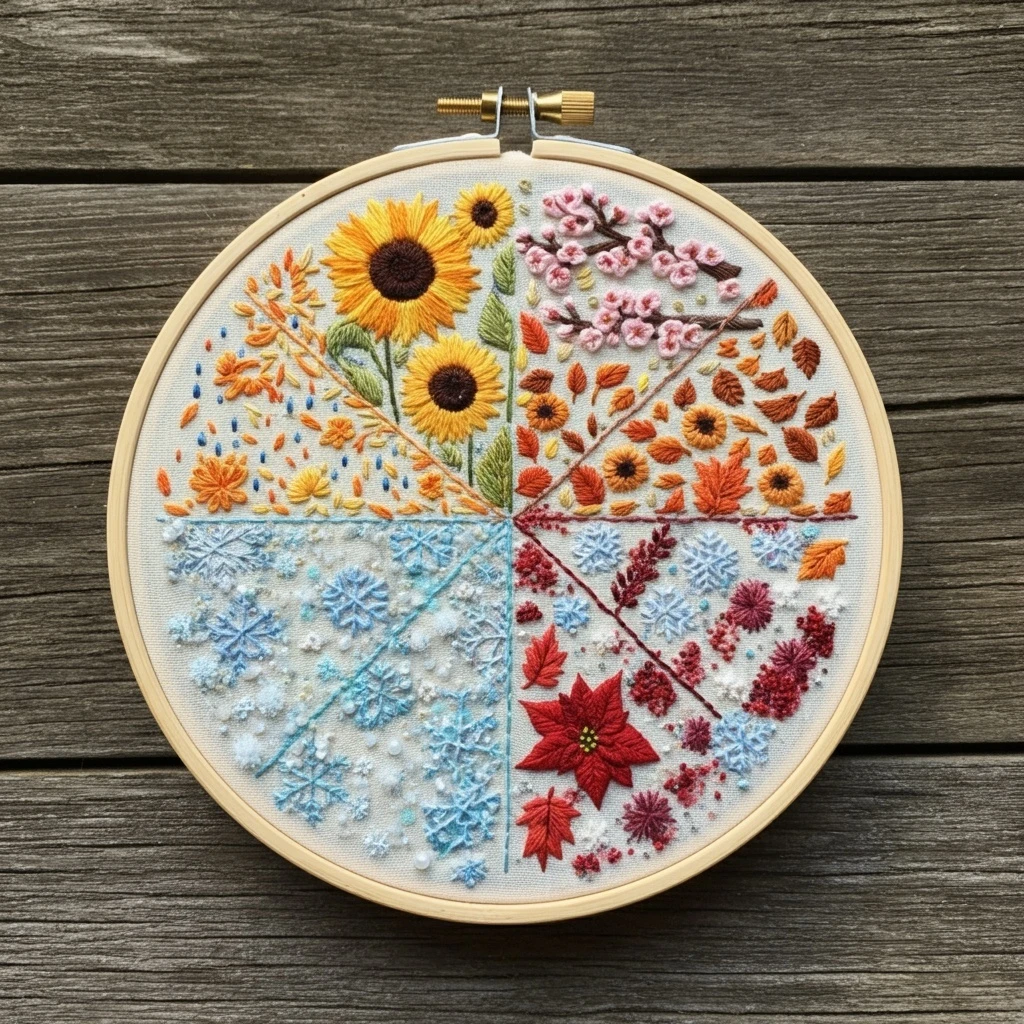
Beginners Guide Four Seasons Divided
A polished stitching plan for a beginner-friendly hoop divided into four seasonal scenes. The design asks for clear section outlines, soft color families, and small texture changes so spring, summer, autumn, and winter each feel distinct while staying harmonious in one circular composition.
Design reading
- Composition: a divided hoop layout, likely using quadrant or window-style seasonal sections. Keep borders crisp so the viewer reads the four seasons at a glance.
- Color balance: spring should feel fresh and pastel, summer bright and sunny, autumn warm and earthy, winter cool and quiet.
- Best visual strategy: use the same stitch vocabulary across all sections, then change thread counts and color blends to create seasonal variety.
Suggested DMC floss palette
Use these as practical matches for a four-season divided beginner hoop. Keep the palette compact, then blend neighboring shades where gentle transitions are needed.
Stitch plan by design area
| Area | Recommended stitches | Thread count | Practical notes |
|---|---|---|---|
| Dividing lines and hoop structure | Back stitch, whipped back stitch, stem stitch | 2 strands for lines, 3 for a bolder border | Stitch the dividers first so each seasonal scene stays clean. Whip the line with a lighter shade for a neat corded edge. |
| Spring flowers and buds | Lazy daisy, detached chain, French knots, straight stitch | 2 strands for petals, 1 strand for tiny buds | Use lighter pink on petal tips and mauve near centers. Keep knots small so the beginner layout does not feel crowded. |
| Summer blooms and sun accents | Satin stitch, woven wheel, fishbone leaf, seed stitch | 2-3 strands depending on size | Work from the center outward. Use DMC 725 sparingly as a highlight so the yellow remains bright but not overpowering. |
| Autumn leaves | Fishbone stitch, satin stitch, fly stitch, split stitch veins | 2 strands for leaf bodies, 1 strand for veins | Blend DMC 970 with 922 for leaves that shift from gold to copper. Add DMC 919 to the underside or tips for a curled-leaf effect. |
| Winter branches and snow | Stem stitch, back stitch, tiny straight stitches, couching | 1-2 strands | Use brown for branches, then add small touches of Winter White on top edges. Blue-gray shadows keep white snow visible on light fabric. |
| Grass, greenery, and filler texture | Seed stitch, fly stitch, long-and-short stitch, straight stitch clusters | 1-2 strands | Vary stitch direction so the four seasons do not look flat. Use short stitches for beginner control. |
Blending and shading ideas
Spring: blend one strand DMC 3716 with one strand 3688 for soft petal shading.
Summer: pair DMC 725 with 970 for marigold-like centers and sunny accents.
Autumn: transition DMC 970 → 922 → 919 inside larger leaves using long-and-short stitch or alternating satin stitches.
Winter: combine DMC 3865 with 3753 for snow shadows that still feel delicate and beginner-friendly.
Outlining details
Use DMC 433 for most outlines so the piece stays soft. Reserve DMC 938 for the deepest branch joints, small seeds, or important detail lines. Avoid outlining every petal in black; a dark brown outline gives a warmer handmade finish.
Texture suggestions
- Use French knots for berries, flower centers, and snowfall dots.
- Use seed stitch in each quadrant for a different seasonal ground texture.
- Use whipped back stitch on the central divider for a polished framed look.
Beginner-friendly workflow
- Start with the dividers and main branches.
- Finish one season at a time to avoid thread clutter.
- Keep thread lengths around 14-16 inches to reduce tangles.
Thread-count guidance
- 1 strand: fine veins, snow shadows, tiny details.
- 2 strands: most outlines, leaves, petals, branch work.
- 3 strands: bold flower centers, borders, textured focal accents.
Finishing notes
Because this design is divided, tension consistency matters more than heavy filling. Keep the fabric drum-tight, stitch symmetrical elements in the same order in each quadrant, and step back often to check whether one season is visually heavier than the others. If a quadrant looks too strong, add one or two small accents in a neighboring section rather than over-filling the whole hoop.
For a clean final piece, press from the back on a towel, avoid crushing French knots, and mount the hoop with the design centered so the seasonal divisions feel intentional and balanced.