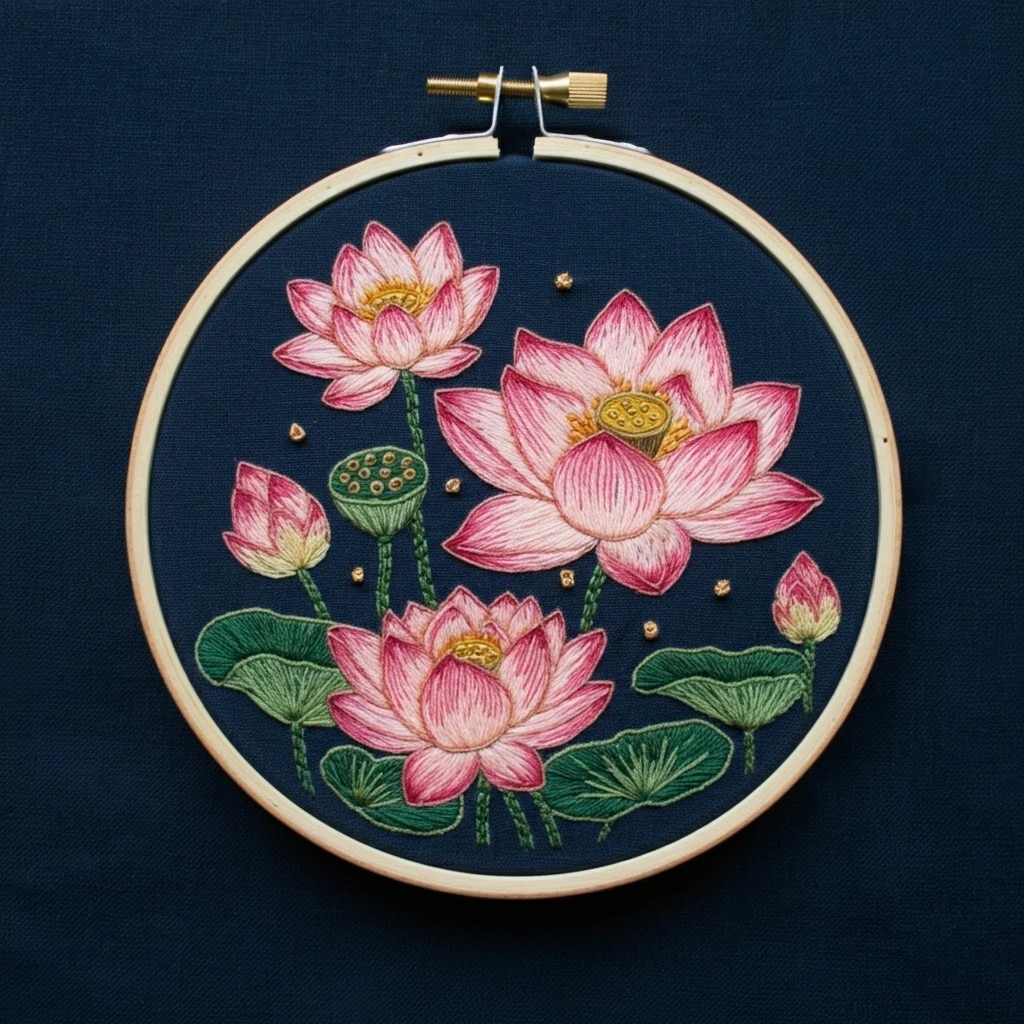
A graceful garden composition built around layered lotus petals, rounded lily-pad greens, calm blue-green water shadows, and small golden accents. The stitching approach below keeps the design beginner-friendly while adding soft shading and texture where it matters most.
Lotus pinksLily pad greensWater movementSoft botanical shading
Color story and DMC floss palette
The reference reads as a fresh lotus garden: pale blush petals, deeper rose inner folds, sage and moss leaves, watery blue-greens, warm ochre centers, and dark accents for definition. Use the darker shades sparingly so the overall design stays airy.
DMC 818 — Baby Pink
soft lotus petal base
Use 2 strands for outer petals and tiny buds; keep stitches long and smooth for a satin-like bloom.
DMC 3713 — Salmon Very Light
warm petal midtone
Blend into 818 for petal bodies, especially where petals overlap or turn inward.
DMC 3354 — Dusty Rose Light
inner petal shadows
Work with 1 strand in short directional stitches at petal bases and fold lines.
DMC 3722 — Shell Pink Medium
deep rose accents
Reserve for the darkest creases, tiny vein details, and the lower petals that need depth.
DMC 3821 — Straw
lotus centers and pollen glow
Use French knots or small seed stitches in flower centers; mix with one strand of 3852 for warmer sparkle.
DMC 3852 — Straw Very Dark
golden highlight
Add a few knots or straight stitches only; too much yellow can overpower the quiet pink flowers.
DMC 3012 — Khaki Green Medium
lily pad base
Good for broad leaves, pad edges, and soft garden foliage behind the blossoms.
DMC 3011 — Khaki Green Dark
leaf shadows
Use for underside edges, leaf notches, and the side of stems away from the light.
DMC 3052 — Green Gray Medium
soft leaf highlight
Blend with 3012 for rounded lily pads and the upper edges of foliage.
DMC 3810 — Turquoise Dark
water and cool shadow
Use 1 strand for ripples, tiny water lines, and cool shadows between leaves.
DMC 928 — Gray Green Very Light
misty water highlight
Float short running stitches around the lotus to suggest reflections without filling the whole background.
DMC 839 — Beige Brown Dark
fine outlines and earthy details
Use 1 strand for delicate outlines, stems, leaf centers, and any small branch or soil marks.
Stitch suggestions by area
Lotus petals: Use satin stitch for small petals and long-and-short stitch for larger petals. Angle stitches from the petal base toward the tip, changing direction slightly on each petal so the flower looks layered.
Petal veins: Add one-strand split stitch or stem stitch in 3354/3722. Keep these lines short and tapered; do not outline every petal edge heavily.
Flower centers: Work French knots, colonial knots, or tiny seed stitches in 3821 and 3852. Cluster them loosely so the center feels organic.
Lily pads: Use fishbone stitch for small pointed leaves and satin/long-and-short stitch for rounded pads. Add a single curved split-stitch vein in 3011.
Stems: Stem stitch is ideal because it curves smoothly. Use 2 strands of 3011 or 839 for sturdy stems, switching to 1 strand near buds.
Water: Use broken running stitch or short straight stitches in 928 and 3810. Space them irregularly to suggest gentle reflections.
Blending and shading plan
Soft petals: Thread the needle with one strand of 818 and one strand of 3713 for a natural blush transition.
Deep petal bases: Use one strand 3713 plus one strand 3354 where petals emerge from the center.
Leaf dimension: Blend 3012 + 3052 on lit edges, then 3012 + 3011 for lower or overlapping leaves.
Water depth: Use mostly 928 for subtle highlights and touch in 3810 only beneath flowers and pads.
Outline control: Use 839 in 1 strand rather than black. It defines the drawing while keeping the botanical look soft.
Beginner shortcut: If long-and-short stitch feels difficult, fill petals with satin stitch first, then add 2–3 short shadow stitches at the base. You will still get a shaded effect without complex blending.
Recommended stitching order
Transfer the design lightly; avoid thick pencil marks in pale petal areas.
Stitch the main stems first with 2-strand stem stitch so flowers and leaves can sit cleanly on top.
Fill the largest leaves and lily pads, keeping the center vein visible.
Work the lotus petals from back petals to front petals, using paler tones on outer petals.
Add darker rose accents at petal bases and where petals overlap.
Place flower-center knots last so they stay raised and crisp.
Add water ripples after the floral forms are complete; stop early rather than overfilling.
Finish with one-strand outline touches only where the shape needs sharpening.
Practical embroidery tips
Keep the fabric drum-tight. Smooth satin petals need steady tension. Re-tighten the hoop whenever stitches begin to look uneven.
Use shorter lengths of floss. Pale pinks can fuzz quickly; cut 14–16 inch lengths and separate strands before re-combining them.
Mind stitch direction. Petals should radiate from the center, leaves should follow their natural vein, and water should travel horizontally or in gentle curves.
Test knots on scrap fabric. French knots with 1 strand look delicate; 2 strands make the lotus center more visible. Choose based on hoop size.
Leave breathing room. In a lotus garden design, unstitched fabric can act like light and open air. Do not fill every background gap.
Press from the back. After finishing, place the embroidery face-down on a towel and press gently so raised knots and satin petals are not flattened.