
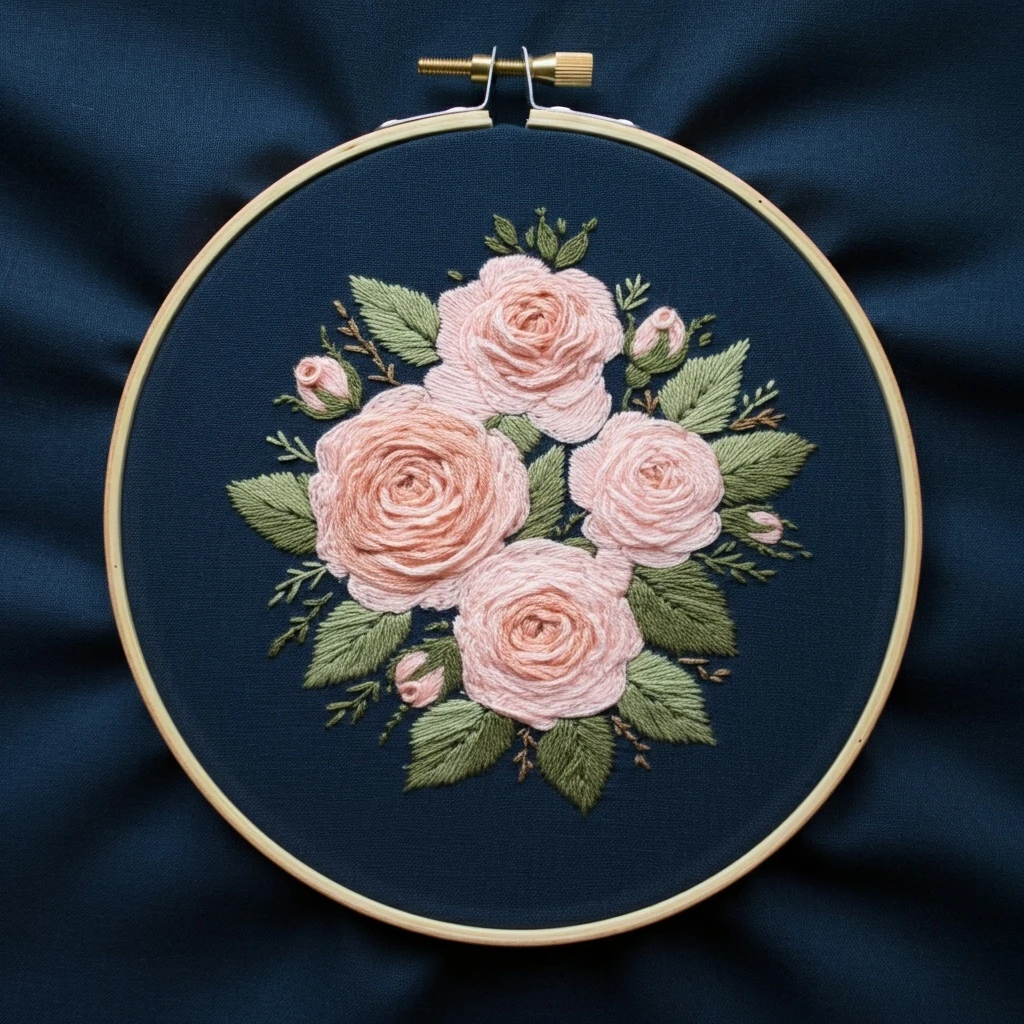
Blush Rose Garden On Navy Fabric
This design suggests a soft garden arrangement of blush roses and leafy accents stitched onto a deep navy ground. The dark fabric acts like a dramatic backdrop, making pale pink petals, ivory highlights, and fresh greenery stand out beautifully.
To keep the piece elegant rather than heavy, lean into luminous light values, selective shading, and slightly brighter outlines than you would use on white fabric. The recommendations below are designed to help the roses glow clearly against navy while preserving a classic floral look.
Suggested DMC floss palette
A rose-garden palette chosen to read clearly on navy fabric, with light values and fresh greens doing most of the visual lifting.
| Swatch | DMC | Color name | Practical use notes |
|---|---|---|---|
| B5200 | Snow White | Bright highlights for petal tips, reflective edges, and tiny accents that need to pop strongly against navy fabric. | |
| 712 | Cream | Soft ivory blending shade for inner light petals and transitions between white highlights and blush pink. | |
| 3713 | Salmon - Very Light | Delicate blush wash for petal edges, outer rose layers, and airy flower buds. | |
| 761 | Salmon - Light | Main blush tone for open roses and most of the visible petal mass. | |
| 3326 | Rose - Light | Use at petal bases and in layered folds to add depth without making the roses look too dark. | |
| 3350 | Dusty Rose - Ultra Dark | Best for the deepest petal creases, rose centers, and a few selective shadow lines. | |
| 772 | Yellow Green - Very Light | Leaf highlights and any foliage that needs to stay bright enough to show on dark fabric. | |
| 3012 | Khaki Green - Medium | Main leaf color for balanced greenery, medium stems, and soft leafy fillers. | |
| 3011 | Khaki Green - Dark | Deeper leaf shadows and stem bases. Use sparingly so details do not disappear into the navy background. | |
| 420 | Hazelnut Brown - Dark | Warm twig tones or branch accents if the design includes garden stems or wreath structure. | |
| 932 | Antique Blue - Light | Optional soft cool accent if you want subtle shadow blending that harmonizes with the navy fabric. | |
| 3799 | Pewter Gray - Very Dark | Use instead of black for the tiniest deepest accents. It reads more refined and less harsh. |
Design reading & fabric considerations
The navy background changes how the palette behaves, so contrast planning matters more than usual.
Why navy works
The dark fabric adds instant drama and makes pale petals look luminous, almost like moonlit blooms.
What to avoid
Do not overuse very dark outlines or deep green fills, because they can sink into the background and flatten detail.
Best contrast strategy
Use white and cream highlights generously on focal roses, then keep shadows controlled and selective.
Layout balance
Repeat light roses across the design so bright elements feel evenly spaced rather than clustered in one corner.
Suggested stitches
Choose stitches that create smooth petal shaping and visible leaf texture on dark fabric.
Thread-count guidance
Slightly fuller stitching helps details read more clearly on dark fabric.
- 1 strand: fine veins, tiny detail lines, and subtle last-pass shadow accents.
- 2 strands: the best all-purpose choice for outlines, stems, most petals, and standard leaves.
- 3 strands: good for focal roses, highlighted petals, and leaf shapes that need stronger presence.
- 6 strands: reserve for occasional French knots or deliberately raised center details only.
Blending, outlining, and shading guidance
The goal is a soft floral look with enough contrast to stay legible on navy.
- Build petals from light to dark: start with B5200 or 712 at the brightest edge, move into 3713 and 761 for the main body, then tuck 3326 or 3350 into the deepest folds.
- Needle blending works beautifully here: use one strand of 712 + one strand of 3713 for creamy blush transitions, or one strand of 761 + one strand of 3326 for soft inner shadow.
- Use lighter outlines than expected: outline key rose shapes with 3326 or even 761 rather than a very dark thread, so edges remain soft and floral.
- Keep deepest shadows small: 3350 and 3799 should appear only in tiny pockets where petals overlap or curl tightly inward.
- Leaf shading should stay visible: start with 772 on upper or outer edges, fill with 3012, and place 3011 only at the base or undersides.
- Echo highlights around the design: place bright white or cream touches on multiple blooms so the whole composition feels balanced and luminous.
Texture suggestions
A little texture keeps the garden feeling natural and dimensional.
- Mix long and short stitch roses with a few satin stitch buds for variety.
- Add French knot clusters as tiny filler flowers or garden seed heads.
- Use fishbone leaves for larger foliage and straight stitch leaves for small fillers.
- Let a few outer petals stay lightly outlined or even unoutlined for a softer, painterly finish.
- If the design feels too flat, add one padded satin-stitched focal bud near the center of interest.
Beginner-friendly stitching order
Working in a steady order helps keep the composition tidy.
- Transfer the full design clearly and test your tracing method on dark fabric first.
- Stitch main stems and branch lines before filling flowers.
- Complete the largest roses one at a time so shading stays consistent within each bloom.
- Add smaller buds and secondary petals next.
- Work leaves and foliage after the blossoms so they can tuck behind petals naturally.
- Finish with highlights, tiny accents, and final selective outlining.
Practical tips for dark-fabric embroidery
A few adjustments make stitching on navy much easier.
- Use a bright task light so light-value thread colors stay easy to read while you work.
- Choose a transfer method that shows clearly on dark fabric, such as chalk, a light transfer pencil, or washable white marking tools.
- Keep the back neat, because navy fabric can show lumps or shadowing from bulky thread tails.
- Shorter satin stitches often lie smoother and catch light better than long stitches on dark backgrounds.
- If a pink looks too dull on navy, add a tiny touch of cream beside it rather than replacing the whole section.
- Press finished work from the back over a towel to preserve raised texture and keep the fabric surface smooth.