
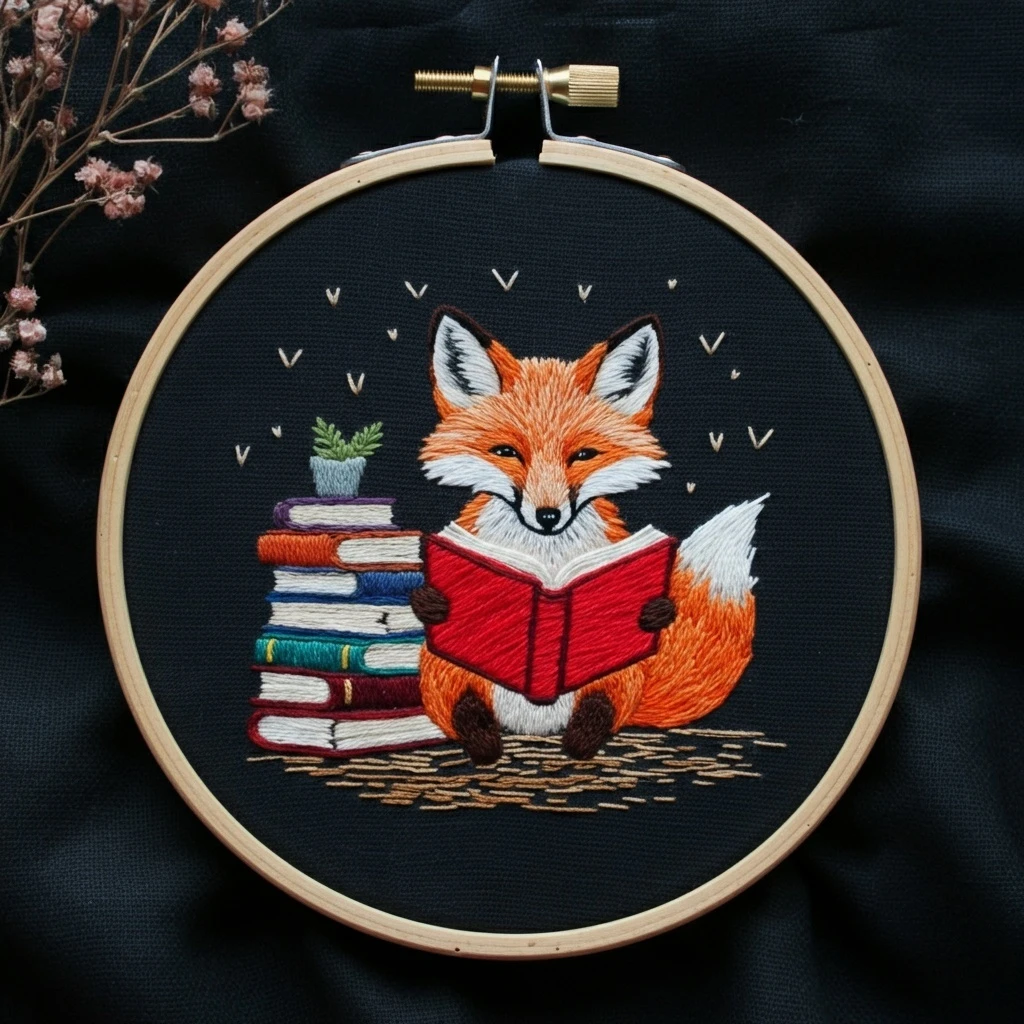
Book Loving Fox
A cozy woodland design built around a bright orange fox, a deep red open book, stacked storybooks, soft cream page details, a tiny potted plant, and warm straw-like ground texture on dark fabric. This guide balances rich storybook color with beginner-friendly stitch choices.
Polished DMC Color Palette
The design uses high contrast: fiery fox fur, crisp white facial accents, a saturated red book, blue/teal/wine book spines, muted greenery, and warm beige ground stitches. Keep the fox and book as the visual focus, then use calmer supporting colors around them.
Main fox fur highlights; use long directional stitches along cheeks, chest edges, and tail curves.
Mid-tone fox fur, ears, body, and tail; blend with 741 for a warm, lively coat.
Darker fur shadows under ears, side of face, legs, and tail base.
Muzzle, inner ears, chest, tail tip, and book-page highlights; use sparingly for sparkle.
Soft shadows inside white fur and pages; feather into B5200 instead of outlining harshly.
Eyes, nose, paws, book crease, fox outline, and deepest separators.
Open book cover; stitch smoothly so it reads as the bold central prop.
Book cover shadow, lower folds, and maroon book spine in the stack.
Blue book spines; place beside white page edges for crisp contrast.
Teal book spine accents; add tiny yellow stitches for decorative bands.
Plant leaves; stitch short fern-like strokes radiating from stems.
Ground texture and tiny background marks; ideal for broken seed or running stitches.
Stitch Map by Design Area
Fox fur and face
- Long and short stitch: Work the face from the nose outward, following the direction of natural fur. Vary stitch length so color transitions look soft.
- Thread count: Use 1 strand for the face, muzzle, and ear detail; use 2 strands for larger body and tail sections.
- Blending: Combine 1 strand DMC 741 with 1 strand DMC 721 for the main coat, then add single-strand DMC 922 shadow strokes.
- Eyes and nose: Satin stitch or tiny padded satin in DMC 3371, finished with a one-stitch B5200 highlight.
Open red book
- Satin stitch: Fill the book cover in DMC 321 with neat stitches angled consistently from top edge to lower center.
- Shadowing: Add DMC 815 along the book spine, lower corners, and page fold; blend a few red stitches into the shadow edge.
- Pages: Use B5200 with DMC 762 under the cover edge and along the page fan for dimension.
- Outlining: Back stitch the book edges with 1 strand DMC 3371 or a softer dark brown if you want a gentler finish.
Stacked books
- Book spines: Use satin stitch or split stitch fill for colored bands in 798, 3846, 815, 721, and optional purple DMC 333.
- Page blocks: Use 1–2 strands B5200, then add short DMC 762 or 3864 horizontal lines for page texture.
- Separators: Back stitch the book outlines with 3371, but keep the line thin so the stack does not overpower the fox.
- Decorative bands: Add tiny straight stitches in DMC 3821 or 3864 to mimic gold stamping on the teal book.
Plant, ground, and background marks
- Leaves: Use fishbone stitch or detached straight stitches in DMC 469, with a few lighter accents in DMC 472.
- Pot: Fill with satin stitch in muted blue-gray such as DMC 931 or 932; outline with 1 strand 3371.
- Ground: Scatter short running stitches and seed stitches in DMC 3864, 420, and 738 for straw texture.
- Floating marks: Use small V-shaped straight stitches in cream or beige; keep them irregular and airy.
Thread-Count & Blending Guidance
| Area | Suggested strands | Why it works |
|---|---|---|
| Fine facial fur, inner ears, muzzle shadows | 1 strand | Allows tapered strokes, subtle shading, and clean expression around the eyes. |
| Main fox body and tail | 2 strands | Covers faster while still letting fur direction show through. |
| Book cover and larger book spines | 2 strands | Creates smooth color blocks that contrast with the textured fur. |
| Outlines, page lines, facial details | 1 strand | Keeps features crisp without making the design look heavy. |
| Ground texture and decorative background marks | 1–2 strands | Use 1 strand for delicate texture, 2 strands for visible stitches on dark fabric. |
Best blend for the fox coat
For the richest orange, thread your needle with one strand DMC 741 and one strand DMC 721. Add isolated DMC 922 strokes where the fur turns under the chin, beside the book, at the tail base, and around the legs. Keep B5200 stitches clean and directional so the white fur looks soft rather than flat.
Beginner-Friendly Stitching Order
Use a white transfer pen, chalk pencil, or water-soluble stabilizer. Test marking removal first, especially on black or navy linen.
Stitch the rectangular book shapes first because they set the baseline and help you place the fox body cleanly.
Complete the bright book cover before the paws so the dark paw stitches can sit on top cleanly.
Place white muzzle, chest, and tail tip first, then orange mid-tones, then darker copper shadow strokes.
Eyes, nose, mouth, and whisker-like separators should be stitched after the fur fill so the expression stays sharp.
Add ground stitches, plant leaves, tiny book decorations, and floating V marks after the main subject is complete.
Extra Practical Tips
For cleaner outlines
- Use split back stitch around the fox if you want a softer illustrated edge.
- Use regular back stitch on books for neat graphic geometry.
- Outline white fur with gray-brown or pearl gray rather than pure black where a gentle edge is needed.
For better texture
- Do not make every fur stitch the same length; stagger them like tiny brushstrokes.
- Let some dark background show between ground stitches for a natural scattered straw effect.
- On the tail, curve stitches toward the white tip so the tail feels fluffy and dimensional.
A 6-inch hoop gives comfortable room for the stacked books and tail. For a smaller hoop, simplify the page lines and reduce the number of floating background marks rather than shrinking the fox facial details.