
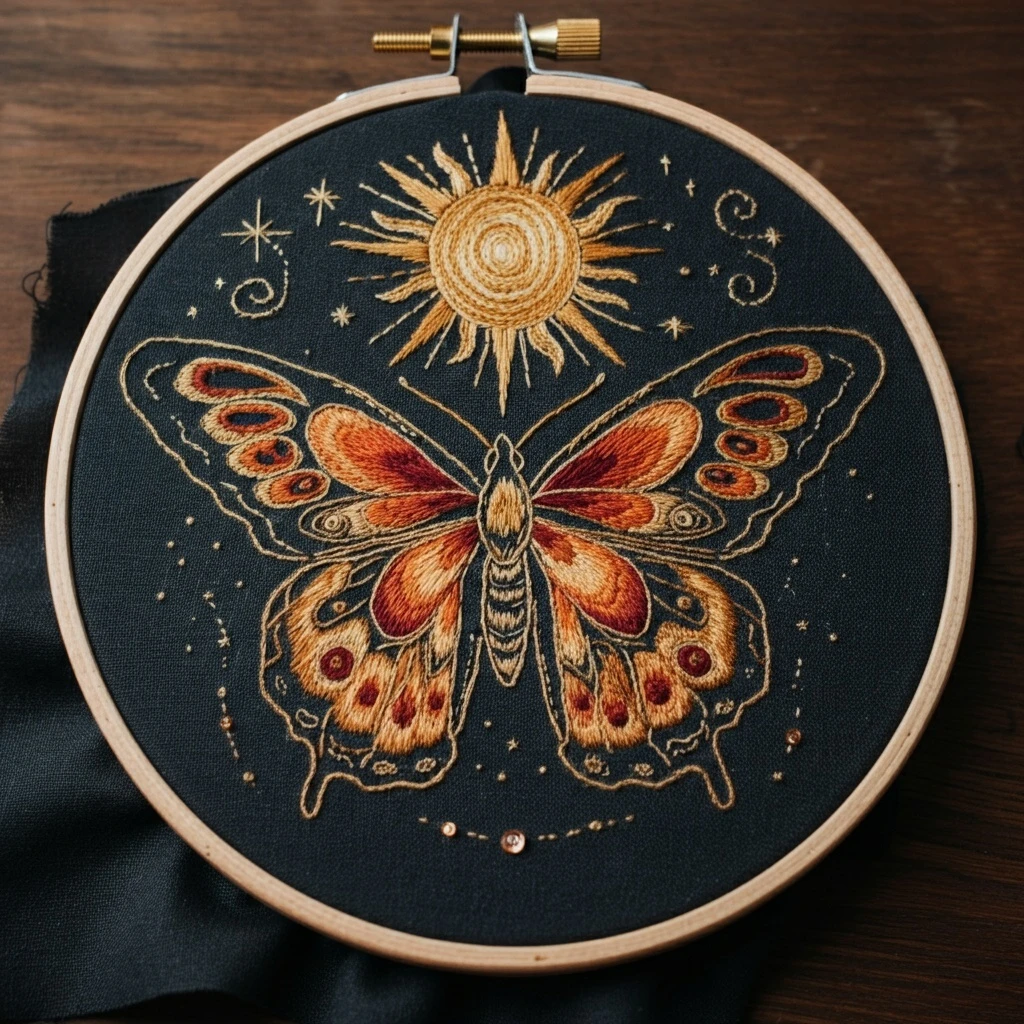
Celestial Butterfly on Black Fabric
This dramatic design is made for dark cloth: a luminous butterfly with celestial wing markings, glowing moon-and-star details, and jewel-toned highlights that pop against black fabric. The stitched result should feel magical and high-contrast, with clean wing symmetry, sparkling gold accents, and careful thread coverage so the dark ground does not dull the colors.
Polished DMC Color Palette
This palette is chosen for visibility on black fabric. Pale creams, golds, lavender, turquoise-blue, and rose tones will read clearly, while deep violet and charcoal help shape the butterfly without losing the silhouette.
Stitch Map by Design Element
Thread Count & Blending Guide
Fine details
Use 1 strand for antennae, wing veins, star rays, tiny dots, moon outlines, and final correction stitches. On black fabric, pale one-strand details still read clearly.
Main fills
Use 2 strands for wing panels, moon fills, body shapes, and larger celestial motifs. Two strands help prevent the black ground from dulling the floss color.
Raised sparkle
Use 2–3 strands for prominent French-knot stars or decorative body dots. Use three strands sparingly so the starfield sparkles without becoming bulky.
Shading, Outlining & Texture Suggestions
Working on black fabric
- Use a white, silver, or water-soluble transfer method that remains visible while stitching.
- Choose two strands for most color areas so the black background does not show through.
- Avoid long dark carried threads behind pale motifs; they can create shadows or bulk.
- Check the design under strong light while stitching so subtle colors remain balanced.
Butterfly symmetry
- Stitch matching sections on left and right wings before moving to the next color.
- Repeat highlight placement so the butterfly feels intentional and balanced.
- Keep the body centered and use it as the visual anchor for wing direction.
- If one side looks heavier, balance it with a few small star stitches rather than more fill.
Celestial sparkle
- Mix French knots, straight stitches, and tiny crosses for a varied starfield.
- Keep the brightest 3865 points near the largest celestial motifs.
- Use gold sparingly on black fabric; a few well-placed stitches look luxurious.
- Leave dark space around stars so they appear to glow.
Outlining approach
- Use pewter, lavender, cream, or gold outlines where black thread would disappear.
- Outline after filling so the edges sit crisply above the wing colors.
- Use split stitch for curved wing edges and back stitch for small star rays.
- Reserve 310 for details on light stitched areas rather than the outer silhouette.
Beginner-Friendly Stitching Order
- Transfer with contrast: mark the butterfly outline, body, wing panels, larger moons, and main stars using a white or light transfer tool suitable for dark fabric.
- Stitch the body first: anchor the center with 3799, 414, or 154 so wing symmetry is easier to judge.
- Fill wing panels: work matching left and right sections together, moving from dark inner shades to brighter outer highlights.
- Add wing veins: use one-strand lines once the wing fills are complete.
- Stitch celestial motifs: add moons, large stars, and gold details in 783, 3821, 3865, and 746.
- Finish with sparkle: add tiny knots, seed stitches, antennae, final outlines, and correction stitches last.
Practical Tips for a Clean Finish
Fabric & hoop
Use black cotton, black linen, or a tightly woven dark cotton-linen blend. Keep the hoop drum-tight because pale stitches on black fabric show every wobble and tension change.
Needle choice
A sharp embroidery needle size 7–9 works well for one- and two-strand details. For three-strand knots, use a slightly larger needle so the knots pull through smoothly.
Lighting matters
Stitch under a bright lamp or daylight. Black fabric absorbs shadows, so good lighting helps you avoid uneven stitch spacing and misplaced star details.
Keep thread clean
Pale floss shows lint and dark fibers easily. Wash hands before stitching, keep thread lengths shorter, and store cream or white floss away from dark fabric scraps.