
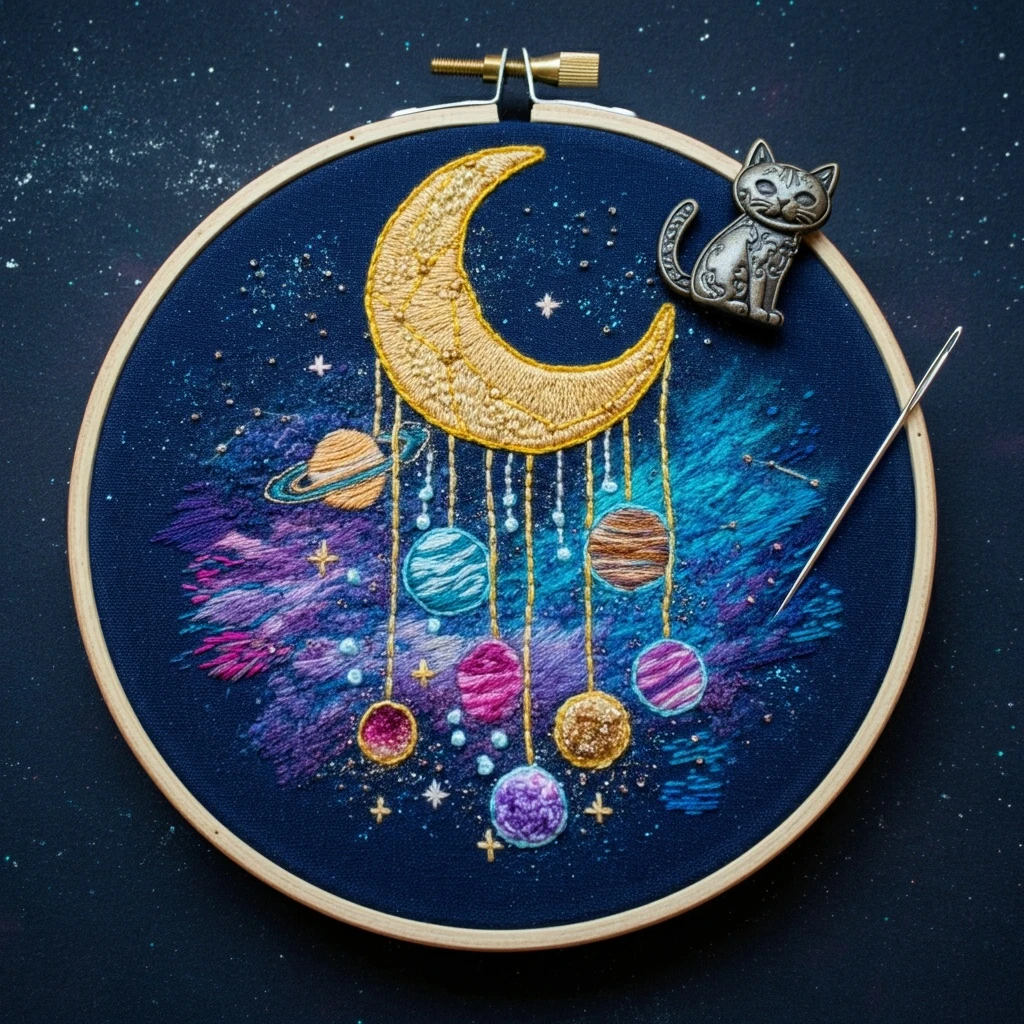
Celestial Moon Planets
This cosmic embroidery design combines a luminous moon, small planets, orbit lines, stars, and soft celestial accents. The stitched version should feel balanced and magical: a creamy dimensional moon, colorful planet details, fine orbit curves, and scattered golden sparkles that keep the composition airy rather than crowded.
Polished DMC Color Palette
This palette balances moonlit creams, golden stars, cool blue and teal planets, lavender cosmic shading, and warm rust or rose accents. Use the bright whites and golds sparingly so they feel like true sparkle against the softer planet tones.
Stitch Map by Design Element
Thread Count & Blending Guide
Fine linework
Use 1 strand for orbit lines, planet bands, crater details, star rays, and small outline corrections. One strand keeps the celestial geometry refined.
Main fills
Use 2 strands for the moon fill, planet bodies, larger stars, and bolder ring sections. Two strands give clean coverage while preserving smooth curves.
Raised sparkle
Use 2–3 strands for French-knot stars and prominent planet dots. Use three strands only for a few focal sparkles near the moon or largest planet.
Shading, Outlining & Texture Suggestions
Moon dimension
- Keep the brightest moon stitches on the outer edge facing the starfield.
- Use 822 and 762 for craters or inner shadows rather than heavy dark outlines.
- Use small curved stitches to follow the moon shape and avoid flat blocks.
- Add final white highlights after all cream and gray shading is complete.
Planet clarity
- Use one color family per planet so small shapes stay readable.
- Place darker stitches along the lower or far side of each planet.
- Use one-strand bands only after the planet fill has settled.
- Leave a tiny highlight spot on each larger planet for a polished look.
Orbit movement
- Mark orbit curves lightly before stitching so they remain smooth and even.
- Use couching for long sweeping arcs if you want a very clean curve.
- Break some orbit lines behind planets to create overlap and depth.
- Keep orbit stitches thinner than planet outlines so they feel airy.
Starfield balance
- Cluster more stars near the moon and planets, then fade outward.
- Mix knots, seed stitches, and tiny crosses for varied sparkle.
- Use gold as the main sparkle and blue-lavender as supporting dust.
- Leave open fabric between clusters so the design keeps a clean celestial feel.
Beginner-Friendly Stitching Order
- Transfer lightly: mark the moon, planets, orbit curves, largest stars, and a few dot clusters. Keep tiny stars freehand for the end.
- Stitch the moon first: fill the moon body, add soft shading, then place outer highlights.
- Fill the planets: work one planet at a time, completing the base fill before bands or ring details.
- Add orbits and rings: stitch curves slowly with one strand, breaking lines behind planets for depth.
- Place larger stars: use straight stitches or small satin shapes for focal sparkles.
- Finish with tiny details: add French knots, cosmic dust, crater marks, final highlights, and outline corrections last.
Practical Tips for a Clean Finish
Fabric & hoop
Warm cream cotton, linen, or cotton-linen keeps the moon and planets soft while still allowing gold and blue details to stand out. Maintain firm hoop tension for smooth orbit lines.
Needle choice
Use a sharp embroidery needle size 7–9 for one- and two-strand stitching. For three-strand knots, switch to a slightly larger needle so the wraps pull through cleanly.
Curves and circles
For neat planets, use shorter satin stitches near curved edges and slightly longer stitches across the center. For orbits, rotate the hoop as you stitch so your hand follows the curve comfortably.
Preventing clutter
Stop adding stars before every blank space is filled. The open fabric is what makes the moon, planets, and orbit lines feel spacious and celestial.