
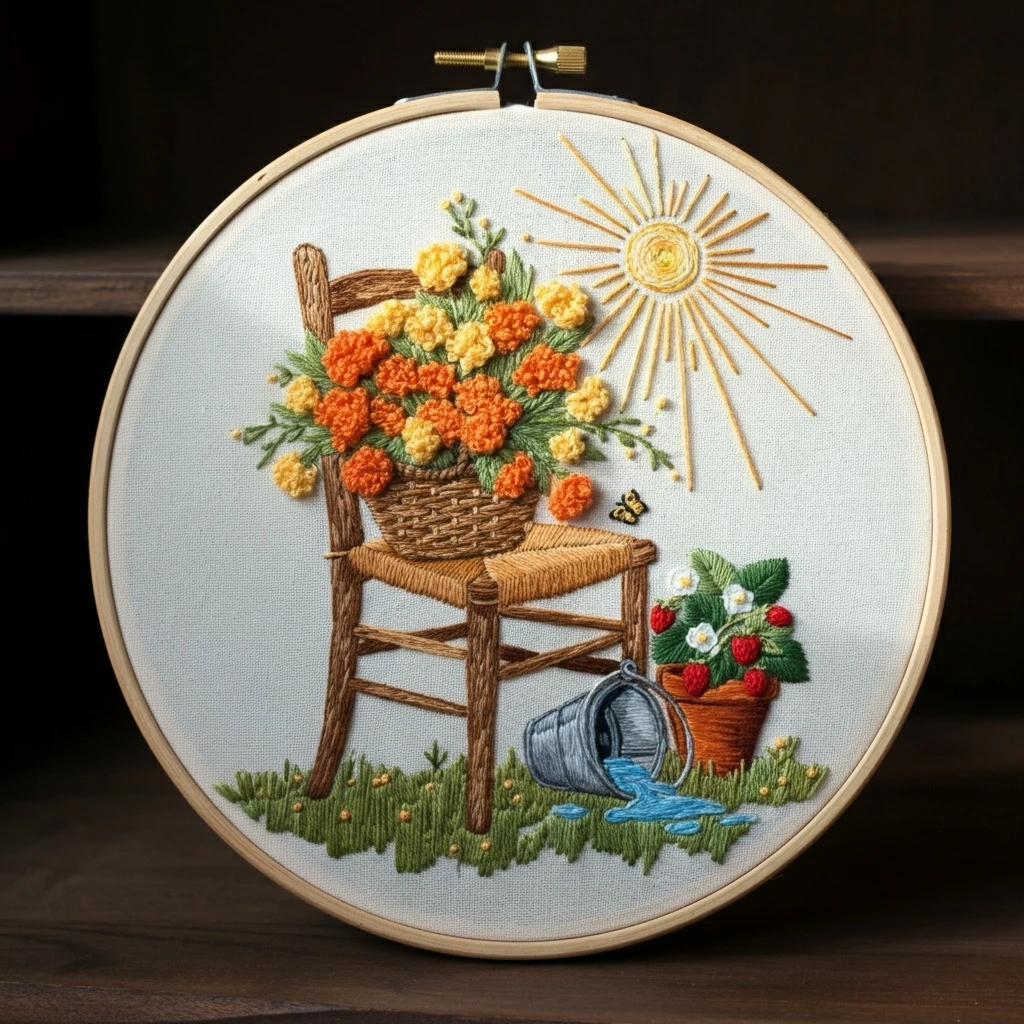
Chair with Flowers
This charming floral chair design combines a simple wooden chair silhouette with a soft bouquet or trailing flowers arranged around the seat and back. The stitched version should feel warm, homey, and garden-like: crisp chair rails, subtle wood shading, cheerful blossoms, leafy stems, and gentle outlines that keep the furniture structure clear while letting the flowers feel abundant.
Polished DMC Color Palette
This palette pairs warm chair browns with fresh greenery and a cottage-garden floral mix of rose, blush, yellow, lavender, and blue. Use the browns in clean structural lines, then let the flowers add texture and color around the seat and back.
Stitch Map by Design Element
Thread Count & Blending Guide
Fine detail
Use 1 strand for chair grain, thin stems, vine curls, tiny flower centers, small petal outlines, and final corrections. One strand keeps delicate garden details tidy.
Main forms
Use 2 strands for chair rails, seat fill, larger petals, leaves, and visible flower clusters. Two strands give clean coverage without making the small design bulky.
Raised texture
Use 2–3 strands for French-knot flower centers and textured floral dots. Use three strands only for focal blooms so the chair lines stay neat.
Shading, Outlining & Texture Suggestions
Clean chair structure
- Stitch the chair frame before the surrounding flowers so the furniture stays readable.
- Use darker brown on lower edges and under the seat for simple dimension.
- Add short wood-grain strokes rather than filling every surface with lines.
- Keep legs and back rails straight by rotating the hoop to stitch comfortably.
Soft floral fullness
- Place larger blossoms first, then fill gaps with tiny knots and leaves.
- Use darker petal colors at flower centers and lighter colors at outer tips.
- Mix lazy daisy flowers, satin petals, and French knots for natural variety.
- Let a few flowers overlap the chair lightly to make the design feel integrated.
Leaf and vine texture
- Curve stems around the chair rather than making them all vertical.
- Use fishbone stitch for larger leaves and straight stitches for tiny leaf clusters.
- Keep darker greens behind flowers and lighter greens on outer sprigs.
- Avoid overfilling greenery; the flowers need space to stand out.
Outlining approach
- Outline the chair after the fill stitches so the rails look crisp.
- Use brown outlines for wood and green outlines for foliage; avoid harsh black.
- Use split stitch for curved floral shapes and back stitch for straight chair lines.
- Outline only selected petals if a bloom needs definition.
Beginner-Friendly Stitching Order
- Transfer the structure: mark the chair outline, seat, back rails, main flowers, stems, leaves, and only the largest vine curves. Add tiny filler flowers later by eye.
- Stitch the chair first: complete the frame, seat, legs, and wood highlights before adding blossoms over or around it.
- Add main stems and vines: place the greenery structure so the flower clusters have a natural path.
- Stitch larger flowers: work focal blooms in pink, yellow, lavender, and blue before adding small filler flowers.
- Add leaves and fillers: tuck small leaves, buds, and knots around the main blooms to create fullness.
- Finish with highlights: add flower centers, tiny white stitches, final chair outlines, and small wood-grain corrections last.
Practical Tips for a Clean Finish
Fabric & hoop
Warm cream cotton, linen, or cotton-linen suits the cozy chair-and-garden palette. Keep the hoop drum-tight so straight chair rails remain even and floral knots do not pucker the fabric.
Needle choice
Use a sharp embroidery needle size 7–9 for one- and two-strand stitching. For three-strand French knots in flower centers, switch to a slightly larger needle for easier pull-through.
Preventing clutter
Keep the chair lines visible by limiting flowers that cross over major rails. A few overlaps add charm; too many can hide the chair silhouette.
Color balance
Repeat each flower color in at least two places so the bouquet feels balanced. If one corner becomes too bright, add a few green leaves or brown chair highlights nearby.