
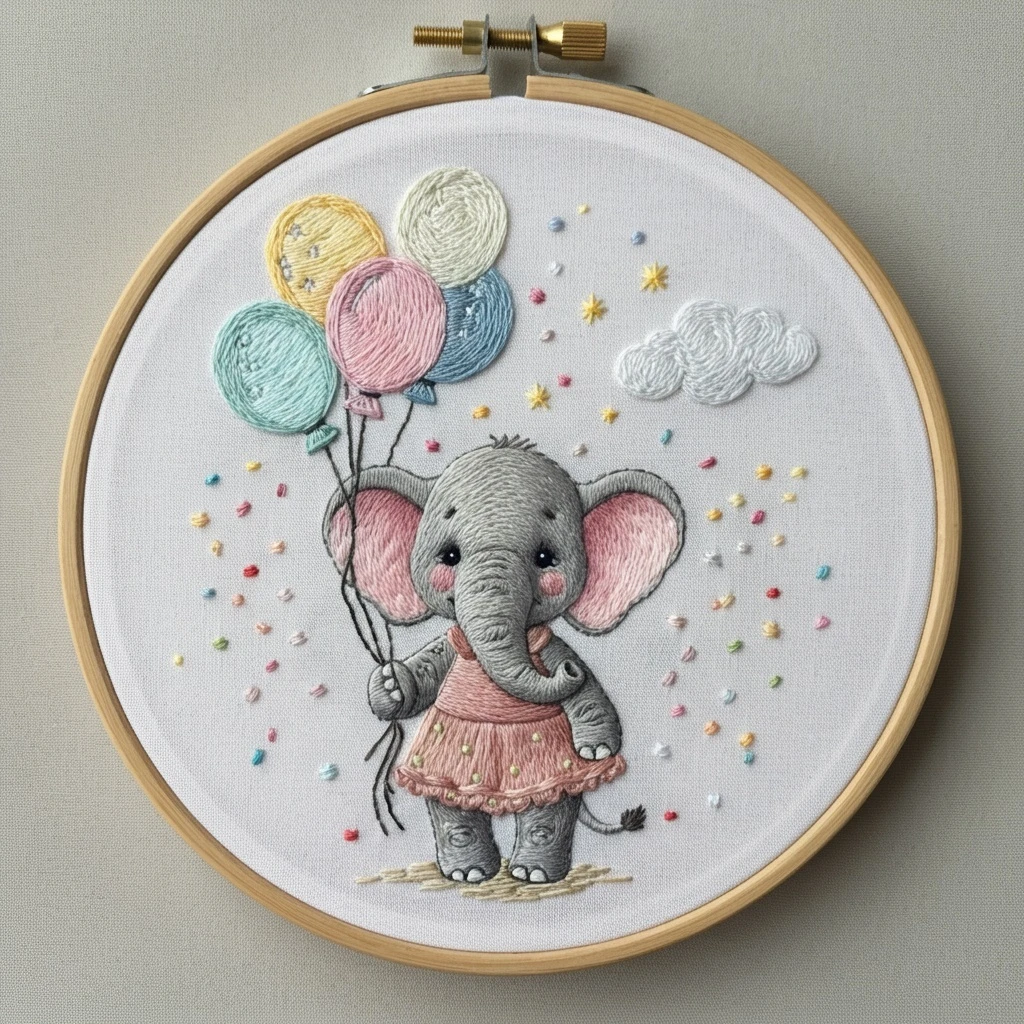
Charming Baby Elephant with Balloons
This sweet nursery-style design features a soft baby elephant paired with floating balloons and delicate string details. The embroidery should feel gentle, cheerful, and rounded: plush gray elephant shading, oversized ears, a softly curved trunk, tiny eye and cheek details, pastel balloon highlights, and fine strings that stay light enough not to compete with the main character.
Polished DMC Color Palette
This palette uses soft elephant grays, warm nursery creams, and cheerful balloon colors. Keep the elephant body mostly neutral and let the balloons carry the brighter pink, blue, yellow, mint, and lavender accents.
Stitch Map by Design Element
Thread Count & Blending Guide
Fine details
Use 1 strand for eyes, nostril, mouth, toes, balloon strings, highlight glints, and small facial details. One strand keeps the baby elephant sweet and delicate.
Main fills
Use 2 strands for elephant body fills, ears, trunk, balloons, and any larger decorative accents. Two strands provide smooth coverage without making the design bulky.
Raised accents
Use 2–3 strands for balloon knots, small bows, or raised dots. Use three strands sparingly so the strings and elephant features remain light.
Shading, Outlining & Texture Suggestions
Soft elephant dimension
- Keep the forehead, cheek, trunk top, and ear edges lighter than the belly and feet.
- Use curved stitch direction to support the rounded baby-elephant shape.
- Use dark gray sparingly; too much can make the elephant look older or heavy.
- Add facial details last so the expression stays neat and friendly.
Balloon shine
- Place the brightest highlight in the same upper area on each balloon.
- Use a darker shade along the lower edge or tied knot for depth.
- Leave the balloon strings thin so the balloons feel light.
- Repeat pastel colors in small details to balance the cluster.
Nursery-friendly texture
- Keep stitch texture soft and rounded rather than sharp or overly detailed.
- Use short, neat stitches for the elephant and smoother satin for balloons.
- Use French knots only for tiny decorative dots or balloon knots, not dense texture.
- Choose pastel accents that feel cheerful but not too saturated.
Outlining approach
- Outline after fills so body edges and balloon shapes look crisp.
- Use 414 or 413 for elephant outlines instead of harsh black.
- Use a matching darker balloon shade for each balloon outline.
- Use split stitch for curved elephant outlines and back stitch for strings.
Beginner-Friendly Stitching Order
- Transfer gently: mark the elephant outline, ear folds, trunk curve, eye, balloon shapes, and string paths. Keep face and string markings light.
- Stitch the elephant body: fill the main gray shapes first, adding shadows and highlights before small facial details.
- Add ears and trunk: follow the curves with directional stitches and add blush inside the ears if included.
- Work the balloons: stitch each balloon from darker lower edge to lighter upper highlight.
- Add strings: use one-strand fine lines after balloons are complete so the strings connect neatly.
- Finish with details: add eye, cheek, toes, balloon knots, final highlights, and outline corrections last.
Practical Tips for a Clean Finish
Fabric & hoop
Warm cream cotton, linen, or cotton-linen keeps the design soft and nursery-friendly. Keep the hoop drum-tight so balloon satin stitches stay smooth and elephant outlines do not pucker.
Needle choice
Use a sharp embroidery needle size 7–9 for one- and two-strand work. If adding small raised knots, switch to a slightly larger needle for easier pull-through.
Keeping the face sweet
Use the tiniest possible dark stitches for the eye and nostril. A small curved eye line usually looks gentler than a large dark filled eye.
Preventing show-through
Do not carry dark gray thread behind pale balloon highlights or cream areas. End threads cleanly and restart nearby to keep the pastel sections fresh.