
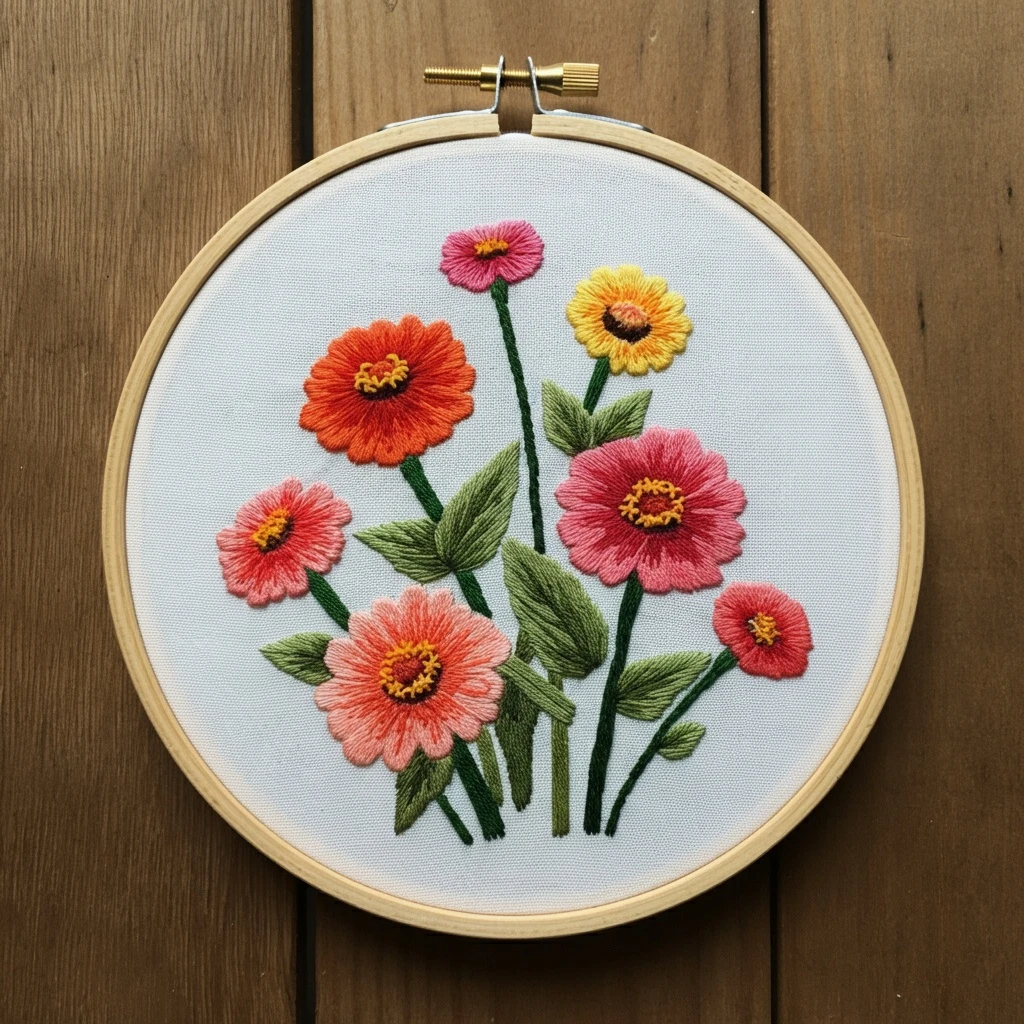
Cheerful Zinnia Garden

Cheerful Zinnia Garden — DMC Palette & Stitching Guide
Cheerful Zinnia Garden Embroidery Art
DMC palette & stitching notes

Cheerful Zinnia Garden

This garden design is built around bright zinnia blooms with layered petals, sunny textured centers, leafy stems, and cheerful filler flowers. The stitched version should feel lush but clear: bold coral, pink, orange, and yellow petals; darker shadow at petal bases; golden knot centers; and fresh green leaves that frame the blooms without overpowering the flower heads.

Polished DMC Color Palette

This palette gives zinnias their cheerful variety: coral, pink, rose, orange, yellow, and lavender supported by layered greens. Use darker colors at the petal bases and lighter shades at the tips to make each bloom look full and dimensional.

DMC 351
Coral
Main coral zinnia petals, warm flower mid-tones, and vivid focal blooms.
DMC 352
Coral Light
Coral petal highlights, lifted petal tips, and soft transitions from orange to pink.
DMC 350
Coral Medium
Deep coral shadows, petal bases, and underside folds in warm zinnias.
DMC 922
Copper Light
Orange zinnia petals, sunny bloom sections, and warm accent flowers.
DMC 921
Copper
Pumpkin-orange shadows, rich petal bases, and deeper warm flower folds.
DMC 3821
Straw
Yellow zinnia petals, bright flower centers, and sunny lifted highlights.
DMC 783
Topaz Medium
Golden centers, pollen knots, yellow petal shadows, and warm seed texture.
DMC 977
Golden Brown Light
Deeper flower-center shadows, orange-yellow transitions, and seed depth.
DMC 3722
Shell Pink Medium
Pink zinnia petals, rosy filler flowers, and soft bloom highlights.
DMC 761
Salmon Light
Pale pink petal tips, blush flowers, and airy petal highlights.
DMC 315
Antique Mauve Dark
Rose-pink petal shadows, flower centers, and deeper floral contrast.
DMC 210
Lavender Medium
Purple zinnia accents, cool contrast flowers, and shaded lavender petals.
DMC 211
Lavender Light
Pale lavender petal tips, small filler blossoms, and gentle cool highlights.
DMC 3051
Green Gray Dark
Leaf shadows, stem bases, and foliage tucked behind flower heads.
DMC 3052
Green Gray Medium
Main stems, leaves, and garden greenery around the blooms.
DMC 3053
Green Gray
Leaf highlights, young shoots, outer sprigs, and light-facing greenery.
DMC 3013
Khaki Green Light
Pale leaf tips, tiny filler stems, and fresh garden highlights.
DMC 3865
Winter White
Tiny petal shine, pale filler flowers, and final crisp highlight stitches.
DMC 801
Coffee Brown Dark
Fine seed shadows, stem depth, and small earthy detail lines.
DMC 932
Antique Blue Light
Optional cool filler blossoms or pale background accents to balance warm flowers.

Stitch Map by Design Element

Large zinnia petals
Use long-and-short stitch, satin stitch, or detached chain petals. Work darker shades like 350, 921, or 315 at the petal base, mid-tones through the body, and lighter shades such as 352, 761, 3821, or 211 on the petal tips.
Layered petal rings
Stitch the back ring first, then overlap the front petals slightly. Keep stitches radiating outward from the center so each zinnia has a natural, circular bloom structure.
Flower centers
Use French knots, colonial knots, seed stitch, or tiny satin dots in 783, 3821, 977, and 801. Add darker knots at the lower center and brighter knots on the light-facing top edge.
Small filler flowers
Use lazy daisy, tiny straight stitches, or small woven wheels in 761, 211, 3865, 932, and 3821. Keep filler flowers smaller and simpler than the main zinnias.
Leaves
Use fishbone stitch for larger leaves, satin stitch for small leaves, and straight stitches for tiny sprigs. Use 3051 in shaded areas, 3052 for main leaf fill, and 3053 or 3013 for tips and veins.
Stems
Use stem stitch, split stitch, or whipped back stitch in 3052 and 3051. Use one strand for thin background stems and two strands for prominent front stems.

Thread Count & Blending Guide

Fine details

Use 1 strand for petal veins, small filler stems, tiny highlights, center shadows, and outline corrections. One strand keeps layered flowers from becoming crowded.

Main flowers

Use 2 strands for zinnia petals, larger leaves, stems, and main floral fills. Two strands give cheerful color saturation while still allowing petal layering.

Raised centers

Use 2–3 strands for French-knot centers and prominent seed texture. Use three strands only for focal zinnias so smaller flowers remain delicate.

Blending idea: Blend 351 with 352 for coral petals, 3722 with 761 for pink zinnias, 921 with 922 for orange blooms, and 3052 with 3053 for leaf transitions. For centers, alternate 783, 3821, and 977 to create a sunny, textured seed head.

Shading, Outlining & Texture Suggestions

Zinnia petal depth

  • Shade every petal from darker base to lighter tip for a layered garden look.
  • Use short stitches around the flower center and longer stitches toward petal ends.
  • Let some front petals overlap back petals with a slightly brighter edge.
  • Use one-strand vein lines sparingly so the petals stay soft.

Center texture

  • Use clustered French knots for focal flower centers and seed stitch for smaller ones.
  • Mix gold, yellow, and golden brown for a natural pollen effect.
  • Keep center texture compact; it should not spill too far into the petals.
  • Add the brightest knots last so they sit visibly on top.

Garden greenery

  • Use darker greens behind flowers and lighter greens at outer leaf tips.
  • Vary leaf direction to keep the garden from looking flat.
  • Use fishbone stitch for larger leaves and simple straight stitches for background sprigs.
  • Leave small open spaces between leaves and petals so each bloom remains readable.

Outlining approach

  • Use matching darker petal shades instead of black outlines.
  • Outline only selected petals where layers need definition.
  • Use split stitch for petal curves and stem stitch for stems.
  • Add outlines after fills but before final center knots and highlights.

Beginner-Friendly Stitching Order

  1. Transfer the garden lightly: mark the main zinnia circles, petal direction, centers, stems, leaves, and only the largest filler flowers.
  2. Stitch stems and back leaves: establish the garden structure behind the flowers first.
  3. Work large zinnias: stitch back petals, then front petals, moving from darker bases to lighter tips.
  4. Add secondary flowers: stitch smaller pink, lavender, yellow, or blue filler blossoms around the main blooms.
  5. Build centers: add knots or seed stitches after the petals are complete so the centers sit on top.
  6. Finish with highlights: add leaf tips, tiny white accents, petal veins, and final outline corrections last.

Practical Tips for a Clean Finish

Fabric & hoop

Warm cream, natural linen, or pale oatmeal cotton-linen makes the zinnia colors glow. Keep the hoop drum-tight so satin petals and clustered knots do not pucker the fabric.

Needle choice

Use a sharp embroidery needle size 7–9 for one- and two-strand stitching. For three-strand French knots in flower centers, switch to a slightly larger needle for easier pull-through.

Color balance

Repeat each bright flower color in at least two places. If one bloom feels too dominant, add small filler flowers or leaf highlights in nearby spaces to rebalance the composition.

Avoiding bulk

Do not make every zinnia center heavily raised. Use dense knots only on focal flowers and flatter seed stitch on smaller blooms for a clean garden finish.

Best beginner shortcut: use lazy daisy or satin stitch for petals, French knots for centers, stem stitch for stems, and fishbone stitch for leaves.
Best realism upgrade: shade each zinnia in petal layers: dark base, saturated mid-petal, pale tip, and a compact textured golden center.
Designed as a practical DMC floss and stitch-planning companion for the Cheerful Zinnia Garden embroidery artwork.

Leave a Reply

Your email address will not be published. Required fields are marked *