
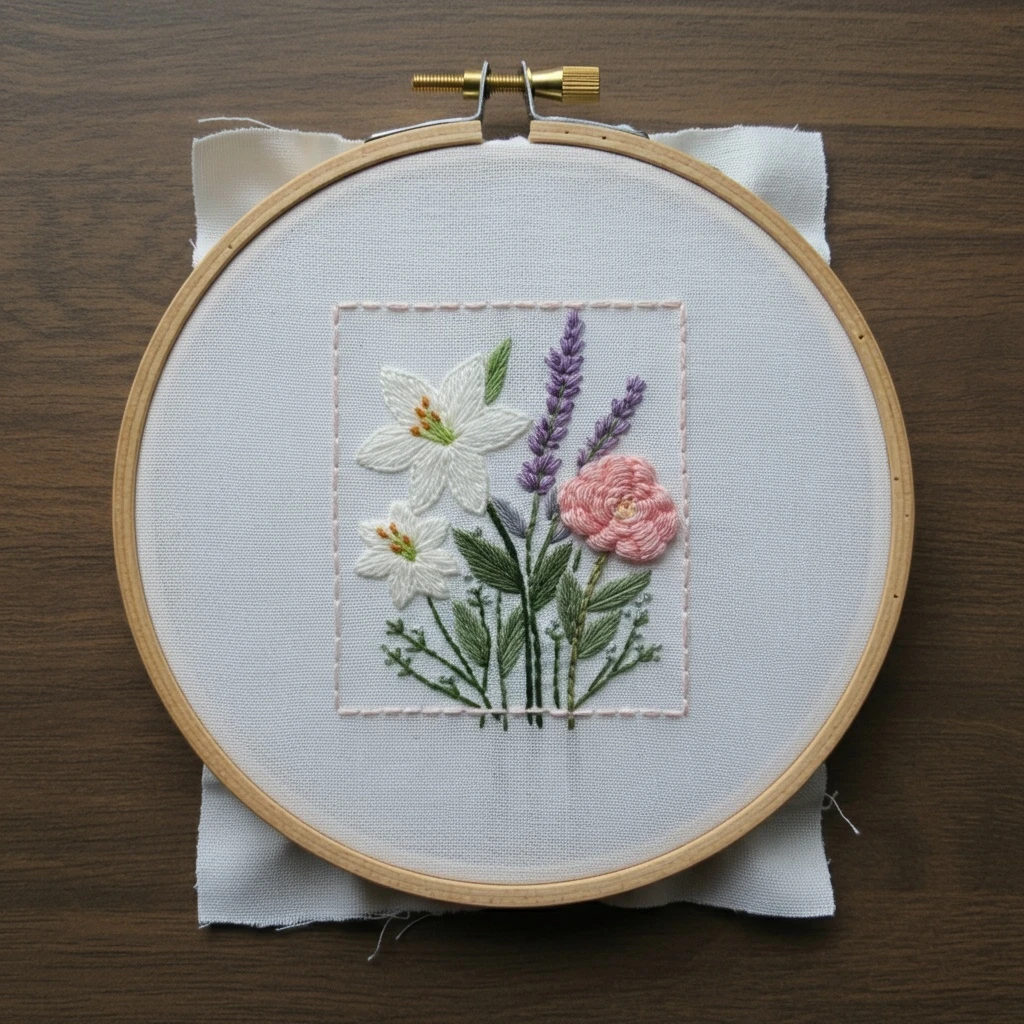
Classic Boxed Floral Bouquet
This boxed bouquet design combines a structured container with a generous arrangement of classic blooms, leafy stems, buds, and filler flowers. The embroidery should feel polished and balanced: a neat box or wrapping base, layered flowers rising above it, soft rose and coral petals, warm yellow centers, muted green foliage, and clean outlines that keep the bouquet readable without making it stiff.
Polished DMC Color Palette
This palette pairs classic bouquet colors with warm container tones. Use the browns and neutrals for the box, pinks and corals for focal flowers, yellow-gold for centers, lavender and blue for gentle variety, and sage greens to hold the bouquet together.
Stitch Map by Design Element
Thread Count & Blending Guide
Fine details
Use 1 strand for box edges, stem lines, tiny buds, petal veins, small outlines, and final highlight stitches. One strand keeps the bouquet clean and not overcrowded.
Main forms
Use 2 strands for flowers, leaves, box fills, larger stems, and main bouquet shapes. Two strands provides enough color while keeping the design beginner-friendly.
Raised texture
Use 2–3 strands for flower centers, small berry-like buds, or textured filler dots. Reserve three strands for focal centers only.
Shading, Outlining & Texture Suggestions
Structured box base
- Stitch the box before the lower flowers so stems and blooms can tuck behind its rim.
- Keep the darkest brown along the lower edge and inside folds.
- Use short highlight stitches on corners to suggest folded paper or crate edges.
- Make box outlines clean and straight to contrast with the soft flowers.
Classic bouquet fullness
- Place the largest flowers first, then fill open gaps with leaves and tiny blossoms.
- Use darker petal shades at centers and lighter shades at petal tips.
- Vary flower stitch types so the bouquet feels natural and hand-arranged.
- Repeat each color at least twice so the bouquet feels balanced.
Greenery depth
- Use darker greens behind flowers and lighter greens along outer sprigs.
- Angle leaves outward from the bouquet center for a fan-like arrangement.
- Use fishbone stitch on prominent leaves and simple straight stitches for background sprigs.
- Do not fill every gap with leaves; small open spaces keep the bouquet airy.
Outlining approach
- Use brown outlines for the box and matching darker flower shades for petals.
- Avoid black outlines unless the pattern has very dark decorative marks.
- Use split stitch for curved petals and back stitch for box edges.
- Add outlines after fills but before final knots and highlight dots.
Beginner-Friendly Stitching Order
- Transfer the main layout: mark the box, rim, largest flower heads, stem directions, major leaves, and a few filler clusters. Save tiny dots for freehand placement later.
- Stitch the box first: complete the container shading and rim so the flowers can visually sit inside it.
- Add main stems: stitch stems emerging from the box before filling the flowers.
- Stitch focal flowers: work large rose, coral, cream, or yellow blooms from darker centers to lighter petal tips.
- Add leaves and filler flowers: fill around the focal blooms with greenery, small blossoms, and buds.
- Finish with texture: add flower centers, tiny dots, petal highlights, box edge highlights, and final outline corrections last.
Practical Tips for a Clean Finish
Fabric & hoop
Warm cream, natural linen, or pale oatmeal cotton-linen complements both the floral palette and the boxed base. Keep the fabric drum-tight so straight box edges and raised flower centers do not pucker.
Needle choice
Use a sharp embroidery needle size 7–9 for one- and two-strand stitching. Use a slightly larger needle only for three-strand knots in large flower centers.
Keeping the box readable
Do not let every stem and flower cover the box rim. A few overlaps look natural, but visible rim sections help the “boxed bouquet” idea stay clear.
Avoiding floral clutter
Step back before adding more filler dots. If the bouquet feels busy, add a few leaf highlights or cream stitches rather than more contrasting flowers.