
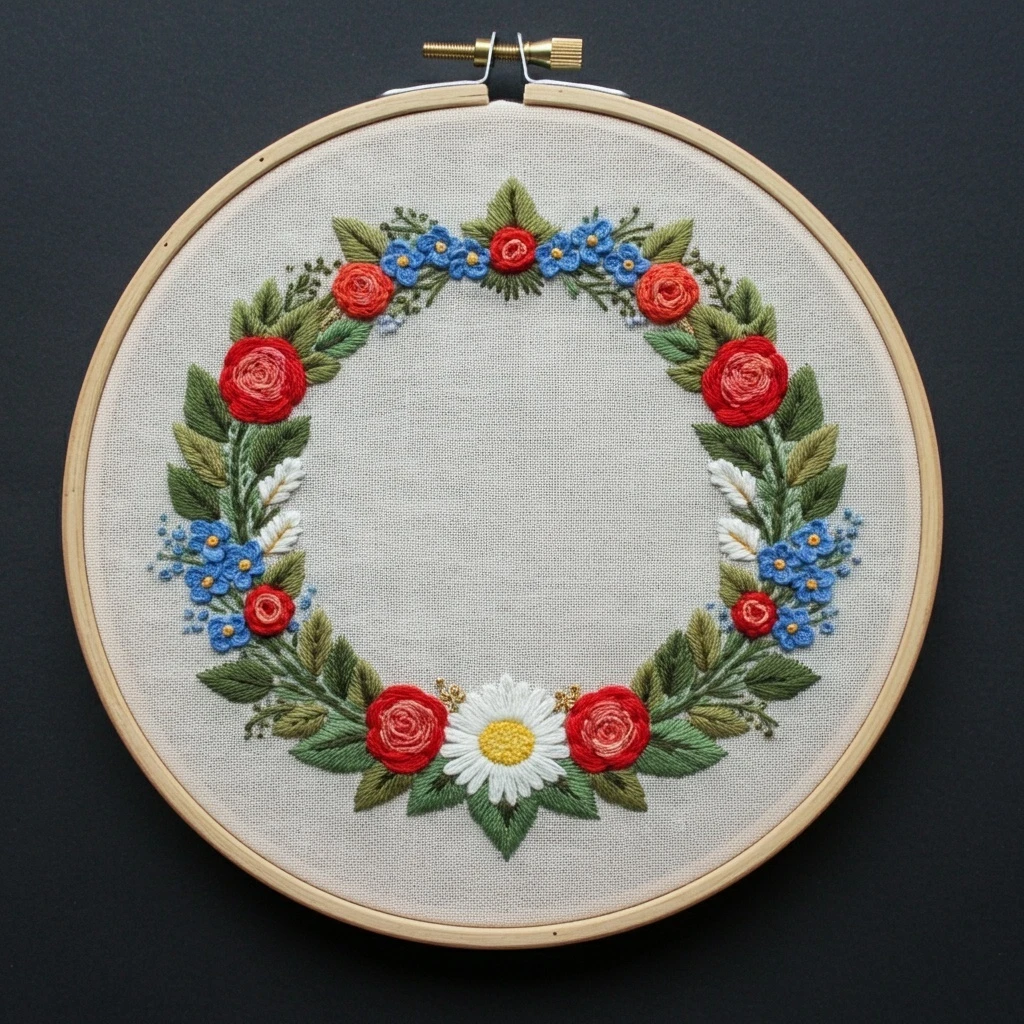
Classic Rose Forget Me Not Wreath
This romantic wreath pairs fuller classic roses with tiny forget-me-not blossoms and soft botanical greenery. The stitched version should feel delicate but dimensional: layered pink rose petals, airy blue five-petal flowers, tiny yellow centers, muted sage leaves, curved stems, and an open wreath center that keeps the floral ring graceful and balanced.
Polished DMC Color Palette
This palette balances soft rose colors with clear forget-me-not blues. Use the pink family for layered roses, the blue family for small five-petal blossoms, and muted greens to link everything into a clean wreath shape.
Stitch Map by Design Element
Thread Count & Blending Guide
Fine details
Use 1 strand for forget-me-not centers, petal outlines, tiny stems, leaf veins, small buds, and final correction stitches. This keeps the small blue flowers delicate.
Main florals
Use 2 strands for rose petals, leaves, wreath stems, and larger forget-me-not petals. Two strands gives good coverage while preserving petal shape.
Raised centers
Use 2–3 strands for rose-center knots and a few foreground flower centers. Use three strands only on larger roses, not tiny forget-me-nots.
Shading, Outlining & Texture Suggestions
Rose dimension
- Stitch the rose center first, then work outward in curved petal layers.
- Keep darker mauve and rose shades close to the center and under overlaps.
- Use pale pink or cream only on the lifted outer petal edges.
- Use soft, selective outlines rather than tracing every petal.
Forget-me-not clarity
- Make each tiny flower five simple petals around one small yellow center.
- Use the palest blue on the outer petal edge and medium blue near the center.
- Cluster forget-me-nots in small sprays instead of spacing them evenly.
- Keep centers tiny; large knots can overwhelm the small petals.
Wreath balance
- Place roses as focal anchors, then use blue sprays to connect the gaps.
- Keep the center open so the wreath shape remains elegant.
- Repeat pink, blue, and green around the circle for a cohesive design.
- Use buds and leaf tips to correct the silhouette without adding bulky flowers.
Outlining approach
- Use matching darker shades: mauve for roses, blue medium for forget-me-nots, and green gray for leaves.
- Use stem stitch for circular stems and split stitch for rose curves.
- Break outlines at overlaps to suggest layering.
- Add outlines after fills but before the final bright centers and highlights.
Beginner-Friendly Stitching Order
- Mark the wreath: lightly draw the circular guide, rose positions, forget-me-not sprays, main leaves, and a few buds. Save tiny filler dots for the end.
- Stitch back stems and leaves: work the darker inner greenery first so the flowers can sit on top.
- Build the roses: stitch centers, then mid petals, then pale outer highlights, following the curve of each flower.
- Add forget-me-nots: place small blue five-petal flowers in clusters between the roses.
- Add leaves and buds: fill gaps with sage leaves, blue buds, pink buds, and fine sprigs.
- Finish with centers and glints: add yellow knots, petal highlights, tiny white accents, and final outline corrections last.
Practical Tips for a Clean Finish
Fabric & hoop
Warm cream, natural linen, pale oatmeal, or soft blush cotton-linen complements the romantic rose-and-blue palette. Keep the hoop drum-tight so small forget-me-not petals and rose centers stay neat.
Needle choice
Use a sharp embroidery needle size 7–9 for one- and two-strand stitching. Use a slightly larger needle only for three-strand rose-center knots.
Keeping small flowers readable
Do not crowd forget-me-nots too closely. A little fabric between blue flowers helps each five-petal shape remain visible.
Preventing color imbalance
Let roses be the main focal weight and use forget-me-nots as airy connectors. If the wreath feels too pink, add blue sprays; if it feels too cool, add a few rose buds or golden centers.