
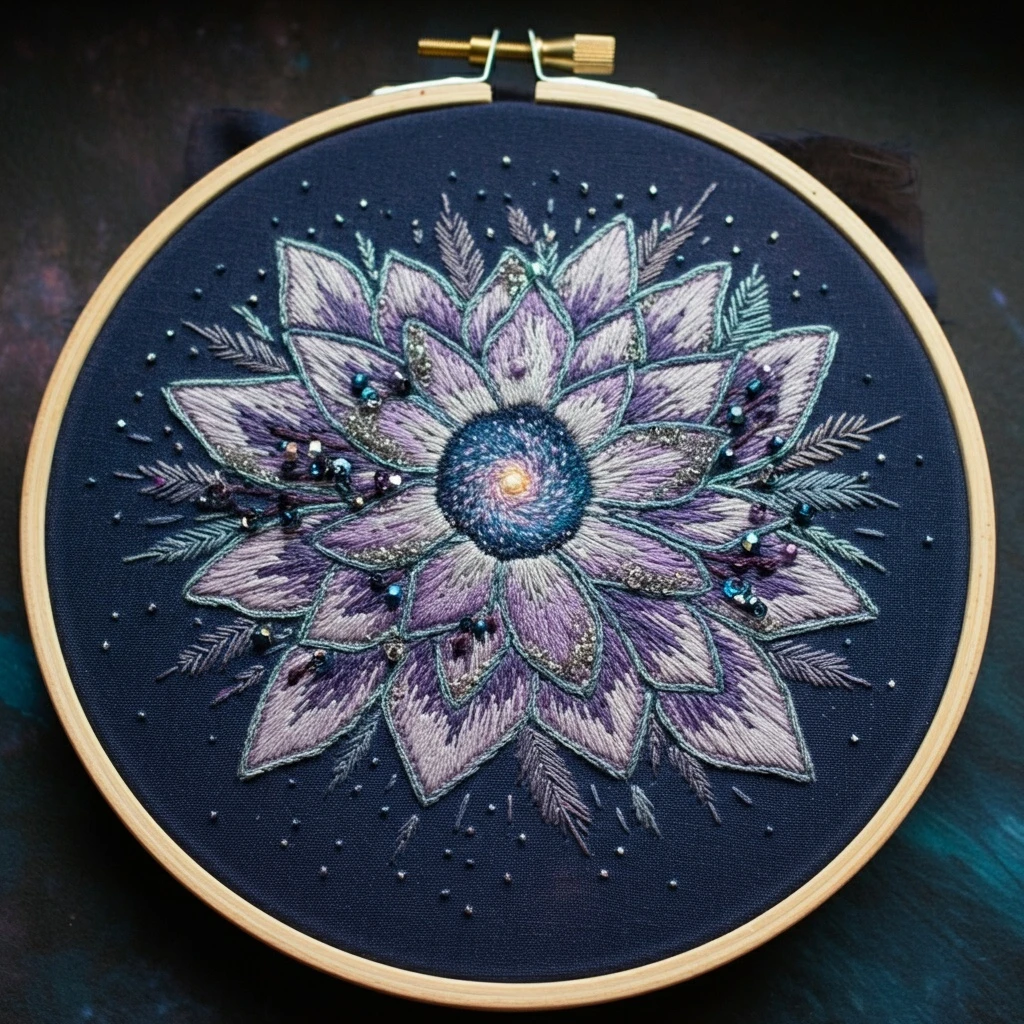
Cosmic Bloom
This celestial floral design blends a blooming flower with galaxy-inspired color, starry accents, and soft cosmic glow. The embroidery should feel dreamy and luminous: deep midnight shadows, violet and lavender petals, cool blue-aqua highlights, pink bloom warmth, tiny gold stars, and crisp white sparkle stitches placed last so the whole motif feels magical rather than busy.
Polished DMC Color Palette
This palette combines galaxy darks, violet petals, cool blue highlights, rosy floral warmth, and starry gold. Use deep shades for petal bases and cosmic background details, then build outward into lavender, aqua, cream, and white glints.
Stitch Map by Design Element
Thread Count & Blending Guide
Fine celestial details
Use 1 strand for stars, orbit lines, tiny dots, petal fold lines, moon glints, and final highlight corrections. One strand keeps the cosmic accents delicate.
Main petal fills
Use 2 strands for bloom petals, larger leaves, soft halo areas, and major color fills. Two strands gives enough saturation for the rich galaxy palette.
Raised sparkle
Use 2–3 strands for selected French-knot stars or flower-center texture. Use three strands only on a few focal points so the night-sky details do not look bulky.
Shading, Outlining & Texture Suggestions
Luminous petal shading
- Keep the darkest purples near petal bases, centers, and hidden overlaps.
- Blend outward into lavender, blue, aqua, or pale cream depending on the petal direction.
- Use curved stitch direction to make each petal feel rounded and blooming.
- Place bright highlights only on lifted edges so the flower stays dimensional.
Cosmic sparkle
- Add stars and dots after the bloom is finished so they sit crisply on top.
- Vary dot sizes: a few French knots, many tiny straight stitches, and several single white points.
- Use gold near the flower center and white or aqua farther out for a galaxy effect.
- Leave open space between stars so the design feels airy, not speckled.
Color balance
- Let violet and lavender dominate the bloom, with aqua as a highlight accent.
- Use pinks to warm selected petals rather than filling every petal pink.
- Repeat gold in the center and a few surrounding stars for harmony.
- If adding leaves, keep them muted so they do not compete with the cosmic palette.
Outlining approach
- Use deep violet, mauve, or cool blue outlines instead of harsh black.
- Outline only hidden petal folds and outer edges that need definition.
- Use split stitch for curved petals and tiny back stitch for star trails.
- Add final outlines before the last white and gold sparkles.
Beginner-Friendly Stitching Order
- Transfer lightly: mark petal shapes, the flower center, major celestial curves, stars, and any leaves. Keep tiny star dust freehand for the end.
- Stitch back petals first: work darker petal layers and hidden shadows so front petals can overlap them cleanly.
- Build front petals: blend from dark bases into lavender, blue, aqua, pink, or cream highlights at the tips.
- Add the center: use knots or seed stitches for the flower center, placing warm gold and white glints last within the cluster.
- Add celestial lines: stitch moon, orbit, or halo curves with one strand so they stay delicate.
- Finish with stars: add star stitches, tiny dots, white glints, gold accents, and final outline corrections last.
Practical Tips for a Clean Finish
Fabric & hoop
Warm cream, pale lavender, dusty navy, or soft black fabric can all work well. Dark fabric makes stars pop, while cream fabric gives a softer celestial botanical look. Keep the hoop drum-tight for smooth petal fills.
Needle choice
Use a sharp embroidery needle size 7–9 for one- and two-strand stitching. For raised star knots or flower-center knots with three strands, use a slightly larger needle for clean pull-through.
Keeping the glow clean
Do not overuse white. A few small white stitches placed at petal tips and stars will look more magical than many large bright marks.
Avoiding muddy blends
Blend neighboring color families gradually: violet into lavender, lavender into blue, blue into aqua, and pink into cream. Avoid jumping directly from dark purple to white except for sparkle points.