
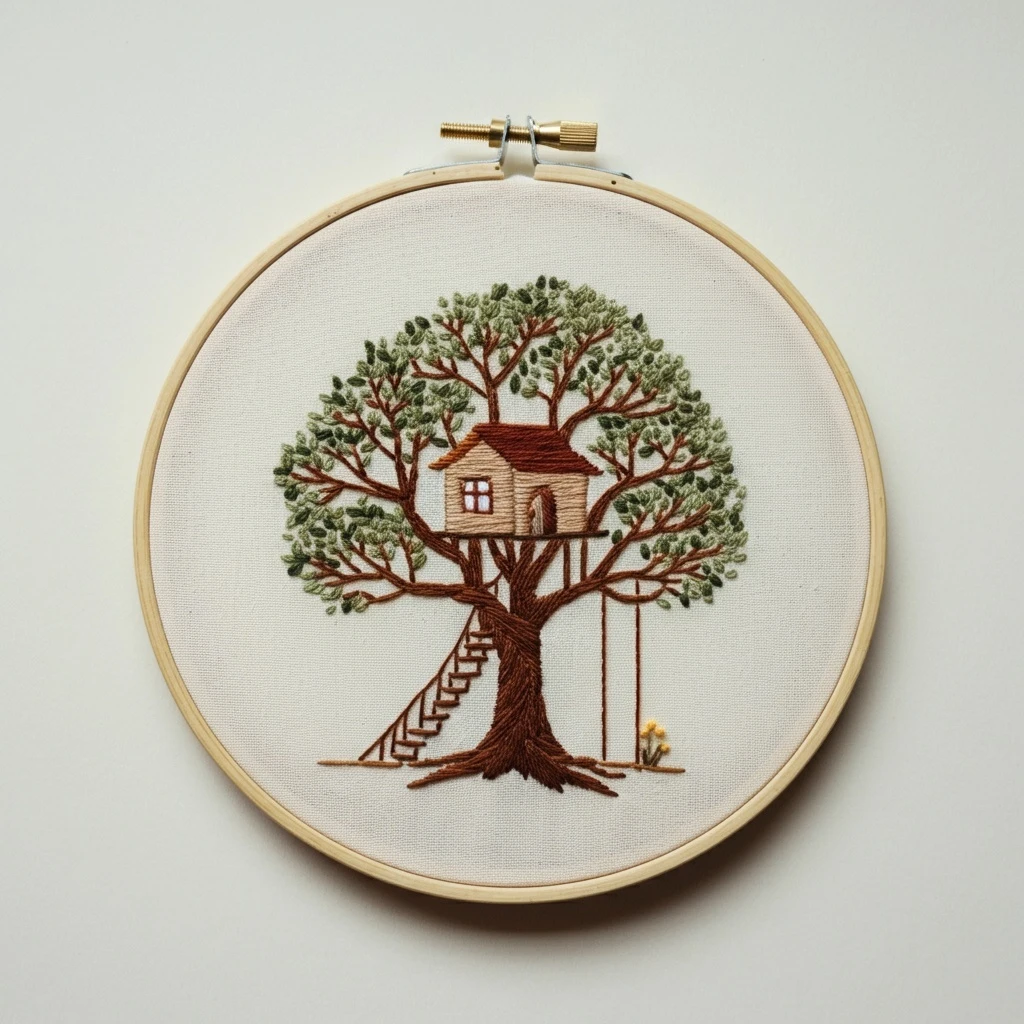
Cozy Treehouse
This cozy treehouse design is built around a sturdy tree trunk, warm wooden house or platform, ladder and rail details, leafy canopy, and small welcoming touches like a tiny window, rope, flowers, or soft sky accents. The embroidery should feel playful and storybook-like: textured bark, layered greens, rustic planks, neat architectural outlines, and just enough tiny details to make the treehouse look lived-in without overcrowding the hoop.
Polished DMC Color Palette
This palette focuses on warm bark and wooden planks, muted leafy greens, creamy window highlights, and small cheerful accent colors. Keep the tree trunk and house structure grounded in browns, then use greens and pale sky tones to soften the scene.
Stitch Map by Design Element
Thread Count & Blending Guide
Fine details
Use 1 strand for plank separations, window frames, ladder rungs, rope, bark cracks, tiny flowers, nail heads, door handle, and final outline corrections.
Main structure
Use 2 strands for tree trunk fill, house planks, roof, platform, leaves, and larger branches. Two strands gives visible texture without making the miniature building bulky.
Raised natural texture
Use 2–3 strands for selected French-knot flowers, mossy knots, canopy dots, or bark highlights. Use three strands sparingly so the scene stays tidy.
Shading, Outlining & Texture Suggestions
Tree and bark depth
- Follow the trunk’s natural curve with vertical or slightly wavy stitches.
- Keep darkest browns in branch forks, trunk creases, and under the platform.
- Add lighter bark ridges in broken strokes rather than long straight lines.
- Let some fabric show between bark marks for a rustic hand-stitched look.
Readable treehouse structure
- Stitch the house walls and roof before adding leaves over them.
- Use darker shadows under the roof, platform, window ledge, and ladder rungs.
- Keep plank separations thin; heavy dark lines can make the house look crowded.
- Use warm window glow to create a cozy focal point.
Leafy canopy texture
- Place dark leaves behind the house and lighter leaves around the outer canopy.
- Vary stitch direction so the leaves look natural and layered.
- Use small leaf clusters rather than filling the entire background solid.
- Add a few pale green tips last for fresh, sunny movement.
Outlining approach
- Use dark brown for tree and house outlines, dark green for foliage, and cool blue-gray for window glass.
- Avoid harsh black outlines; the cozy woodland mood works best with tonal definition.
- Use split stitch for house curves and back stitch for straight planks, ladder, and window details.
- Add final outlines before tiny flowers, lantern glow, nail heads, and white glints.
Beginner-Friendly Stitching Order
- Transfer the main layout: mark the trunk, major branches, treehouse walls, roof, platform, ladder, window, leaf clusters, and tiny accent placements.
- Stitch trunk and branches: build bark shadows first, then mid-tone fill, then light bark texture and branch highlights.
- Build the treehouse: stitch walls, roof, platform, railings, and plank separations before adding the ladder and tiny window details.
- Add ladder, rope, and hardware: use one strand where possible so small structural lines stay neat.
- Layer the leaves: stitch dark canopy areas behind the house, then mid and light leaf clusters around the edges.
- Finish with charm: add flowers, moss, window glow, sky dots, nail heads, and final bright highlights last.
Practical Tips for a Clean Finish
Fabric & hoop
Natural linen, warm cream, pale oatmeal, soft sage, or light sky-blue cotton-linen all suit this woodland design. Keep the hoop drum-tight so ladder rungs, planks, and window details stay straight.
Needle choice
Use a sharp embroidery needle size 7–9 for one- and two-strand stitching. A size 9 needle is especially useful for bark cracks, window panes, ladder rungs, and tiny flower details.
Keeping it cozy
Let the treehouse stay warm and simple. A glowing window, a tidy ladder, and a few flowers can create more charm than too many tiny accessories.
Avoiding clutter
Do not cover every branch with leaves. Leave small openings of fabric between canopy clusters so the house shape and trunk remain easy to read.