
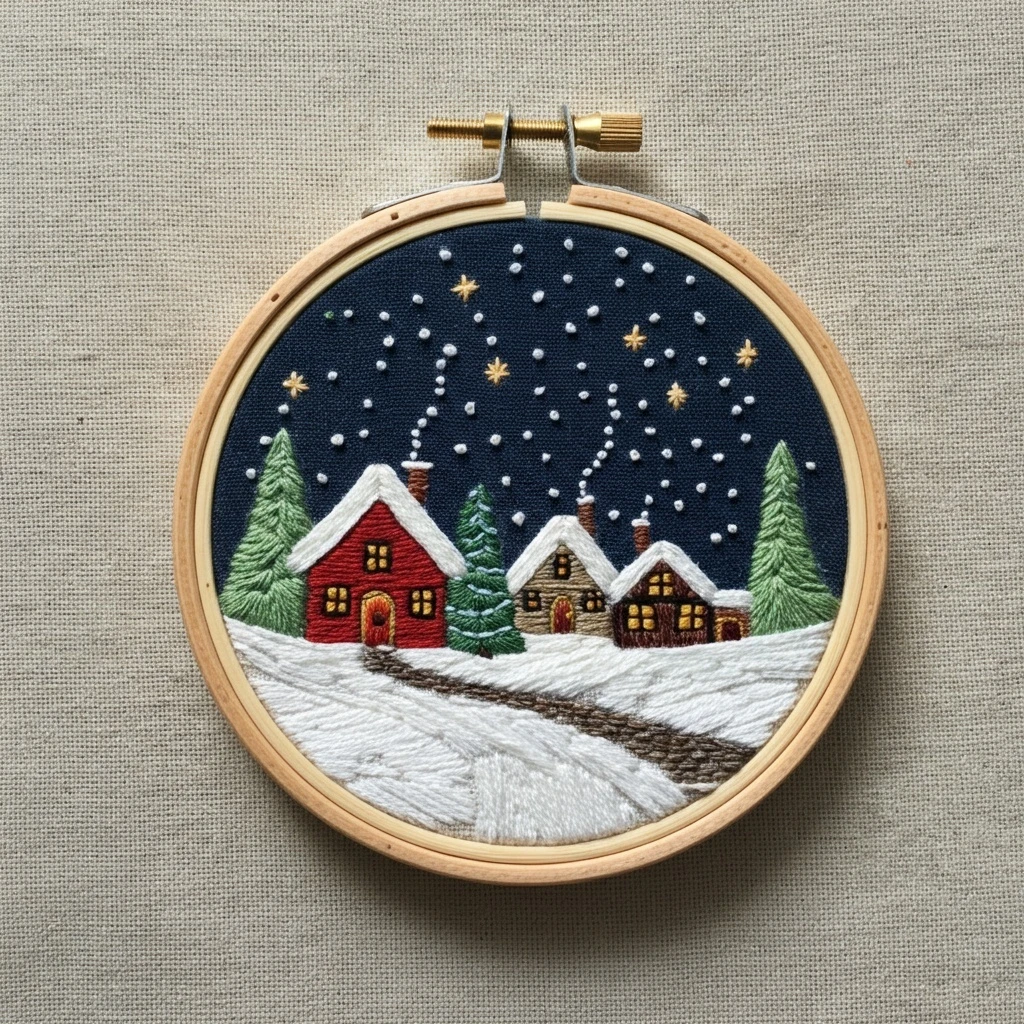
Cozy Winter Village Night Scene
A polished floss palette and practical stitch plan for a snowy hoop scene with a deep navy sky, glowing cottage windows, evergreen trees, layered snowbanks, starry snowfall, brick chimneys, and a winding dark path.
Color Story
The reference design balances a dramatic midnight background with clean white snow, cheerful red and brown cottages, soft beige walls, blue-gray shadows, forest greens, golden stars, and tiny warm yellow windows. Use the darkest colors sparingly for outlines and contrast so the scene stays cozy rather than heavy.
Element-by-Element Stitch Plan
Work from background to foreground: sky details first, then distant trees and houses, then roof snow, path, foreground drifts, and finally small sparkle details.
| Design area | Recommended stitches | Thread count | Practical notes |
|---|---|---|---|
| Night sky | Leave dark fabric exposed, or use long horizontal satin/seed texture only if stitching on light fabric. | 1–2 strands | On navy fabric, do not fill the sky. Add scattered snow knots and starbursts for a cleaner hoop and less puckering. |
| Falling snow | French knots, colonial knots, tiny straight stitches. | 1 strand for small flakes; 2 strands for foreground flakes | Vary knot wraps from one to two. Keep the spacing irregular so snowfall feels natural. |
| Gold stars | Straight-stitch starbursts, fly stitch tips, tiny couching for longer rays. | 1 strand 729 + 1 strand 743, or 2 strands 729 | Make one longer vertical ray and shorter side rays. Add a single B5200 dot near a few stars for sparkle. |
| Smoke curls | Back stitch, whipped back stitch, dotted French knots. | 1 strand 762 or blended 762/B5200 | Stitch smoke as broken, drifting beads rather than a solid line. It should look light against the navy sky. |
| Snowy roofs | Padded satin stitch, split stitch edge, long-and-short shading. | 2–3 strands for fill; 1 strand for edge lines | Pad the center roof snow with a base stitch, then satin over it for rounded snow caps. Shade underside with 762 or 415. |
| Red cottage | Brick stitch, satin stitch, split stitch outline. | 2 strands for walls; 1 strand 498 for detail | Stitch wall rows horizontally to mimic siding. Use 321 for the lit face and 498 at lower edges and corners. |
| Tan cottage | Long-and-short stitch, seed stitch texture, back stitch mortar lines. | 2 strands for fill; 1 strand for texture | Blend 840 with 738 in scattered short stitches to suggest stone without overcomplicating the area. |
| Dark brown cottage | Satin stitch panels, couching, back stitch window grid. | 2 strands 3371/938 | Keep window outlines crisp; dark houses need small golden panes to avoid disappearing into the scene. |
| Windows and doors | Satin stitch, tiny cross stitch panes, back stitch mullions. | 1–2 strands | Use 743 in the center, 729 at the edges, then outline with 3371. A single stitch of 676 makes a soft glow. |
| Evergreen trees | Fishbone stitch, fly stitch, stacked straight stitches, detached chain accents. | 2 strands for boughs; 1 strand for highlights | Start with 935 in the center, add 904 over it, then place 906/3364 on outer tips. Keep branch strokes angled downward. |
| Winding path | Seed stitch, split stitch, short random straight stitches. | 1–2 strands | Use 938 and 3371 for depth, then sprinkle 301 and 840 stones. Narrow the path as it approaches the houses. |
| Snow fields | Long-and-short stitch, stem stitch contour lines, couching, seed stitch. | 2 strands for drifts; 1 strand for shadow lines | Use 3865 for most snow, B5200 for highlights, 762/415 for curved drift shadows. Avoid filling every area in pure white. |
Blending, Shading & Texture Suggestions
Soft snow dimension
- Blend 1 strand B5200 + 1 strand 3865 for snowy roofs that look bright without becoming flat.
- Blend 1 strand 3865 + 1 strand 762 for foreground drift curves and roof shadows.
- Use 415 only in the deepest creases, especially where the path cuts into the snow.
Warm village glow
- Fill windows with 743, shade one corner with 729, then outline with 3371.
- Add one or two tiny straight stitches of 676 beside selected windows for a subtle halo.
- Keep door highlights vertical, so they read as firelight or lamplight from inside.
Evergreen layering
- Lay a dark center spine in 935, then build branch rows with 904.
- Use 906 sparingly on the outer boughs and 3364 for frosty tips.
- Do not make every branch symmetrical; uneven bough lengths give the trees a hand-embroidered charm.
Path texture
- Start with loose, irregular stitches in 938; deepen the center with 3371.
- Scatter small 301 and 840 stitches to suggest exposed stones.
- Outline only one edge of the path with 415 snow shadow, not both, to keep it natural.
Outlining & Thread-Count Guide
For a small hoop design, controlled outlines make the houses readable while softer snow and tree textures keep the scene gentle.
Fine details
Use 1 strand for window mullions, door cracks, smoke, snow shadows, star rays, and thin roof outlines.
Main fills
Use 2 strands for cottage walls, evergreen branches, path stones, and most long-and-short snow areas.
Raised texture
Use 3 strands only for padded roof snow, larger foreground snow knots, or the thickest lower tree boughs.
| Outline area | DMC choice | Technique |
|---|---|---|
| House silhouettes | 3371 for brown house; 498 for red house; 938 for chimneys | Split stitch or tight back stitch, 1 strand. |
| Snow roof edges | 762 for soft edge, B5200 for bright lip | Back stitch under the snow line, then add a few short highlight stitches on top. |
| Tree branch direction | 935 base, 904 mid, 906 highlight | Use angled fly stitches from the trunk outward, decreasing length toward the top. |
| Foreground drift lines | 762 and 415 | Stem stitch or couching with long, shallow curves; keep lines broken rather than continuous. |
Beginner-Friendly Practical Tips
Before stitching
- Choose dark navy cotton or linen so the sky does not need full coverage.
- Transfer house, tree, roof, path, and snowbank outlines with a white water-soluble pencil.
- Hoop the fabric firmly; knots and padded snow look cleaner on a drum-tight surface.
While stitching
- Keep floss lengths around 14–16 inches to reduce fuzzing on white snow.
- Stitch white areas with clean hands and store the hoop covered between sessions.
- Step back often: the tiny windows and snow dots should sparkle, not crowd the sky.
Order of work
- 1. Snowflakes, stars, and smoke on the sky.
- 2. Distant houses and trees.
- 3. Roof snow and window glow.
- 4. Path, foreground snow, final outlines and knots.
Finishing polish
- Add the brightest B5200 highlights last, especially on the roof peaks and top snowbank.
- Use a few extra knots near the top of the sky and fewer near the houses so the composition breathes.
- Press from the back on a towel to preserve raised knots and padded roof texture.