
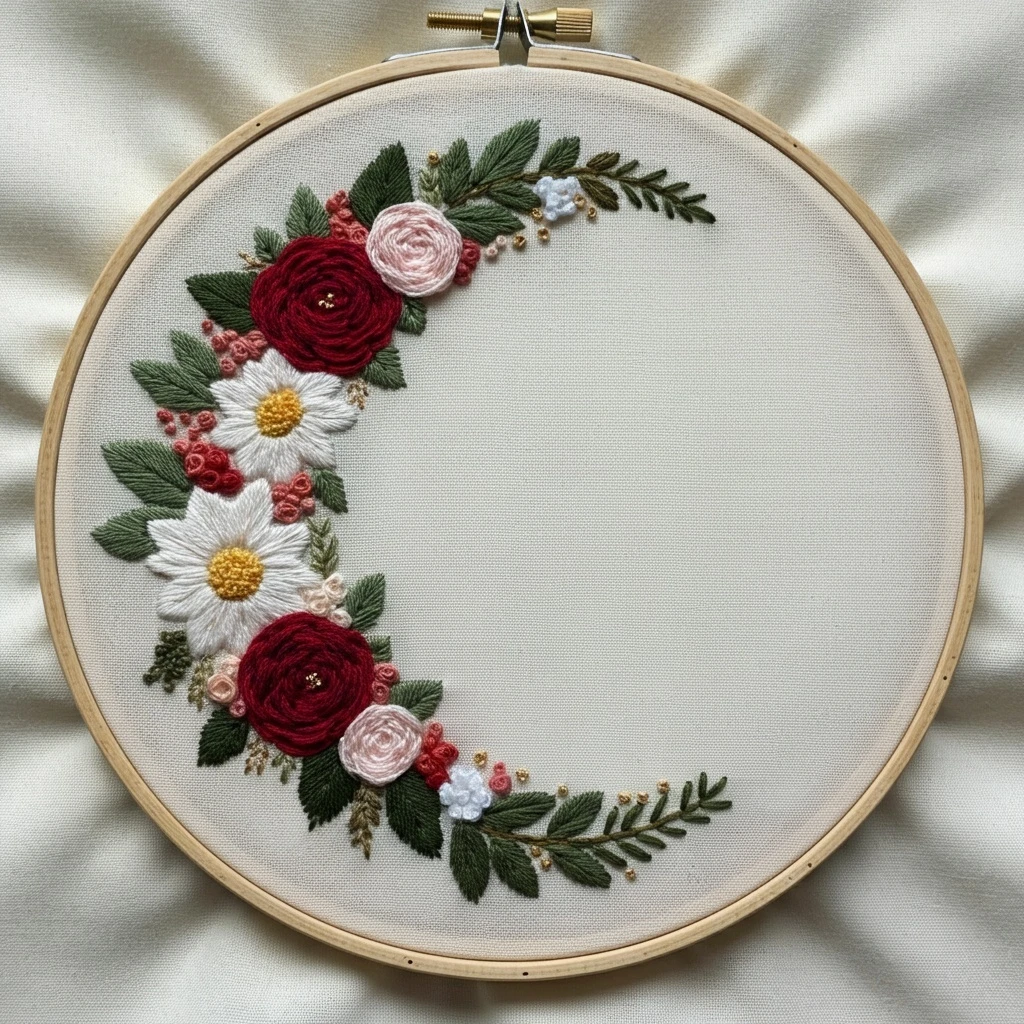
Crescent Floral Wreath
A polished floss palette and practical stitch plan for a romantic crescent wreath stitched on natural linen, with deep red woven roses, blush rosettes, white daisies, coral berry clusters, olive-green leaves, airy fern sprigs, and tiny golden bead-like accents.
Color Story
The reference design is built around a soft cream linen ground and an asymmetrical floral crescent along the left side of the hoop. The strongest accents are velvety crimson roses, balanced by pale blush rosettes, white daisy petals, warm mustard centers, muted coral berries, blue-white filler blossoms, deep evergreen leaves, and small antique-gold knots.
Element-by-Element Stitch Plan
Work the design in layers: stems first, large leaves next, main flowers, filler berries and tiny blossoms, then final gold knots and outline touches. This keeps the crescent shape clean and prevents small details from getting buried.
| Design area | Recommended stitches | Thread count | Practical notes |
|---|---|---|---|
| Crescent stem structure | Stem stitch, split stitch, whipped back stitch. | 2 strands for main arc; 1 strand for fine branchlets | Map the crescent curve lightly before stitching. Keep branch ends thinner at the top and bottom tips. |
| Large red roses | Woven wheel rose, whipped wheel, couching for loose outer petals. | 3 strands for spokes; 4-6 strands for woven wraps if you want raised roses | Use 814 near the center, 815 for the body, and occasional 304 on top edges. Do not pull the weaving too tight; roses should sit plush. |
| Blush rosettes | Woven wheel, spiral back stitch, bullion rosebuds. | 2-4 strands depending on flower size | Start with 225 or 3713 in the center, then add 224 around the outer curve for petal definition. |
| White daisies | Long-and-short stitch, satin stitch petals, detached chain petals. | 2 strands for petals; 1 strand for inner shadow lines | Use B5200 on petal tips and 3865 closer to the center. A few 762 stitches at the base separate overlapping petals. |
| Daisy centers | French knots, colonial knots, seed stitch. | 2 strands 729/3852; 1 strand 783 for darker specks | Pack knots densely in the center. Vary knot size by changing wraps from one to two. |
| Oval leaves | Fishbone stitch, satin stitch with central vein, leaf stitch. | 2 strands for leaf fill; 1 strand for veins | Stitch from the tip toward the base so the leaf direction follows the crescent. Shade one side with 520 or 3362. |
| Fern sprigs | Fly stitch, straight stitch pairs, back stitch stem. | 1-2 strands | Use 520 for the center line and 3363 for alternating fronds. Short, uneven fronds look more botanical. |
| Coral berry clusters | French knots, colonial knots, small satin dots. | 2 strands; 3 strands for larger raised berries | Cluster 761 with a few 304 or 224 knots. Leave tiny gaps between berries so the bunch does not become a blob. |
| Blue-white filler blossoms | Lazy daisy, French knots, tiny star stitches. | 1-2 strands | Use 3756 for cool petals and B5200 for the brightest knot. Place them near wreath tips for visual lightness. |
| Gold accent dots | French knots, colonial knots, couching over a short stitch. | 1-2 strands | Use 676 for small highlights, 729 for standard accents, and 783 in shadow. Space them irregularly along branchlets. |
Blending, Shading & Texture Suggestions
Dimensional roses
- For large red roses, blend 1 strand 814 + 1 strand 815 for the first wraps, then switch to solid 815.
- Add a few loose couching stitches in 304 on the outer rim to catch light.
- Keep the center slightly darker than the outside so the spiral reads clearly.
Soft blush flowers
- Blend 1 strand 225 + 1 strand 3713 for pale rosette centers.
- Use 224 only on the lower or outer edge to create a rounded petal shadow.
- For tiny buds, one bullion knot in 224 with a 3363 green base is enough.
White petals with definition
- Use B5200 sparingly on daisy tips and save 3865 for most petal fill.
- Add one or two 762 straight stitches at the base of petals that tuck behind the center.
- Stitch petals outward from the center so the thread sheen follows each petal shape.
Natural greenery
- Alternate 3362, 3363, 520, and 3051 so leaves vary like the reference.
- Place darker stitches under flowers and lighter stitches on outer leaf tips.
- For ferns, use 1 strand for airy sprigs so they do not compete with the roses.
Outlining & Thread-Count Guide
This design benefits from plush flower textures but delicate outlines. Use more strands on raised roses and knots, then drop to one strand for veins, petal shadows, and tiny branch tips.
Fine details
Use 1 strand for leaf veins, daisy petal shadows, small fern stems, branch tips, and any outline that should stay delicate.
Main fills
Use 2 strands for daisy petals, leaf fills, coral berries, branch lines, and small filler blossoms.
Raised texture
Use 3-6 strands for woven roses, padded rosettes, larger French-knot berries, and dense daisy centers.
| Outline area | DMC choice | Technique |
|---|---|---|
| Rose edges | 902 or 814 for red roses; 224 for blush roses | Tiny couching stitches or partial back stitch only where petals need separation. |
| Daisy petal bases | 762 and 3865 | One-strand split stitch or short straight stitches tucked near the yellow center. |
| Leaf veins | 520 for dark leaves; 3363 for lighter leaves | Straight stitch or stem stitch down the center, with small angled side veins. |
| Branchlets and tendrils | 3051, 520, or 3362 | Whipped back stitch for smooth arcs; single straight stitches for small offshoots. |
| Gold dots | 676, 729, 783 | French knots after all surrounding stitches are complete so they remain crisp and raised. |
Beginner-Friendly Practical Tips
Before stitching
- Use medium-weight natural linen or cotton and hoop it drum tight; raised roses need stable tension.
- Transfer only the crescent stem, flower centers, major leaf shapes, and daisy centers. Leave tiny berries flexible.
- Mark large roses as circles with center dots so your woven wheels stay round.
Order of work
- 1. Main stem arc, branchlets, and fern lines.
- 2. Large leaves behind flowers.
- 3. Roses, daisies, and blush rosettes.
- 4. Berries, filler flowers, gold knots, and final petal shadows.
While stitching
- Keep floss lengths around 14-16 inches; pale pinks and whites fuzz quickly if dragged too much.
- Rotate the hoop when stitching leaves so your needle follows the leaf direction comfortably.
- Step back before adding filler knots. The open right side of the hoop is part of the crescent composition.
Finishing polish
- Add final B5200 daisy highlights and 676 gold knots last so they stay bright.
- Trim traveling threads behind open linen areas to prevent shadows showing through.
- Press from the back on a folded towel to protect raised roses, knots, and padded centers.
Quick Stitch Map for the Crescent Shape
The visual weight should be heaviest through the left-middle arc, where the two daisies and red roses cluster. Let the top and bottom tips taper into slender greenery and small gold dots.
| Placement | Best focus | Keep it balanced by... |
|---|---|---|
| Upper crescent tip | Fern sprigs, small leaves, pale filler blossoms, a few gold knots. | Using 1-strand details and leaving open linen between stems. |
| Upper-left cluster | Large red rose, blush rosette, dark leaves, coral berries. | Letting the blush flower soften the red rose and adding green leaf shadows behind it. |
| Middle-left curve | White daisies with raised gold centers and layered leaves. | Keeping petal stitching neat and using 3865/762 for separation. |
| Lower-left cluster | Second red rose, pink rosette, small berries, denser leaves. | Repeating the rose colors from the top but varying leaf angles. |
| Lower crescent tip | Trailing fern stem, small blue-white blossoms, gold accents. | Reducing thread count toward the tip so the wreath tapers gracefully. |