
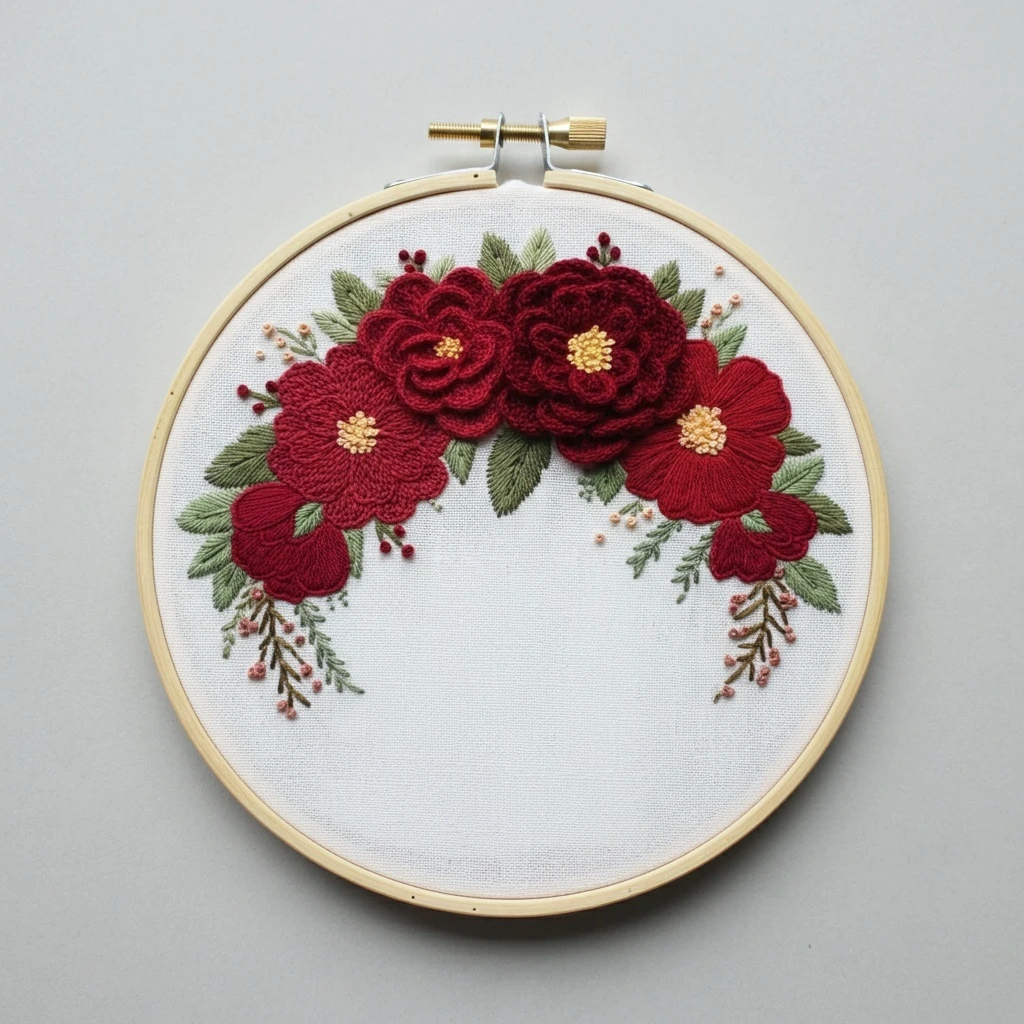
Crimson Floral Wreath
A rich crescent wreath built from deep red blossoms, raised burgundy petal shadows, sage green foliage, warm gold centers, and delicate peach berry sprigs. The open lower space keeps the composition airy, so the stitching should feel lush at the top and light at the trailing ends.
Suggested DMC Floss Palette
Use the darkest garnets to define petal folds and underlayers, brighter reds on forward-facing petals, olive-sage greens for the leaves, and small gold/peach accents to keep the wreath from feeling too heavy.
Stitch Map by Design Element
| Area | Best stitches | Thread guidance | Practical notes |
|---|---|---|---|
| Large flat crimson flowers | Long-and-short stitch, satin stitch, split stitch outline | 2 strands for fill; 1 strand for edge definition | Work from petal edge toward the center. Keep the stitch direction radiating like a fan so the petals look rounded. |
| Raised central roses | Woven wheel, whipped backstitch, padded satin, cast-on stitch | 3–4 strands for woven texture; 2 strands for shadows | Lay 814 first in recessed spaces, then use 815/816 over the top to build plush petal folds. |
| Gold flower centers | French knots, colonial knots, seed stitch | 2 strands for knots; add 3 strands for a few larger center dots | Mix 729 and 676 randomly, placing lighter knots near the visual center for a natural pollen effect. |
| Sage leaves | Fishbone stitch, closed fly stitch, satin stitch, straight stitch vein | 2 strands for fill; 1 strand for veins | Use 3011 at the base, 3012 through the middle, and 3013 on the outer tips or top vein. |
| Fine fern sprigs | Stem stitch spine, single straight stitches, detached chain | 1 strand for delicate sprigs | Stitch these last so they sit neatly between flowers and do not disappear under heavy petals. |
| Berries and twig clusters | French knots, colonial knots, stem stitch | 1 strand stems; 2–3 strands knots | Alternate garnet berries with peach berries. Add one lighter wrap to the top of some knots for shine. |
Blending, Shading & Texture
Crimson petal shading
- For dark folds, blend 1 strand 814 + 1 strand 815.
- For main red body, use 2 strands 816 or 1 strand 815 + 1 strand 816.
- For bright petal edges, add short strokes of 498; reserve 321 for tiny accents only.
- Outline the most visible petals with a fine split stitch in 815, then fill up to that line for crisp scalloped edges.
Leaf depth
- Start leaves with a center vein, then angle fishbone stitches diagonally from each side.
- Use 3011 where leaves tuck under flowers, 3012 for most of the blade, and 3013 at tips.
- For narrow fern sprigs, use 3362 in a single strand so they look airy and botanical.
- A few detached-chain leaves in 3013 soften the outer edge of the wreath.
Raised flower texture
- Pad the two central roses with a small base of split stitch before adding woven or whipped petals.
- Keep the darkest reds inside the curl; bring lighter reds forward on the outer turns.
- Vary petal length slightly. Perfectly even petals can make the flowers look flat.
- Do not overfill the lower open area; the empty fabric is part of the crescent design.
Berry and center sparkle
- Use colonial knots for firmer, bead-like berries and French knots for softer floral centers.
- Wrap burgundy berry knots twice with 2 strands; wrap peach berries once or twice depending on size.
- Scatter gold knots irregularly, not in a perfect circle, to keep the flower centers organic.
- Place the lightest knots last so they sit on top and catch the eye.
Beginner-Friendly Stitching Order
Transfer cleanly
Mark the main flower shapes, leaf direction lines, and berry stems. Keep the lower hoop area free of extra guide marks.
Stitch background leaves
Complete the sage leaves first, especially those disappearing behind petals. This prevents bulky flower stitches from catching.
Build red flowers
Work large flat flowers, then raised central roses. Add dark folds before bright highlights for easier shading control.
Add accents last
Finish with gold centers, berry knots, twig sprigs, and final outlining. Trim jump threads often on the pale fabric.
Finishing Tips
Keep the crescent balanced
The left and right ends should taper softly. Use fewer strands and smaller knots as the wreath trails downward so the top cluster remains the focal point.
Avoid muddy reds
Do not blend every red everywhere. Keep distinct dark, mid, and highlight zones; the flowers look richer when each petal has a clear light direction.
Use the fabric as light
Let tiny gaps of pale fabric remain between petals, leaves, and berry stems. These gaps act like highlights and make the dense wreath easier to read.
Hoop presentation
Press from the back on a towel after stitching. Mount tautly, keeping the floral arc centered slightly above the hoop midpoint to preserve the open crescent shape.