
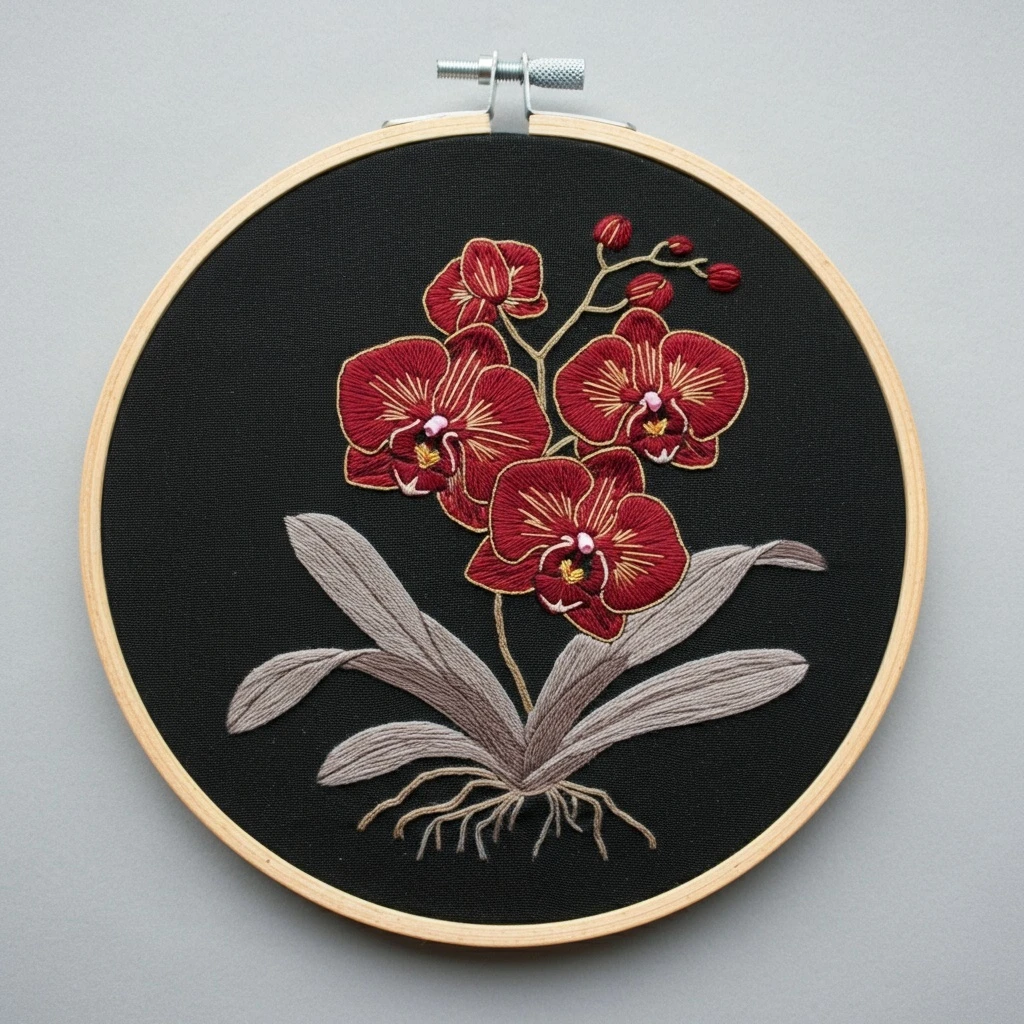
Crimson Orchid Elegance
A dramatic orchid study on black fabric, built from velvety crimson petals, warm beige linework, rosy-pink throats, golden pollen accents, and soft taupe leaves with exposed roots. The design reads refined and botanical, so the stitching should combine smooth petal shading with precise, graceful outlining.
Suggested DMC Floss Palette
Choose deep garnets for the orchid petals, a restrained red highlight for forward-facing curves, creamy gold-beige for the fine botanical linework, and quiet taupes for the leaves and roots. On black fabric, every light stitch shows clearly, so keep highlights deliberate and fine.
Stitch Map by Design Element
| Area | Best stitches | Thread guidance | Practical notes |
|---|---|---|---|
| Broad crimson orchid petals | Long-and-short stitch, satin stitch, split stitch outline | 2 strands for fill; 1 strand for crisp outer edges | Work each petal from edge toward the throat, following the natural fan direction. Blend 814 at folds into 816 and add 498 only near raised edges. |
| Fine champagne outlines and veins | Stem stitch, split stitch, couching, straight stitch | 1 strand for most lines; 2 strands only on the main stem | Keep these stitches smooth and unbroken. On black cloth, a slightly uneven beige line will stand out, so use shorter stitches around curves. |
| Pink orchid throats | French knots, satin stitch dots, tiny detached chain | 2 strands for pink dots; 1 strand for curved accents | Place 818 last so the centers sit forward. Add a touch of 3688 under the dot if you want a shadowed, dimensional throat. |
| Gold pollen details | French knots, colonial knots, seed stitch | 2 strands, one or two wraps depending on scale | Cluster knots loosely rather than perfectly centered. Mix 729 with a few tiny 676 strokes for warm sparkle. |
| Taupe leaves | Long-and-short stitch, fishbone stitch, stem-stitch veins | 2 strands for leaf fill; 1 strand for veins and edge corrections | Use long, tapered stitches to echo the strap-like leaves. Place 3022 at bases, 3023 through the middle, and 3861 on upper edges. |
| Roots and thin branching stems | Stem stitch, whipped backstitch, couching | 1 strand for roots; 2 strands for the central stem if needed | Vary root length and curve. Slightly loosen the tension so the root lines stay organic rather than wiry. |
| Rounded buds | Satin stitch, padded satin stitch, split-stitch contour | 2 strands for satin; 1 strand for beige contour | Shade the lower side with 814, fill with 816, and add one short 498 highlight to suggest the bud catching light. |
Blending, Shading & Texture
Velvet crimson petals
- Use 1 strand 814 + 1 strand 815 for deepest folded petal shadows.
- Use 2 strands 816 for the main orchid red, then feather into 498 near the outer ridge.
- Keep stitches slightly curved toward the center throat; straight vertical rows make orchid petals look stiff.
- Leave tiny dark gaps at petal overlaps when working on black fabric. They act as natural shadow lines.
Elegant linework
- For the beige outlines, use 1 strand 642 in split stitch or very short stem stitch.
- Use 676 only on the brightest vein strokes so the design keeps a sophisticated antique-gold look.
- Couch long stem lines if your fabric weave makes smooth curves difficult.
- Outline after filling petals, not before, when you want the champagne line to sit cleanly on top.
Soft taupe leaves
- Start each leaf with a center vein, then fill diagonally with long-and-short stitches.
- Blend 1 strand 3022 + 1 strand 3023 for shaded bases and 1 strand 3023 + 1 strand 3861 for lighter tips.
- Use a single-strand vein over the fill to sharpen the leaf direction without adding bulk.
- Do not over-highlight every leaf; the muted gray-taupe foliage should support the crimson flowers.
Centers and buds
- Add pink centers after the petals are complete to avoid snagging raised knots.
- Use 818 for the brightest throat dots and 3688 for a small shaded base.
- For buds, pad only the largest ones with a few split stitches before satin stitch.
- Keep gold knots small; they should sparkle, not overpower the orchid lips.
Beginner-Friendly Stitching Order
Prepare the dark fabric
Use a light transfer method that can be removed or covered. Mark the petal direction lines, stem curves, and leaf midribs clearly.
Stitch leaves and roots
Complete the taupe leaves, root cluster, and main stem first. These quieter elements sit behind the bright orchids.
Fill petals gradually
Work one bloom at a time from darkest folds to mid-red fill. Add red highlights only after the petal shape is established.
Finish with details
Add beige outlines, radiating veins, pink centers, gold knots, and final black cleanup stitches where negative spaces need sharpening.
Finishing Tips
Control contrast
Because the ground is black, every beige and pink stitch reads strongly. Use one strand for most details, then step up only when a line truly needs emphasis.
Protect the satin
Orchid petals look best when the sheen is smooth. Avoid carrying long threads across the back, and keep hands clean so black fabric and red floss stay crisp.
Keep the botanical posture
The flowers climb on slender stems above the leaf fan. Let stems remain narrow and graceful rather than filling them heavily.
Hoop presentation
Press gently from the back over a towel, then mount tautly. Center the leaf base slightly below midpoint so the orchids have room to rise elegantly.