
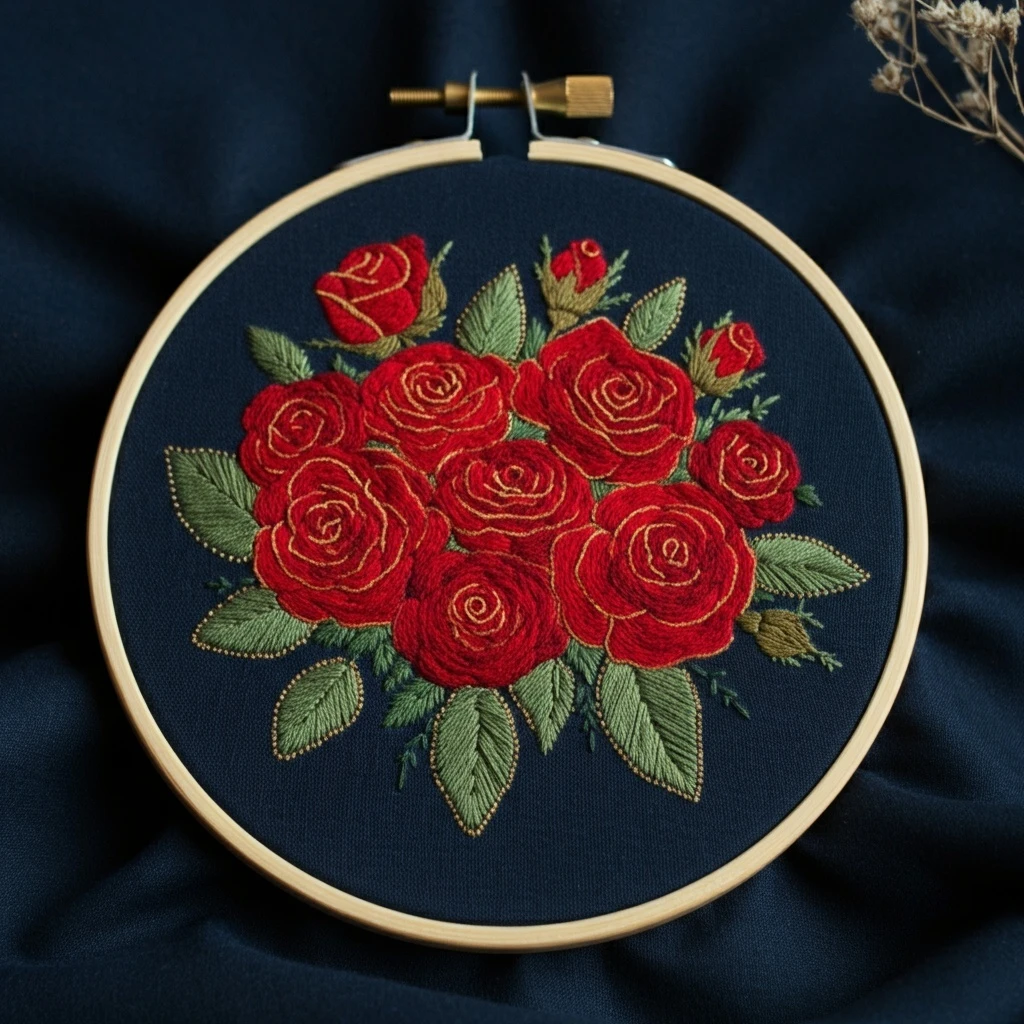
Crimson Rose Bouquet on Midnight Blue
A dramatic bouquet of layered crimson roses sits on deep navy fabric, balanced with sage leaves, olive buds, delicate gold linework, and a pale wooden hoop. This guide focuses on saturated rose shading, luminous metallic-style accents made with cotton floss, and crisp leaf texture that remains readable against the dark ground.
Design notes: rich red roses, spiral petal lines, sage green leaves, olive sepals, gold vein accents, and a very dark blue cloth background.
Suggested DMC Color Palette
The reference image uses strong value contrast: velvety reds for the blossoms, muted greens for foliage, antique gold for curled petal outlines, and very dark blue fabric that makes the bouquet glow. Use the darkest shades sparingly to carve petal depth, then let the bright reds sit on top as highlights.
Stitch Map for the Design
Keep the bouquet bold and tidy by choosing stitches that follow the natural direction of each form: circular for rose spirals, angled for petals, straight vein stitches for leaves, and tiny detached accents for gold dots.
| Design Area | Recommended Stitches | Thread Count & Handling | Practical Notes |
|---|---|---|---|
| Large crimson roses | Long-and-short stitch, padded satin stitch, stem stitch spirals | 2 strands for fill, 1 strand for inner curls and fine petal breaks | Work from the outer petal edge toward the center. Alternate DMC 816, 321, 304, and 666 in short irregular rows so the petals look rounded rather than striped. |
| Rose buds | Satin stitch, split stitch outline, tiny straight stitches | 2 strands for bud fill; 1 strand for sepal edges | Place DMC 814/816 at the bud base and DMC 666 at the top-facing curve. This makes the small buds read as miniature roses. |
| Gold rose linework | Stem stitch, back stitch, couching for tight curves | 1 strand DMC 680; add 1 strand 783 for occasional highlight stitches | Keep lines airy and broken in places. Too much gold can flatten the petals, so emphasize the spiral centers and a few outer arcs only. |
| Broad leaves | Fishbone stitch, satin stitch, long-and-short stitch, straight stitch veins | 2 strands for leaf fill; 1 strand for center vein and serrated edge details | Use DMC 3363 on the shadow side, 3052 through the center, and 3053 on the light edge. Angle stitches toward the central vein. |
| Leaf dotted border | French knots, colonial knots, tiny seed stitches | 1 strand DMC 680 or 783 | Space knots evenly around the larger leaves. On dark fabric, these dots create a lace-like edge and should remain small. |
| Stems, sepals, background greenery | Stem stitch, split stitch, detached straight stitches, fly stitch | 1-2 strands depending on thickness | Let the dark green stems disappear slightly into the navy ground. Use DMC 3012 for sepals and DMC 3363 for twig-like sprigs. |
Blending, Shading & Texture Guidance
Rose depth
- Start each rose with the darkest shade at the center and underlapped petals, then build outward with DMC 816 and 321.
- Place DMC 666 only on the upper curves and small crescent highlights so it looks like light catching velvet.
- For a painterly transition, blend one strand DMC 321 with one strand DMC 304 in the same needle.
- Use short, curved stitches instead of straight horizontal bands; roses should feel rounded and layered.
Leaf realism
- Fishbone stitch is beginner-friendly and naturally creates a central vein.
- Keep one leaf edge brighter with DMC 3053 and the opposite side deeper with DMC 3363.
- Add the dotted gold border after the leaf fill is complete so the outline sits neatly on top.
- Use a laying tool or needle tip to smooth strands; flat satin leaves catch light beautifully against navy fabric.
Gold accents without metallic thread
- DMC 680 gives antique gold warmth, while DMC 783 adds brighter sparkle.
- Use 1 strand for all gold linework. Thick gold lines can make the bouquet look heavy.
- Try whipped back stitch on a few rose spirals if you want a raised corded effect.
- For dots, make one-wrap French knots rather than bulky knots.
Working on midnight fabric
- Use strong lighting and a pale cloth on your lap to reflect light up through the fabric.
- Keep the back neat because dark fabric can show lumps or carried threads under bright red stitches.
- If transferring with a light pen or chalk, test removal first on a scrap of the same cloth.
- Needle sizes 7-9 embroidery needles work well for 1-2 strand detail on tightly woven dark cotton or linen.
Beginner-Friendly Practical Tips
Quick Stitching Sequence
Follow this order for the cleanest finish and easiest color control.
- Transfer the design with a pale removable marking method that is visible on dark fabric.
- Stitch stems and small greenery with DMC 3363 and 3012.
- Fill large leaves with fishbone or satin stitch using 3052, 3053, and 3363.
- Block in rose shadows with 814 and 816, then fill the main petals with 321 and 304.
- Add the brightest petal highlights with 666 in small curved stitches.
- Finish rose spirals, leaf dots, and decorative accents with 680 and small touches of 783.