
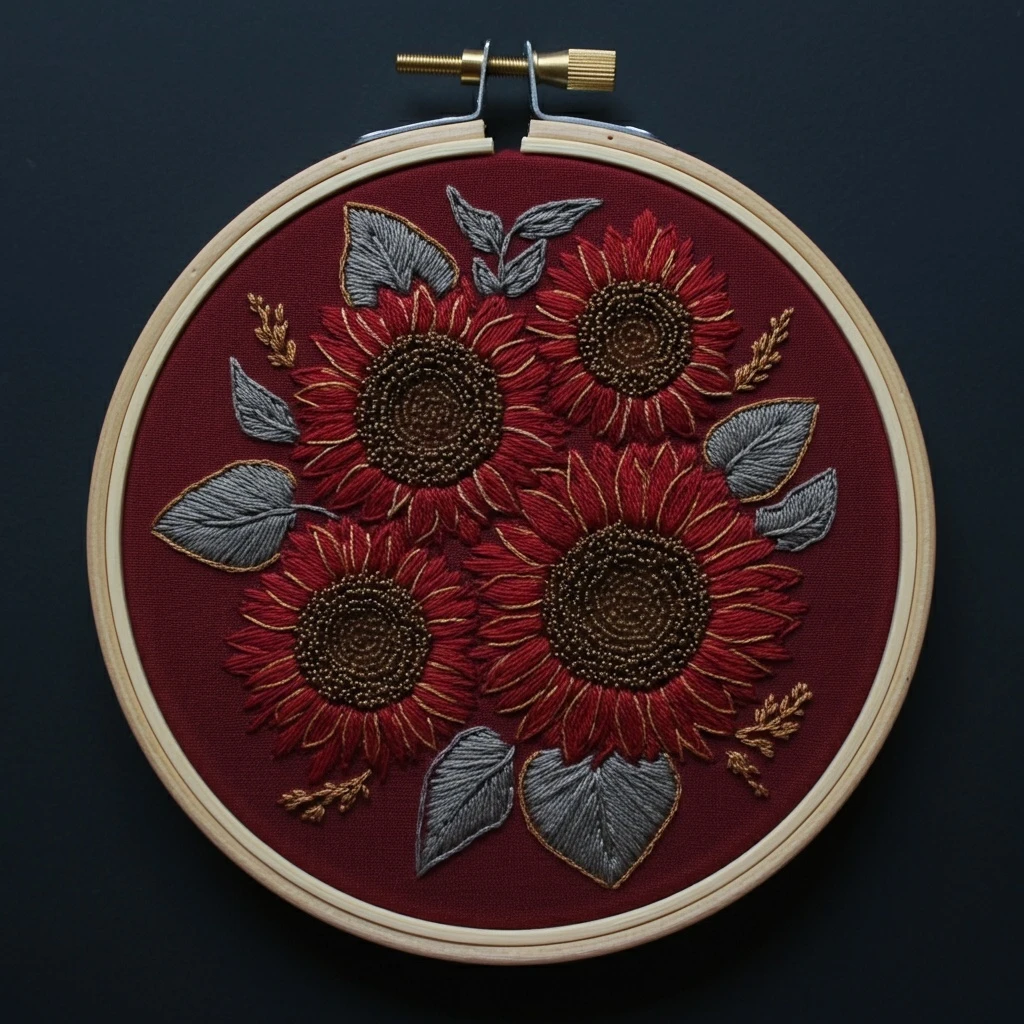
Deep Ruby Sunflowers
A dramatic sunflower hoop worked on wine-red ground fabric, with layered crimson petals, dark textured seed centers, cool pewter leaves, and warm antique-gold outlines. The palette below keeps the design rich and moody while preserving enough contrast for each petal, vein, and seed detail to read clearly.
Suggested DMC Color Palette
Use the darker shades first to anchor the hoop, then add brighter reds and gold highlights sparingly. On burgundy fabric, test each color on a scrap because some mid-tones can disappear unless they are outlined or paired with a lighter stitch.
Stitch Map
- Sunflower petals: Work long-and-short stitch from the center outward. Keep the stitches tapered and slightly irregular so the petals feel natural.
- Petal outlines: Use split stitch or stem stitch in DMC 902/815, then add selected gold couching or single-strand backstitch over the most visible petal edges.
- Flower centers: Build concentric rings with French knots, colonial knots, seed stitch, and tiny straight stitches. Alternate 3371, 898, and 3828.
- Leaves: Use fishbone stitch for the large leaves. Angle each side toward the central vein and switch between 413, 414, and 318 for a metallic pewter effect.
- Sprigs: Use detached chain, fly stitch, or tiny lazy-daisy leaves in 420, touched with 3828 at the tips.
Thread Count Guide
- Petals: 1 strand for fine shading; 2 strands for quicker coverage on larger petals.
- Centers: 2 strands for French knots, 1 strand for the smallest dot texture near the outer rings.
- Gold outlines: 1 strand keeps the antique detail elegant instead of heavy.
- Leaf fills: 2 strands for fishbone stitch; 1 strand for the central vein and fine side veins.
- Stems and tiny accents: 1 strand in stem stitch or backstitch for clean, controlled lines.
Layering, Blending & Shading Strategy
Design Element Guidance
| Area | Recommended approach | Practical note |
|---|---|---|
| Large front sunflower | Long-and-short petals with stronger 902 shadows under the center. | Keep the center edge crisp with a final split-stitch ring in 3371. |
| Upper flowers | Use slightly more 816/817 on visible tips so they stand forward against the fabric. | Leave small gaps of burgundy ground between petal clusters for depth. |
| Seed centers | Dense French knots in mixed browns, with a few gold knots placed off-center. | Vary knot size by wrapping some once and some twice. |
| Grey leaves | Fishbone stitch in 414, shadow edge in 413, highlight vein in 318. | Stitch all leaves in the direction they grow, not horizontally. |
| Gold sprigs | Stem stitch for the stalk; fly stitch or lazy-daisy for small grains. | Use only 1 strand for delicate botanical detail. |
Texture Suggestions
Combine smooth petal stitches with raised knot centers so the bouquet has a clear focal point. The red petals should read as soft and velvety, while the centers should feel pebbled and dimensional.
- Add a few straight-stitch grooves in DMC 420 over the red petals for a sunflower-like ribbed look.
- Use a slightly tighter tension on leaf fishbone stitches for sharp pewter veins.
- Place knots unevenly in the centers; perfect spacing can look too mechanical.
Beginner-Friendly Tips
Work one flower at a time and finish all its petal shading before moving to the next bloom. This keeps the red values consistent and avoids confusion between similar dark shades.
- Use a sharp needle for dense centers and a crewel needle for 2-strand petal filling.
- Shorten floss to 14–16 inches to reduce fraying on dark fabric.
- If the grey leaves look too cool, add one single strand of 420 on the outer contour only.
- Press from the back over a towel after stitching to protect raised knots.
Quick Stitching Plan
For a neat result, outline the motif first, then build texture from the backmost elements forward.