
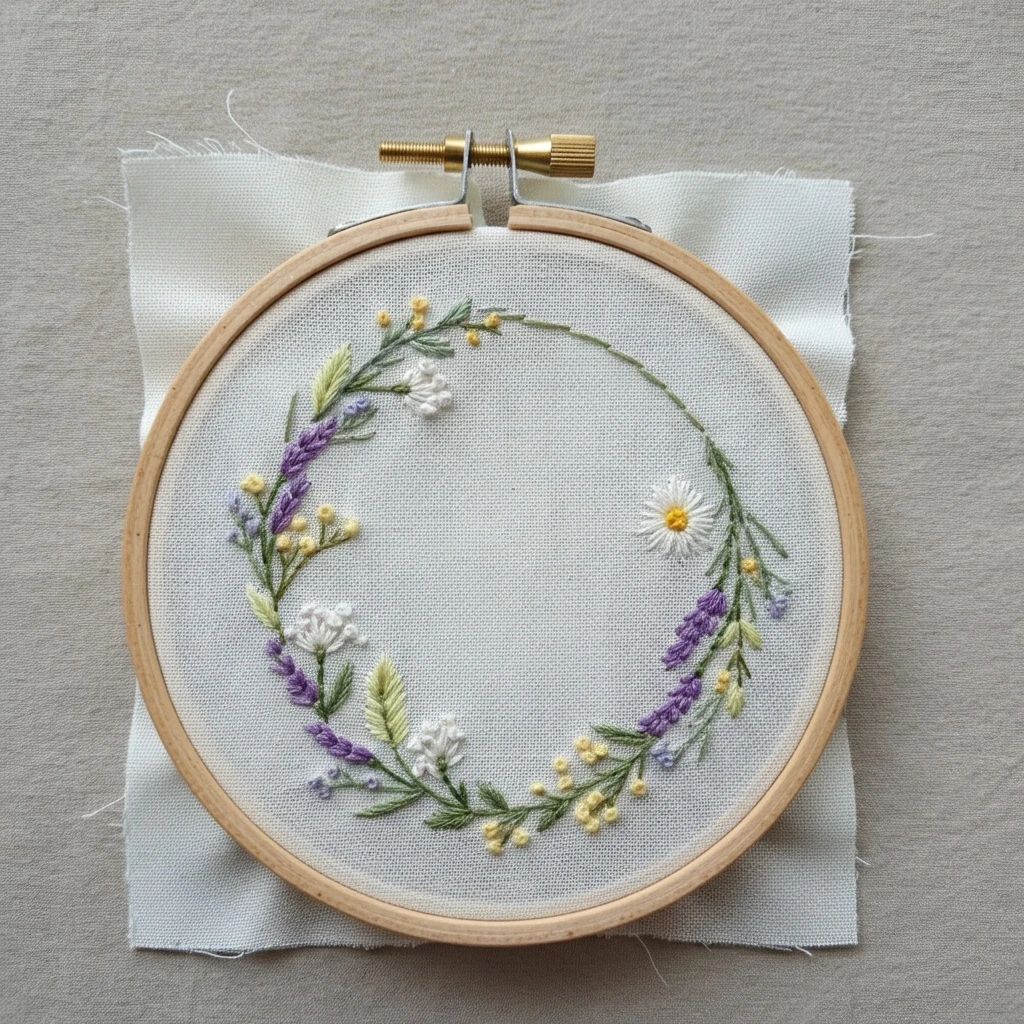
Delicate Lavender And Wildflower Stem Wreath
A light, airy wreath with lavender sprigs, tiny yellow wildflower buds, white floral clusters, daisy petals, and fine green stems. The look is soft and botanical, with most of the visual weight held in the lower-left and lower-right arcs while the top remains graceful and open.
Palette overview
The design works best with a restrained garden palette: muted greens for the circular stems, two to three lavender tones for the flower spikes, warm yellow for the small berry-like buds, and gentle whites for the daisy and filler flowers. Keep the stitch density light so the wreath feels delicate rather than heavy.
Stitch plan by design element
This wreath benefits from a mix of fine line stitches and small raised accents. Work the stems first, then the leaves, then the blossoms and knots so the floral details sit neatly on top.
Curved botanical frame
Use split stitch, stem stitch, or whipped backstitch with 1 strand of DMC 3011 or 3012. Follow the curve in short sections rather than long jumps so the circle stays smooth.
Clustered purple texture
Use detached chain, tiny fishbone, or short satin stitches with 2 strands. Place 333 near the base, 340 through the middle, and 341 on the outer tips.
Raised wildflower dots
Use French knots or colonial knots with 2 strands of 744. Add a single 782 knot or half stitch to the shadow side of larger buds.
Soft filler blossoms
Use groups of French knots in 3865, then add one or two B5200 knots on top for sparkle. Keep the clusters irregular to avoid a polka-dot look.
Open-petal focal point
Use 1 strand B5200 for lazy daisy petals or straight stitches radiating from the center. Work the center last with 782 French knots and a few 744 highlights.
Fine feathery foliage
Use fishbone stitch for larger pale leaves and single straight stitches for needle-like foliage. Mix 3012 and 3013 in the same leaf for a soft fresh effect.
Thread count, blending & shading guidance
Recommended strands
- 1 strand: wreath arc, tiny stem offshoots, daisy petal outlines, and any gray shadow lines.
- 2 strands: lavender petals, small leaves, yellow buds, and most French knots.
- 3 strands: only for a few foreground lavender clusters or larger knots that need a raised texture.
- Single wrap knots: best for the smallest yellow dots; two wraps work well for fuller white clusters.
Order of stitching
- Transfer the wreath lightly; the top-right arc should remain thin and airy.
- Stitch the green stems first, anchoring the wreath shape before adding flowers.
- Add leaves from dark to light, then lavender sprigs from dark base to pale tips.
- Finish with white knots, yellow buds, and the daisy center so raised elements stay clean.
Lavender blend
For a gentle gradient, thread the needle with one strand DMC 340 and one strand DMC 341. Use this mix on the outer half of lavender spikes so the flowers feel sunlit.
Leaf blend
Pair one strand 3012 with one strand 3013 for soft pale leaves. For lower, darker foliage, pair 3011 with 3012 and use short angled stitches.
White flower depth
Use 3865 as the base white and reserve B5200 for the brightest top stitches. A single touch of 645 can separate petals if the fabric is very light.
Texture and outlining details
The charm of this piece is in the contrast between fine stems and raised flower dots. Avoid filling every area completely; leave small gaps of fabric showing between leaves, knots, and lavender petals.
Texture suggestions
- Use French knots for yellow buds and white filler blossoms, varying wrap size to mimic natural wildflowers.
- Use lazy daisy stitches for lavender only where the flower head is wider; use straight stitches for narrow tips.
- Whip a few green stem sections with a lighter green for a slightly raised vine effect.
- Add tiny seed stitches around the lower bouquet area only if you want a fuller meadow feel.
Outlining approach
- Do not heavily outline the lavender; let the petal clusters define the shapes.
- Outline the daisy center with knots rather than a drawn circle, keeping the focal point soft.
- For pale flowers on cream linen, use one strand 3865 around the edge and one or two B5200 highlights on top.
- Keep the main wreath line slightly broken in places to preserve the delicate hand-drawn quality.
Beginner-friendly practical tips
French knots are cleaner when the needle is not too thick. Pull slowly and hold the working thread snug until the knot sits on the fabric.
For the circular wreath, turn the hoop so each stem section is comfortable. This keeps stem stitch direction consistent.
Use tiny transfer dots for knot placement rather than drawing large circles. The finished flowers will look more natural.
The reference has breathing room at the top. Do not overfill that area; a thin green line is enough.
After stitching one lavender cluster, add a smaller echo on the opposite side so the wreath feels intentional but not perfectly symmetrical.
When finished, place the embroidery face down on a towel and press gently from the reverse to protect raised knots and petals.