
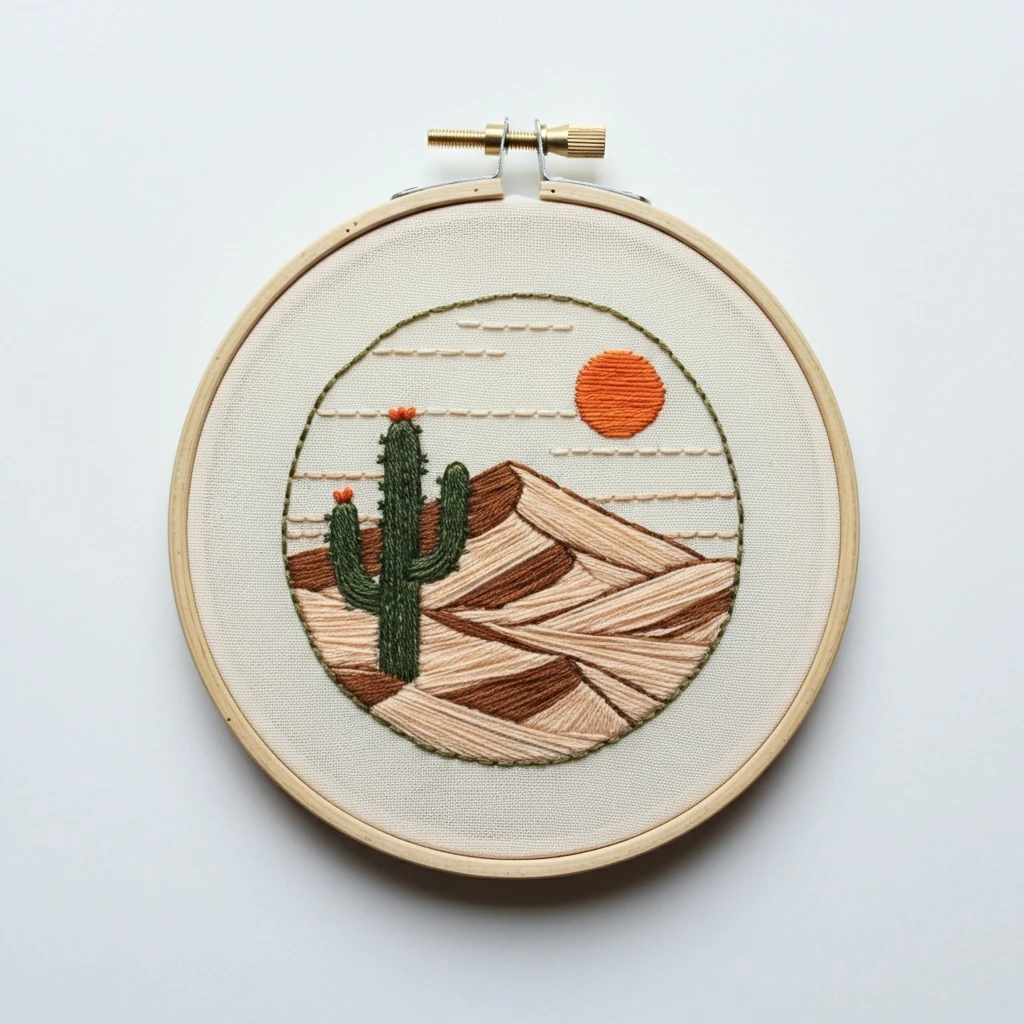
Desert Landscape
A warm hoop scene with layered sand dunes, chocolate-brown ridge shadows, upright saguaro cactus forms, a glowing orange sun, and delicate horizontal sky lines. The palette should feel sun-baked and graphic: creamy linen, toasted beige, copper clay, deep umber, dusty olive, and a crisp desert-sunset orange.
Suggested DMC Color Palette
Use these flosses as a practical match for the design. The shades are arranged from light background details through the warm desert earth tones and finally the cactus greens and outlines.
Pale dune faces, soft sky dashes, and highlight stitches where the sand catches light.
Main sandy slopes; excellent for long satin blocks and woven-looking dune planes.
Mid-tone transitions between cream and brown; add along lower edges of dune facets.
Rusty mountain planes and warm canyon accents; blend with brown for darker ridges.
Deep dune shadows, far mountain folds, and grounding stitches around the landscape base.
Fine separating lines between dune panels and the darkest creases of the mountains.
Round sun and tiny cactus blossoms; use dense satin for a bright focal point.
Main cactus bodies; vertical stitches make the ribs look tall and textured.
Outer cactus edges, rib shadows, and the circular border when a softer green outline is desired.
Subtle cactus highlights or tiny alternating stitches on ribs without making them too bright.
Quiet sky lines and soft contour marks; keeps background details visible but airy.
Optional border substitute or added desert scrub accents for a slightly warmer olive outline.
Stitch Map by Design Area
The sample relies on clear direction changes: each dune or mountain shape is filled in a different angle so the landscape reads like folded fabric.
Sun & sky
- Long-and-short satin: fill the sun horizontally with 2 strands of DMC 741.
- Back stitch: use DMC 842 or 739 for the pale sky dashes; keep them loose and evenly spaced.
- Thread count: 2 strands for the sun, 1 strand for sky lines to avoid heaviness.
Cactus forms
- Vertical satin stitch: work from base to top, following each arm’s growth direction.
- Split stitch ribs: add a few narrow darker lines in DMC 934/936 for ribbed texture.
- French knots: make small orange blossoms with DMC 741, 2 wraps, 2 strands.
Dunes & mountains
- Directional satin: change stitch angle in every dune panel so the shapes remain distinct.
- Stem stitch outlines: define ridge edges with DMC 898 or 975 using 1 strand.
- Shading: move from 739 to 738 to 437, then 920/975 in shadowed wedges.
Blending & Shading Guidance
Outlining & Texture
Beginner-Friendly Stitching Order
Transfer and stabilize. Use tightly stretched cotton or linen in the hoop. Mark the circle, main dune divisions, cactus silhouette, sun, and sky dashes with a removable pen.
Stitch the pale sky first. Work the horizontal dashed lines with 1 strand before filling the sun or cactus. This keeps the background flat and tidy.
Fill the sun. Use compact horizontal satin stitches in DMC 741. Start at the widest center line, then shorten rows as you move toward the top and bottom.
Build the landscape from far to near. Stitch the distant hills first, then the front dunes. Change stitch direction with each shape to create natural contour and movement.
Add cactus shapes last. The cactus sits in front, so fill it after the dunes. Add rib lines and blossom knots after the green fill is complete.
Finish with outlines and border. Add the circular border, ridge seams, and any final couching. Trim thread tails neatly so the pale fabric remains clean.
Practical Thread-Count Notes
1 strand
Best for sky dashes, fine dune separations, tiny cactus rib shadows, and the cleanest circular border on a small hoop.
2 strands
Use for most satin-filled dunes, cactus bodies, sun fill, and medium-width outlines. This is the safest all-purpose count for the design.
3 strands
Reserve for a bolder border or slightly raised cactus texture. Avoid using 3 strands in tiny mountain wedges, where bulk can distort the shape.
Tip: Keep satin stitches shorter than the full width of very large dune sections by breaking them along the drawn contour lines. This prevents snagging and gives the desert floor a more textured, woven finish.