
DMC color palette & hand embroidery notes
Dragon and Castle Night
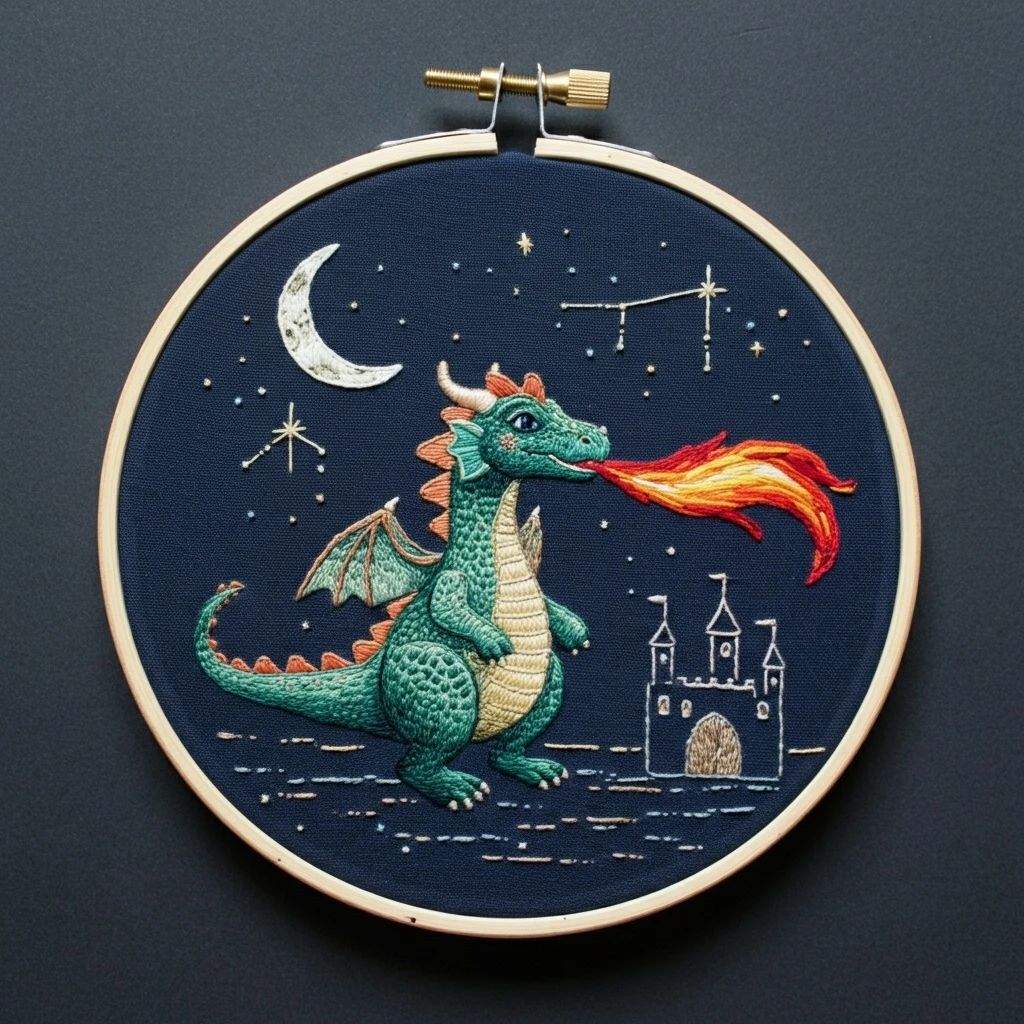
A whimsical night-sky hoop with a teal dragon, glowing fire breath, crescent moon, tiny constellations, and a pale castle silhouette. The palette balances deep navy fabric, jewel greens, warm flame tones, creamy moonlight, stone gray, and soft peach accents.
Design color read
The reference image is stitched on dark midnight-blue fabric, so the embroidery relies on high contrast: a bright turquoise-green dragon, buttery cream belly and horns, coral-orange back spines, red-to-yellow flame, pale stars, a mottled crescent moon, and a light outlined castle. Use saturated floss for the dragon and fire, then keep the castle and sky accents slightly muted so the creature remains the focal point.
For best results, test the lightest colors on your chosen dark fabric before stitching. Very pale shades often need an extra strand or a second pass to read clearly.
Stitch guide by design element
| Element | Suggested stitches | Practical notes |
|---|---|---|
| Dragon body and tail | Split stitch outline, short-and-long fill, seed stitches or tiny detached chains for scales | Angle the fill stitches around the belly and haunches to keep the body rounded. Add scale dots after filling so they sit visibly on the surface. |
| Belly plates | Satin stitch with back stitch separators | Use 677 as the base and add small 640 or 762 separator lines between plates. Curve each satin section slightly rather than stitching straight vertical bars. |
| Wings | Back stitch ribs, long-and-short membrane shading | Outline the wing ribs in 640, then lightly fill the membrane with 3847 blended with a few coral or beige gray touches for a leathery look. |
| Fire breath | Long-and-short stitch, couching for flame ribbons, fine split stitch tips | Work from yellow center outward: 307, 741, then 321. Let red tips extend slightly beyond orange for flickering movement. |
| Moon and stars | Satin stitch, French knots, straight stitch starbursts | Blend 746 with 762 and a few 640 speckles for the crescent. For stars, combine one-wrap French knots with tiny straight stitches in 746, 677, and 307. |
| Castle | Back stitch, whipped back stitch, satin stitch door | Keep the castle mostly outline-based to preserve the delicate silhouette. Use 746 for bright walls, 762 for shadow, and 640 for the arched wooden door. |
| Ground and horizon dashes | Running stitch, detached straight stitch | Scatter short horizontal stitches in 762, 677, and 640. Vary length and spacing so the dragon feels grounded without creating a heavy base. |
Blending, shading, and texture suggestions
Beginner-friendly workflow
- Transfer lightly: On dark fabric, use a white water-soluble pencil or chalk marker. Mark only key outlines and star positions so the sky stays clean.
- Stabilize before filling: Use a snug hoop and consider a lightweight backing if the fabric is loosely woven; dense dragon fill can pucker without support.
- Work from back to front: Stitch moon, stars, castle, and ground first; then dragon fill; then scales, eye, claws, and flame highlights last.
- Use short stitches on curves: Short stitches around the face, belly, and tail prevent jagged edges and make the dragon look rounded.
- Check contrast often: Step back from the hoop after each section. On navy fabric, medium colors may appear darker than expected, so add 964, 746, or 307 highlights where needed.
Finishing touch
Add the dragon’s eye with one tiny dark stitch, a small 964 or 746 highlight, and a fine 321 or coral accent around the lid. This single detail gives the whole character expression without making the face too busy.