
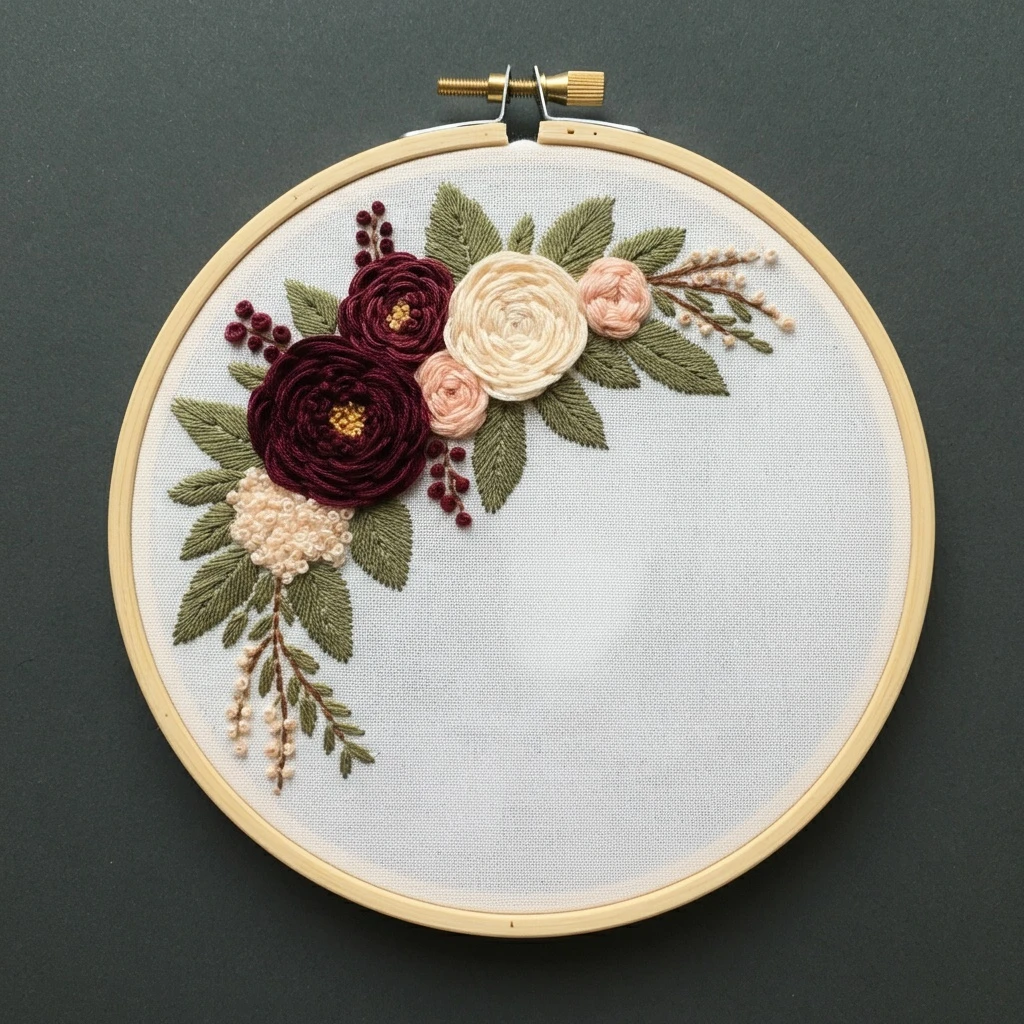
Elegant Burgundy Blush Floral Arrangement
A polished DMC floss plan for an elegant arrangement of wine-burgundy blossoms, soft blush petals, creamy highlights, and muted sage foliage. The goal is romantic depth: rich florals with gentle shading and refined botanical detail.
Suggested DMC Color Palette
Use the deepest garnets sparingly for shadow, let medium burgundy carry the main petals, and reserve pale pinks and winter white for luminous edges and airy flower accents.
Deepest burgundy shadows inside large petals, tucked flower centers, and the lowest contrast folds.
Main wine-red flower petals and rich outer petal edges; excellent for satin stitch and long-and-short shading.
Warm crimson-burgundy transition shade for petal midtones and soft blended areas.
Muted blush roses, softened petal bases, and rosy transitions between burgundy and pale highlights.
Light blush petal highlights, tiny buds, and delicate flower tips where the design needs airiness.
Softest pink highlights on petal rims and small reflective stitches on pale blossoms.
Creamy white flowers, petal sparkle, and subtle accents that keep the arrangement elegant rather than stark.
Deep leaf bases, stems in shadow, and grounding greenery around the bouquet.
Olive evergreen leaf structure, darker veins, and small foliage clusters.
Soft sage leaf highlights and lighter botanical details around blush flowers.
Warm sepia stems, twig-like connectors, and subtle basket-like botanical lines if present.
Fine dark outlining for flower centers, shadowed stem joints, and extra definition without using black.
Stitching Suggestions
These stitch choices emphasize dimensional petals, soft color transitions, and delicate leafy movement while remaining practical for hoop embroidery.
Large burgundy blossoms
Begin at the petal rim with 816/815 and work inward to 814 for depth. Keep stitch direction radiating from the flower center so the petals curve naturally.
Blush petals and small roses
Use 1 strand for the outline and 2 strands for fill. Blend 3722 into 761, then add a few single-strand 3713 highlights along curled edges.
Cream flowers
Pad larger white petals with a tiny layer of 3865 before the final satin layer; this gives dimension while staying delicate.
Leaves
Use 3362 or 3051 down the center vein, then angle 3053 outward for a soft sage highlight. Change direction leaf by leaf for a natural look.
Stems and tendrils
Use 1 strand of 611 or 3051 for narrow stems. Whip the line with a lighter green where a polished raised vine effect is desired.
Flower centers
Cluster 1-wrap French knots in 839, 814, or 611. Add a few 3865 or 3713 seed stitches for subtle sparkle.
Fine details and silhouette
For crisp botanical edges, use one strand of 839 on the darkest burgundy areas and 3051 on deep green edges. Avoid heavy black outlines.
Thread Count, Blending & Texture
Practical Beginner Tips
A few simple habits will make the burgundy-and-blush palette look smooth rather than heavy.
- Work dark burgundy flowers first so the strongest shapes establish the composition, then add blush and cream flowers to balance the bouquet.
- For a refined finish, use 2 strands for most filled petals, 1 strand for outlines and veins, and 3 strands only for raised knots or textured flower centers.
- Blend burgundy petals by alternating adjacent stitches of 816 and 815 rather than making hard color bands; finish the deepest folds with sparse 814.
- Keep pale shades clean by stitching 3865 and 3713 after the darker colors, and wash hands before handling white or blush thread.
- If you are a beginner, trace the main petal direction lines lightly before stitching. Direction matters more than perfect coverage for realistic floral movement.
Finishing Notes
Press from the back on a towel so knots and padded petals do not flatten. If framing in a hoop, keep the fabric gently taut and trim excess fabric only after checking that the bouquet sits centered and the pale flowers remain clean.